Infinity Knot Necklace Buying Guide: What to Look For
Discover what to look for in an infinity knot necklace. Learn about metal grades, chain types, knot symmetry, and pricing in our expert buying guide.

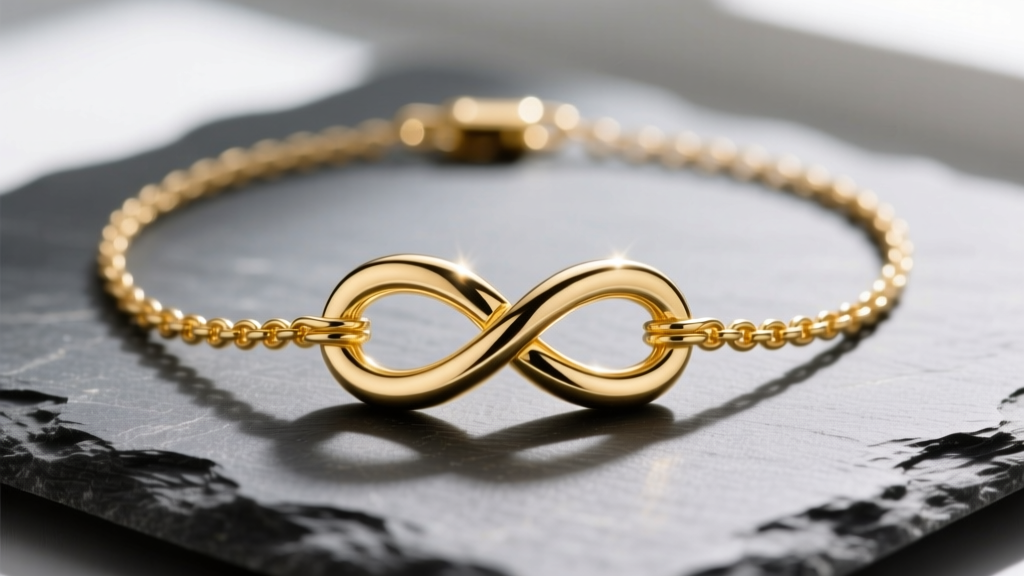
The infinity knot necklace has remained a cornerstone of fine jewelry for decades, symbolizing eternity, empowerment, and unbreakable bonds. However, the continuous figure-eight geometry that makes this pendant so visually striking also creates unique structural vulnerabilities. A poorly engineered infinity knot will bend at the crossover point, tangle endlessly with its chain, or suffer from rapid metal fatigue.
As we navigate the jewelry market in 2026, mass-produced, hollow-cast pendants have flooded e-commerce platforms, making it harder than ever to distinguish between a lifelong heirloom and a disposable accessory. This comprehensive buying guide breaks down the exact metallurgical standards, chain mechanics, and construction techniques you must evaluate before purchasing an infinity knot necklace.
The Anatomy of a High-Quality Infinity Knot
The defining feature of an infinity knot is its continuous, unbroken loop. In a high-quality piece, this loop should be completely seamless. The most critical area to inspect is the crossover point—the exact center where the metal passes over itself. This junction bears the brunt of torsional stress when the necklace is pulled or caught.
Cast vs. Stamped Construction
Manufacturers generally use two methods to create infinity pendants: lost-wax casting and die-stamping.
- Lost-Wax Casting (3D): This is the hallmark of fine jewelry. The pendant is cast as a solid, three-dimensional object. It possesses structural depth, meaning the crossover point is thick enough to resist bending. A well-cast knot will have a rounded, tactile feel and a substantial weight.
- Die-Stamping (Flat): Common in fast-fashion jewelry, stamped knots are punched out of thin sheets of metal. They are entirely flat and hollow. While lightweight and inexpensive, stamped infinity knots are highly prone to warping. If you apply even moderate pressure to the crossover point of a stamped knot, it will permanently deform.
Expert Tip: Always look for a 'solid' or 'semi-solid' descriptor. Avoid terms like 'electroformed' or 'hollow-cast,' which indicate a thin shell of metal filled with air or resin, destined to crush under daily wear.
Metal Alloys: Durability Meets Daily Wear
Because the infinity knot is often worn as a daily staple, the metal alloy must possess adequate tensile strength and corrosion resistance. According to the Federal Trade Commission's Jewelry Guides, precise metal marking is required, allowing educated buyers to verify purity. Here is how the most common metals perform in an infinity knot design.
14k vs. 18k Gold
While 18k gold (75% pure gold) offers a richer, deeper yellow hue, it is inherently softer. For an infinity knot, which features narrow bridges of metal at the loop intersections, 14k gold (58.5% pure gold) is vastly superior for daily wear. The higher proportion of alloy metals like copper, silver, and zinc increases the Vickers hardness of the piece, preventing the crossover point from bending out of shape. If you prefer white gold, ensure it is rhodium-plated to prevent the underlying yellowish tint from showing through the high-wear areas.
Sterling Silver and the Tarnish Factor
Sterling silver (925) is an excellent entry point for fine jewelry, but it is highly susceptible to oxidation. When buying a silver infinity knot, seek out pieces that feature a heavy rhodium flash plating. As noted by Blue Nile's silver education guide, rhodium acts as an impermeable barrier against sulfur in the air, keeping the knot brilliantly white and tarnish-free for years. Avoid unplated silver for complex knot designs, as polishing the tight inner loops of an infinity symbol without scratching the surface is notoriously difficult.
Platinum: The Ultimate Heirloom Choice
Platinum (usually 95% pure, alloyed with ruthenium) is dense, hypoallergenic, and incredibly durable. Unlike gold, which loses microscopic layers of metal over decades of wear, platinum simply displaces. An intricate platinum infinity knot will retain its exact structural integrity and sharp edges for generations, making it the premier choice for high-value diamond pavé settings.
| Metal Type | Purity Stamp | Durability Rating | Estimated Price Range (2026) |
|---|---|---|---|
| Sterling Silver (Rhodium Plated) | 925 | Good (Requires care) | $60 - $150 |
| 14k Solid Gold | 14k / 585 | Excellent (Daily wear) | $250 - $600 |
| 18k Solid Gold | 18k / 750 | Very Good (Softer) | $400 - $900 |
| Platinum | 950 Pt | Superior (Heirloom) | $800 - $1,800+ |
Chain Selection: The Hidden Point of Failure
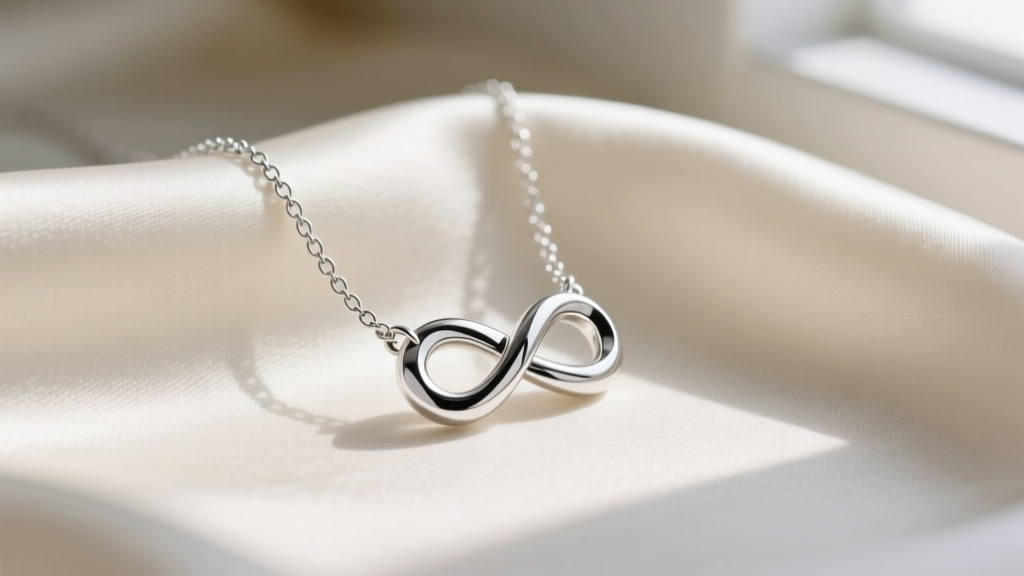
The most common complaint regarding infinity knot necklaces is tangling. However, the fault rarely lies with the pendant itself; it is almost always a chain geometry issue. The continuous loops of the infinity knot act as a spindle, and if the chain twists, the knot will spin and tangle the entire necklace.
The Best Chain Styles for Infinity Knots
- Box Chains (0.9mm - 1.2mm): This is the undisputed champion for infinity pendants. Box chains are constructed from square links connected at 90-degree angles. They naturally lay flat against the skin and are highly resistant to twisting, ensuring the infinity knot remains perfectly oriented on the chest.
- Wheat Chains: Featuring woven, braided links, wheat chains offer a sophisticated texture that complements the fluid lines of the knot. They are incredibly strong and rarely kink.
Chains to Avoid
- Standard Cable Chains: The alternating horizontal and vertical oval links of a traditional cable chain are prone to twisting. Once the chain twists, it forces the infinity knot to flip upside down and wrap around the links.
- Rope Chains: While beautiful, rope chains are too heavy and thick for most delicate infinity knots. The weight of the rope will overpower the pendant, causing it to slide off-center.
Always inspect the jump ring—the small loop connecting the pendant to the chain. On high-quality infinity necklaces, this jump ring should be soldered completely shut. An unsoldered, split jump ring will eventually warp and snap under the lateral pulling forces unique to the figure-eight design.
Sizing, Symmetry, and the 'Lay-Flat' Test
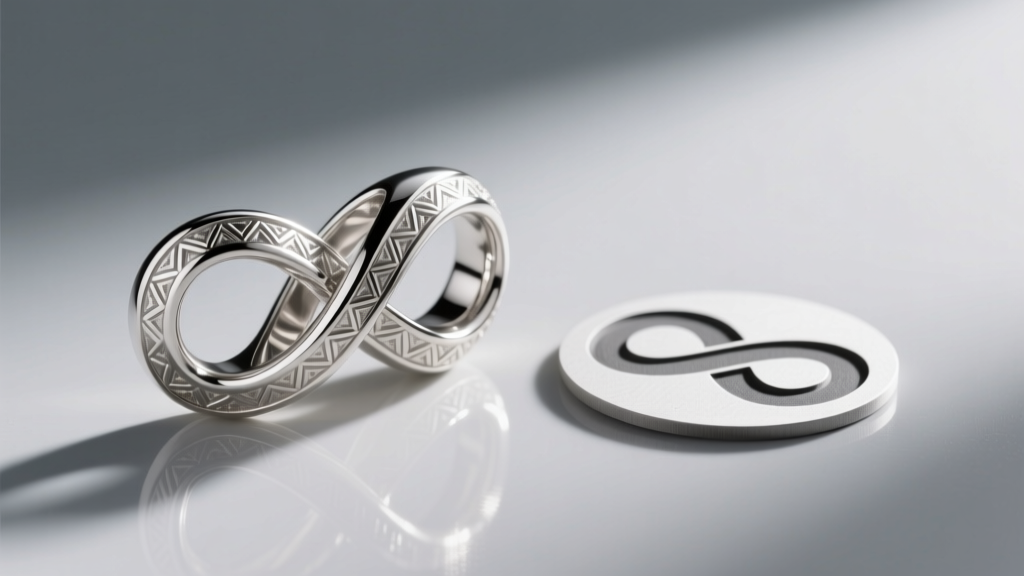
When evaluating an infinity knot necklace, either in a boutique or upon receiving an online order, you must perform the 'Lay-Flat' test. Drape the necklace over your hand or a flat surface. A properly engineered infinity knot will lay completely flush against the surface without one side of the loop lifting higher than the other. If the pendant naturally curls or flips, the wax model used for casting was asymmetrical, or the metal cooled unevenly, creating internal tension.
Pendant Dimensions and Proportions
The scale of the knot dictates its visual impact and structural stability.
- Delicate (10mm - 15mm width): Ideal for layering or a subtle, minimalist aesthetic. Must be cast in 14k gold or platinum to prevent bending at this small scale.
- Standard (16mm - 22mm width): The most versatile size, perfect for a standalone statement piece that sits elegantly on the collarbone.
- Statement (25mm+ width): Often features diamond pavé or mixed-metal accents. Requires a heavier chain (1.5mm+) to balance the visual weight.
Expert Maintenance & Troubleshooting
The tight inner loops of an infinity knot are notorious traps for skin oils, lotions, and cosmetic dust. Over time, this buildup dulls the metal's brilliance and can cause skin irritation.
To clean your necklace, avoid harsh chemical dips. Instead, use a solution of warm water and a few drops of mild, phosphate-free dish soap. Soak the necklace for 15 minutes, then use a soft-bristled baby toothbrush to gently agitate the tight crevices where the metal crosses over. Rinse thoroughly with distilled water to prevent water spots, and dry with a lint-free microfiber cloth.
A Warning on Ultrasonic Cleaners: If your infinity knot features micro-pavé diamonds set into the crossover point, never use an ultrasonic cleaner. The high-frequency vibrations can easily loosen the tiny prongs, causing stones to fall out into the machine's tank. Stick to manual, gentle brushing for any gemstone-adorned knots.
Final Verdict: Where to Invest Your Budget
When shopping for an infinity knot necklace, prioritize construction over carat weight. A perfectly symmetrical, solid-cast 14k gold knot on a 1.1mm box chain will outlast and outshine a hollow, diamond-stamped 18k gold piece every time. By paying close attention to the crossover thickness, jump ring soldering, and chain geometry, you will secure a timeless piece of jewelry that truly reflects the unbroken bond it represents.


