Anatomy of a Jailhouse Cross Necklace: A Technical Guide
Discover the metallurgy, chain construction, and engraving techniques behind the authentic jailhouse cross necklace in our expert technical guide.

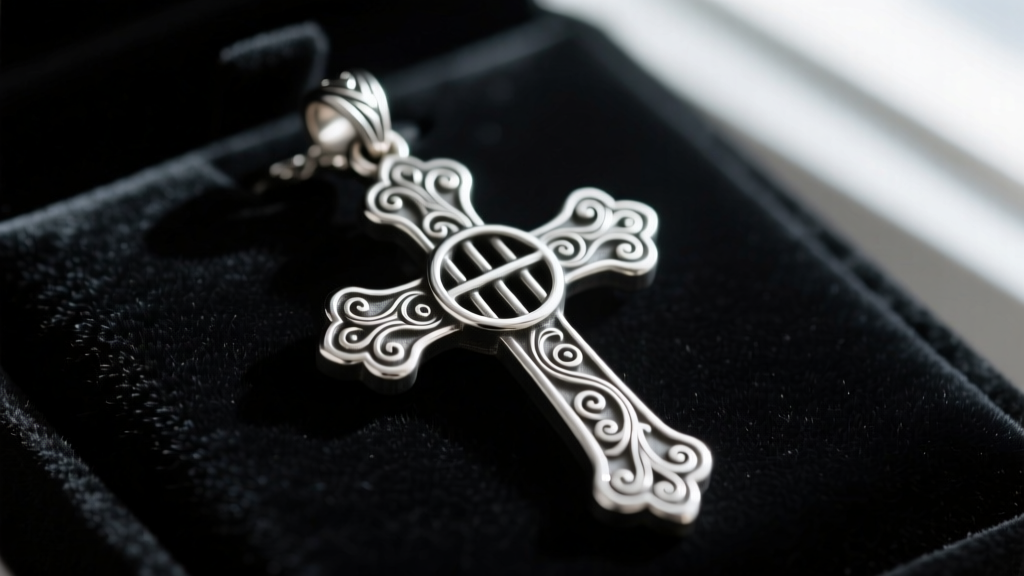
The jailhouse cross necklace is far more than a simple religious or fashion pendant; it is a masterclass in improvisational metallurgy, hand-fabrication, and cultural expression. Originating from the resource-restricted environments of the mid-20th-century penal system and deeply intertwined with Chicano street culture, lowrider aesthetics, and prison-made jewelry, this specific style of necklace demands a high level of technical scrutiny. Unlike mass-produced cast jewelry, an authentic jailhouse cross and its accompanying handmade chain are defined by specific wire gauges, hand-sawn links, and bright-cut engraving techniques.
In this expert deep dive, we deconstruct the anatomy of the jailhouse cross necklace, examining the material grades, structural integrity, and fabrication methods that separate genuine artisan pieces from commercial replicas.
Cultural and Structural Origins
The term "jailhouse" in jewelry refers to the techniques developed by incarcerated artisans who had to fabricate intricate pieces using rudimentary tools and scavenged materials. The jailhouse cross necklace typically features a heavily ornate, gothic, or Chicano-style cross pendant suspended on a thick, hand-linked chain. The structural hallmark of this style is its sheer density and weight. These pieces were designed to be durable, serving as both a personal talisman and a display of the maker's technical prowess under extreme constraints.
Today, master jewelers and streetwear artisans continue to build these necklaces using traditional metalsmithing techniques, elevating the jailhouse cross from a makeshift accessory to a highly sought-after collector's item in the luxury streetwear and custom jewelry markets.
Metallurgy: Coin Silver vs. Sterling
Historically, incarcerated jewelers melted down silver coins, silverware, and electrical contacts to cast their pieces. This resulted in the widespread use of Coin Silver (900), which consists of 90% pure silver and 10% copper. Coin silver is slightly harder than standard sterling due to its copper content, making it highly resistant to the deformation caused by heavy daily wear.
Modern master fabricators typically use 925 Sterling Silver for its superior workability and standardized purity. According to the Gemological Institute of America (GIA), sterling silver's 7.5% alloy (usually copper) provides the necessary tensile strength for wire drawing and chain linking. However, high-end custom jewelers will sometimes intentionally alloy their own silver to mimic the specific Vickers hardness (HV) of vintage coin silver, achieving a hardness rating of around 75-80 HV in the annealed state, which work-hardens to over 140 HV during the chain-linking process.

Chain Fabrication: The Hand-Sawn Mandrel Technique
The chain is arguably the most critical component of a jailhouse cross necklace. A true "jailhouse chain" is never machine-stamped or cast. It is hand-fabricated using a mandrel, a jeweler's saw, and a torch. The artisan wraps thick silver wire tightly around a steel rod (mandrel) to create a continuous coil. This coil is then sawed down the center, yielding dozens of individual open jump rings.
Wire Gauge and Tensile Strength
The structural integrity of the chain relies heavily on the wire gauge. Authentic jailhouse chains typically utilize wire ranging from 8-gauge (3.26mm)12-gauge (2.05mm). Thicker gauges (6-gauge or 4-gauge) are occasionally used for the links immediately surrounding the pendant bail to support the massive weight of the cross.
Once the links are woven into complex patterns (such as the 5-piece, 9-piece, or butterfly weaves), every single joint must be individually soldered. This is where the technical skill of the jeweler is tested. Using a precise oxy-acetylene or oxy-propane torch, the maker applies hard silver solder (which melts at approximately 1,450°F) to each seam. If the heat is not perfectly controlled, the solder will ball up or the wire itself will melt, ruining the link.
Authenticity Matrix: Hand-Sawn vs. Cast Replicas
Commercial manufacturers often attempt to replicate the jailhouse aesthetic using lost-wax casting. Here is how to technically differentiate a handmade chain from a cast replica:
| Feature | Authentic Hand-Sawn Chain | Mass-Produced Cast Replica |
|---|---|---|
| Link Seams | Completely seamless; soldered and filed flush. | No seams; links are closed ovals cast as a single piece. |
| Wire Cross-Section | Perfectly round or half-round; dense and non-porous. | Slightly flattened or irregular; may show microscopic porosity. |
| Flexibility | Fluid, drapes heavily with mechanical articulation. | Stiff; lacks articulation due to solid cast joints. |
| Weight Distribution | Consistent gram weight per linear inch. | Often hollowed out on the back to save precious metal costs. |
Pendant Architecture and Engraving Techniques
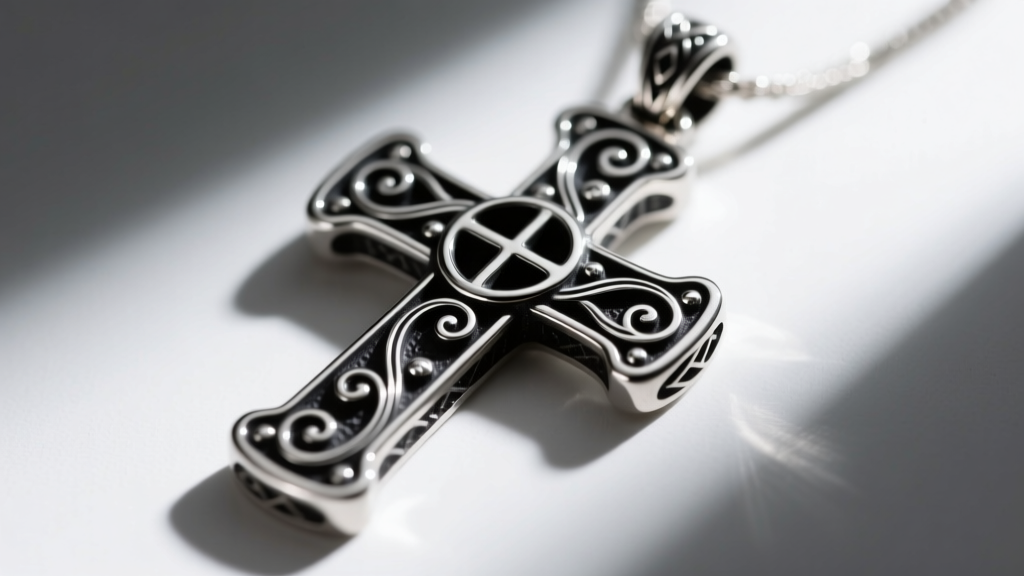
The jailhouse cross pendant is characterized by its three-dimensional relief, heavy beveling, and intricate surface ornamentation. While early prison-made crosses were carved from soap, wood, or melted plastic, modern silver iterations are either hand-fabricated from sheet metal and wire, or cast from a master model that has been heavily tooled.
For a comprehensive understanding of precious metal marking and quality assurance on these heavy pendants, the UK Assay Office Hallmarking Guide provides excellent standards on how heavy silver items should be stamped and verified, ensuring the buyer is receiving genuine 925 silver rather than silver-plated base metals.
Bright-Cut Engraving and Scrollwork
The defining visual element of the cross face is the engraving. Master jewelers use a technique called bright-cut engraving. Using hardened steel gravers (specifically the flat or onglette graver), the artisan cuts deep, angled grooves into the silver. The geometry of the cut is designed to reflect light, creating a "bright" line that contrasts sharply with the dark, oxidized background.
Common motifs integrated into the jailhouse cross include:
- Teardrops: Often carved into the terminals of the cross, symbolizing loss or time served.
- Flame and Smoke Relief: Deeply carved borders that give the illusion of the cross emerging from fire.
- Nameplates and Banners: Integrated silver ribbons wrapping around the cross arms, custom-engraved with names or dates.
- Stone Setting: While traditional jailhouse jewelry rarely used precious stones, modern iterations frequently incorporate flush-set or bezel-set black onyx, cubic zirconia, or natural turquoise to add color contrast against the oxidized silver.
Hardware, Clasps, and Weight Distribution
A heavy jailhouse cross necklace can easily weigh between 150 grams and 400 grams. Standard lobster clasps or spring rings will fail under this load, leading to catastrophic loss. Therefore, specialized hardware is required.
The industry standard for these necklaces is the handmade barrel clasp or the heavy-duty hook-and-eye clasp. A barrel clasp consists of two cylindrical ends that slide into one another, secured by an internal tension pin or a threaded screw mechanism. This design distributes the tensile stress across the entire surface area of the clasp rather than relying on a single tiny spring. Furthermore, the jump rings connecting the clasp to the chain are always soldered shut and are typically forged from a thicker wire gauge than the rest of the chain to prevent pulling and deformation.
Patina Maintenance and Oxidation
The high-contrast look of a jailhouse cross relies on intentional oxidation. Jewelers use liver of sulfur (potassium sulfide) to rapidly tarnish the silver, turning the recessed areas and engraving cuts pitch black. The raised surfaces are then polished with a rouge cloth, leaving the dark patina only in the low spots.
"Maintaining a jailhouse chain requires avoiding ultrasonic cleaners and harsh chemical dips. These methods will strip the intentional liver-of-sulfur patina from the deep link crevices, leaving the chain looking flat, gray, and lifeless. Instead, use a treated silver polishing cloth only on the high-friction contact points of the links to maintain the bright silver highlights while preserving the dark recesses."
By understanding the metallurgy, hand-sawn chain construction, and bright-cut engraving techniques, collectors and enthusiasts can properly evaluate the craftsmanship of a jailhouse cross necklace. It remains a testament to the ingenuity of metalsmithing, transforming raw wire and sheet into a heavy, enduring piece of wearable art.


