Decoding Jen Psaki's Necklace: Material Analysis
Explore the metallurgy and design behind Jen Psaki's necklace. We compare 14k vs 18k gold, chain tensile strength, and pendant settings for daily wear.

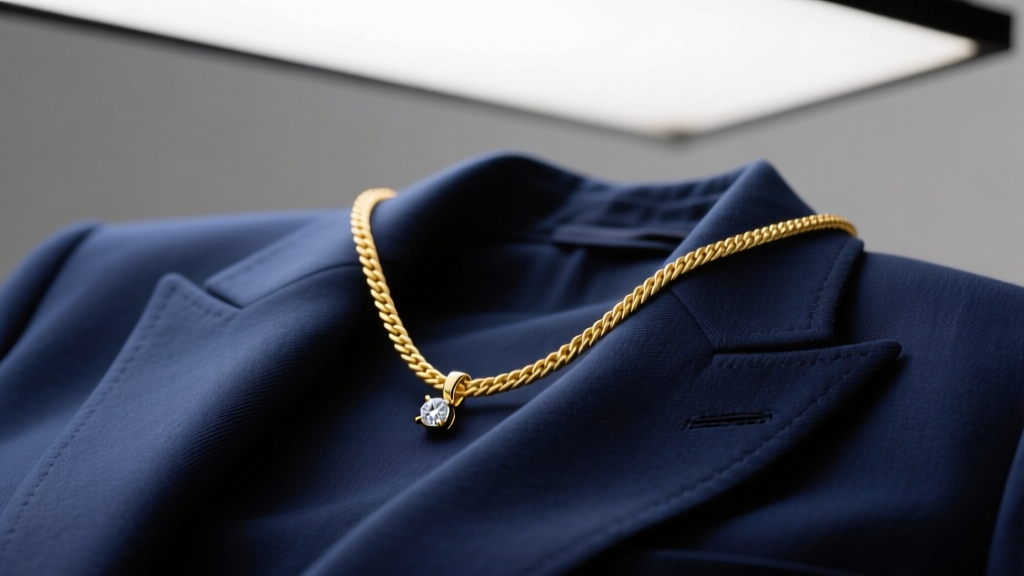
The Anatomy of a Broadcast-Ready Signature Piece
When analyzing the wardrobe of prominent political commentators and broadcast journalists, accessories often serve as subtle anchors of personal branding. A prime example is the frequent subject of style queries: Jen Psaki's necklace. Whether she is navigating the high-stakes environment of the White House briefing room or hosting her prime-time MSNBC broadcast, Psaki consistently relies on a delicate, understated gold chain with a minimal pendant. While fans often scramble to identify the exact designer—frequently pointing toward fine jewelry staples like Jennifer Meyer or similar custom solitaire pieces—the true mastery of this look lies not in the brand name, but in the material properties and engineering of the jewelry itself.
For a piece of jewelry to survive the rigors of daily professional wear while maintaining its aesthetic integrity under harsh studio lighting, it must be engineered with precision. In this comprehensive material analysis, we deconstruct the metallurgy, chain architecture, and setting mechanics that make this specific style of necklace the gold standard for broadcast-ready, everyday fine jewelry in 2026.
Studio Lighting and Metal Reflectivity: 14k vs. 18k Gold
Television studios utilize high-intensity, mixed-temperature lighting rigs, often blending 5600K daylight-balanced LEDs with warmer practical lights. The way a metal reflects this light is dictated by its alloy composition. Pure 24k gold is too soft for delicate chains and possesses a harsh, almost orange-yellow hue that can cause lens flare or color-casting on camera.
This is why the ideal iteration of Jen Psaki's necklace aesthetic relies on 14k yellow gold rather than 18k. 14k gold contains 58.5% pure gold, with the remaining 41.5% typically composed of silver, copper, and trace amounts of zinc. This specific copper-to-silver ratio not only deepens the warmth of the gold—making it highly flattering against a wide variety of skin tones and studio backdrops—but it also alters the metal's refractive index. According to the Gemological Institute of America (GIA), the alloying metals in 14k gold create a slightly less reflective, more satin-friendly surface when given a soft polish, preventing the distracting glare that high-polish 18k gold can produce on high-definition cameras.
Metallurgical Durability: The Vickers Hardness Scale
The primary failure point of any delicate necklace is the chain snapping under micro-tension. To understand why certain chains survive years of daily wear while others break within weeks, we must look at the Vickers Hardness (HV) scale.
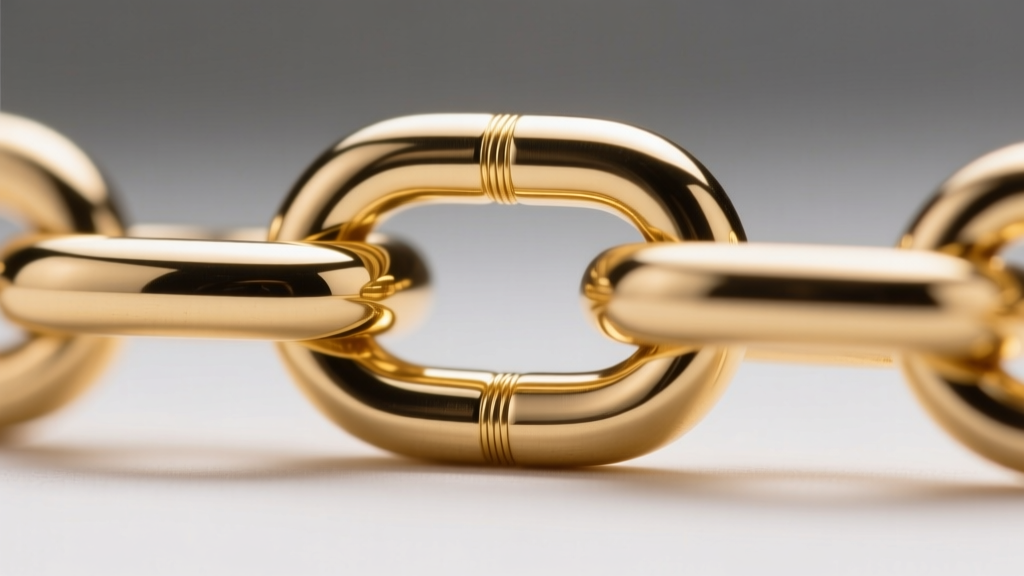
18k gold, being 75% pure gold, is inherently softer, typically registering between 110 and 130 HV. While it feels luxurious and heavy, an 18k chain with a gauge below 1.0mm is highly susceptible to stretching and micro-fractures when caught on clothing. 14k gold, conversely, registers between 140 and 160 HV. This 20% increase in structural rigidity is the difference between a chain that gracefully withstands the friction of a silk blouse and one that snaps when snagged on a lapel mic.
For those attempting to replicate this exact look, platinum (often alloyed with 5% ruthenium for a hardness of roughly 135 HV) is an alternative, but its higher density makes delicate chains feel uncomfortably heavy and look overly thick. 14k gold remains the undisputed champion for high-tensile, micro-gauge chains.
| Material | Purity | Vickers Hardness (HV) | Tensile Strength | Best Use Case |
|---|---|---|---|---|
| 14k Yellow Gold | 58.5% | 140 - 160 HV | High | Delicate daily-wear chains (0.8mm - 1.1mm) |
| 18k Yellow Gold | 75.0% | 110 - 130 HV | Medium | Heavier chains, statement pendants |
| Platinum (95/5 Ru) | 95.0% | 130 - 145 HV | Very High | Diamond settings, thick structural chains |
Chain Architecture: Cable Links and Laser Welding
The visual hallmark of the necklace style favored by Psaki is the classic cable chain. Characterized by uniform oval or round links connected in a simple, continuous pattern, the cable chain is prized for its ability to lay flat against the collarbone without twisting. However, not all cable chains are manufactured equally.
The Importance of Laser-Welded Seams
In mass-produced jewelry, chain links are often left unsoldered or joined using traditional lead-based solders that create weak, visible seams. In 2026, high-end daily-wear chains utilize precision laser welding. A laser welder uses a highly focused beam of light to fuse the exact point where the link closes, melting the 14k gold alloy into itself without adding foreign solder metals. This results in a seam that possesses the exact same tensile strength as the rest of the link. When shopping for a comparable piece, always verify with the jeweler that the chain features laser-welded links, especially if the gauge is a delicate 0.9mm.
Pendant Engineering: The Bezel Setting Advantage
The pendant resting at the center of Jen Psaki's necklace is typically a small, brilliant-cut diamond or a subtle gold disc. When dealing with micro-pendants (usually ranging from 3mm to 5mm in diameter), the setting mechanics are critical for both security and comfort.
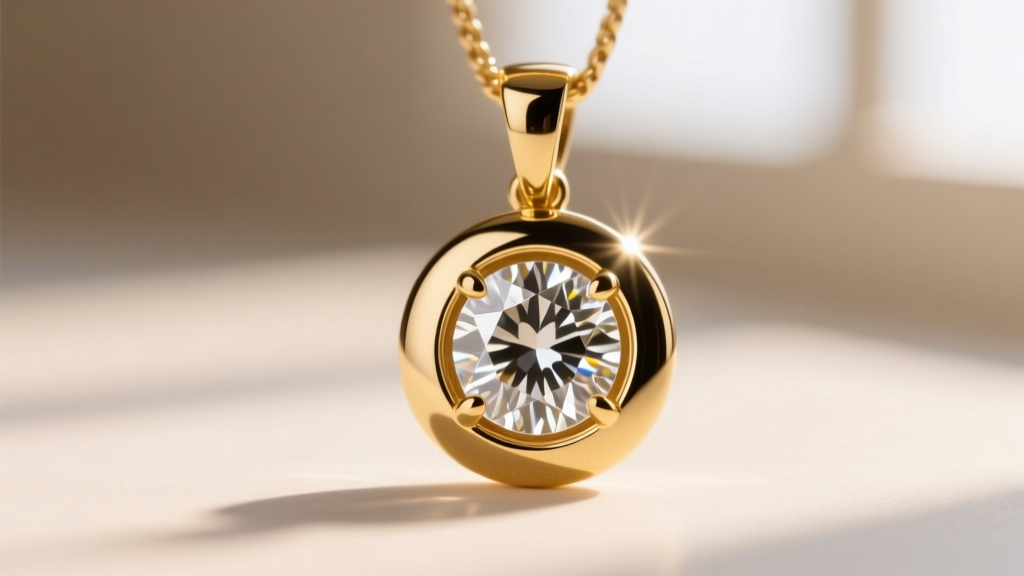
Traditional prong settings, while excellent for maximizing light return in larger engagement rings, are a liability for daily-wear broadcast jewelry. Prongs can easily catch on the fine weaves of professional blouses, scarves, or lanyards, risking both damage to the clothing and the loss of the stone. The solution is the bezel setting. A bezel setting features a continuous, smooth rim of 14k gold that is pressed over the girdle (the outer edge) of the diamond.
According to master jewelers and guidelines from Jewelers of America, a properly executed bezel setting should have a metal lip of at least 0.3mm overlapping the stone. This not only secures the diamond against lateral impacts but also creates a completely snag-free profile. Furthermore, a low-profile bezel—where the basket of the setting sits flush against the skin—prevents the pendant from flipping upside down, a common annoyance with poorly weighted micro-pendants.
Clasp Mechanics: Overcoming Spring Fatigue
A chain is only as secure as its clasp. The delicate nature of a 0.9mm cable chain requires a clasp that is proportionate in weight but robust in mechanics. The standard spring ring clasp is notoriously unreliable for daily wear; the internal steel spring is prone to fatigue, and the tiny trigger mechanism often fails to close completely, leading to lost necklaces.
The superior choice, and the one found on high-quality iterations of this necklace style, is a scaled-down lobster clasp (typically 5mm or 6mm in length). Lobster clasps utilize a heavier, more resilient internal spring and a solid metal arm that locks securely into the base. To complete the engineering, the jump ring connecting the lobster clasp to the chain must be soldered shut. An unsoldered jump ring will eventually pull apart under the lateral stress of taking the necklace on and off over the head.
Sourcing and Maintenance in 2026
If you are looking to invest in a piece that mirrors the material excellence of Jen Psaki's necklace, expect to pay between $450 and $850 for a solid 14k gold cable chain (16 to 18 inches) featuring a laser-welded 0.9mm gauge and a bezel-set diamond pendant ranging from 0.05 to 0.10 carats. Brands like Jennifer Meyer, Mejuri, and independent Etsy jewelers specializing in laser-welded chains offer excellent starting points.
Maintenance for 14k gold is straightforward but requires discipline. Avoid wearing the necklace in chlorinated pools, as chlorine reacts with the copper and silver alloys in 14k gold, causing irreversible micro-pitting and structural weakening. For cleaning, a simple soak in warm water with a few drops of ammonia-free dish soap, followed by a gentle brushing with a baby-soft toothbrush, will remove the accumulation of skin oils and cosmetic powders that dull the diamond's brilliance. By understanding the metallurgy and engineering behind these seemingly simple pieces, you can invest in fine jewelry that performs flawlessly both on and off camera.


