July Birth Flower Necklace Guide: Larkspur & Water Lily Designs
Discover expert insights on selecting a July birth flower necklace. Explore larkspur motifs, metal grades, enamel techniques, and chain pairings.

The Botanical Blueprint: Larkspur vs. Water Lily in Jewelry
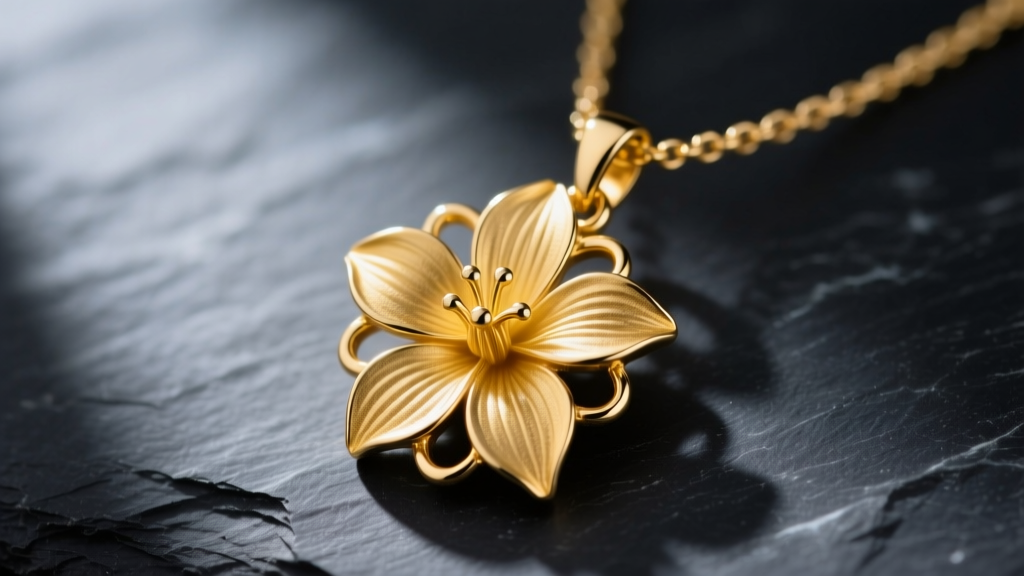
When commissioning or purchasing a july birth flower necklace, understanding the botanical architecture of the subject is critical for evaluating craftsmanship. July boasts two birth flowers: the Larkspur (Delphinium elatum) and the Water Lily (Nymphaeaceae). While water lilies offer radial symmetry that is relatively straightforward to cast, the larkspur presents a unique challenge for jewelry designers due to its zygomorphic (bilaterally symmetrical) structure and distinct spurred sepal.
High-end botanical jewelry does not merely approximate a flower; it captures its precise morphology. A master jeweler will sculpt the larkspur's five petal-like sepals, ensuring the posterior sepal extends into the characteristic hollow spur. Mass-produced pendants often omit this spur or flatten the bloom into a generic five-petal daisy shape. When inspecting a piece, look for the asymmetrical depth and the delicate, palmate lobing of the lower leaves, which should measure no more than 0.8mm in thickness in a well-executed micro-pave or solid gold casting.
Metallurgy & Casting: Crafting Delicate Floral Pendants
The structural integrity of a floral pendant hinges on the casting method and the alloy's Vickers Hardness (HV). Because larkspur stems and water lily stamens require wire-like dimensions (often 1.0mm to 1.5mm in diameter), the metal must resist bending under the tension of a chain pull.
Lost-Wax Casting Tolerances and 3D Resin Masters
Modern artisanal jewelers utilize high-resolution DLP (Digital Light Processing) 3D printers to create the master wax models. To capture the 0.05mm venation on a larkspur petal, the printer must operate at a 25-micron layer height. If the resolution is lower, the veins blur, resulting in a soft, undefined petal surface after the burnout process. Furthermore, the investment powder used to create the mold must be ultra-fine grain (typically 120-200 mesh) to prevent surface porosity on these ultra-thin floral extremities.
Metal Grade Comparison for Botanical Pendants
| Metal Alloy | Vickers Hardness (HV) | Best Application | Durability Risk |
|---|---|---|---|
| 14k Yellow Gold | 120 - 150 HV | Intricate stems, high-wear daily chains | Low; excellent rigidity for thin stems |
| 18k Yellow Gold | 110 - 130 HV | Pave diamond settings in flower centers | Medium; prone to bending if stem is <1.2mm |
| 950 Platinum | 130 - 160 HV | Heirloom pieces, complex prong work | Low; high tensile strength, but heavy |
| Sterling Silver (925) | 60 - 80 HV | Budget-friendly, large statement pieces | High; thin stems will warp easily |
Enamel Techniques for Botanical Realism
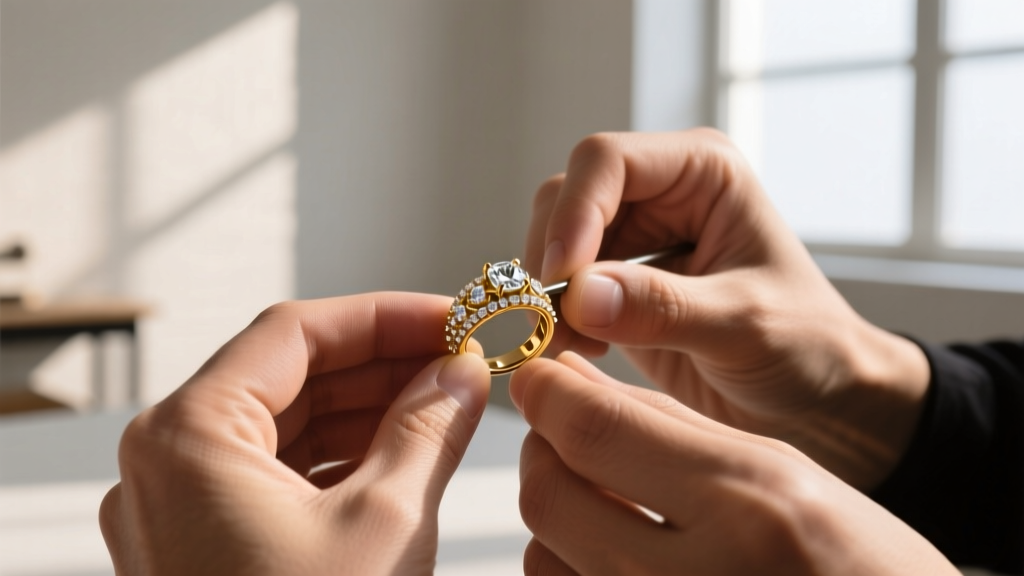
For those seeking a vibrant july birth flower necklace that mimics the vivid blues, purples, and whites of the living larkspur, vitreous enamel is the superior choice. However, not all enameling is created equal. According to historical jewelry manufacturing archives maintained by the Victoria and Albert Museum, the technique used drastically alters the light interaction with the petals.
Plique-à-Jour vs. Champlevé
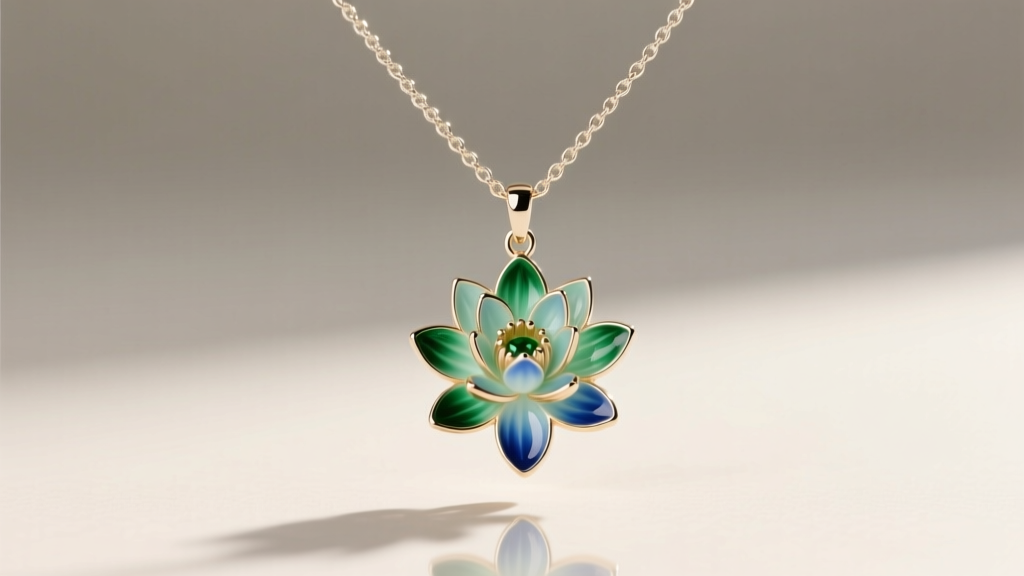
Champlevé involves carving troughs into a solid metal base and filling them with opaque enamel. While durable, it lacks the translucency of real flower petals. Plique-à-jour, conversely, is a backless enamel technique. The jeweler constructs a metal framework (cloisons) resembling a stained-glass window, temporarily backs it with copper or mica, and fills the cells with transparent enamel. After firing at approximately 750°C to 800°C, the copper backing is dissolved in a nitric acid bath. The result is a translucent, light-catching petal that perfectly replicates the delicate tissue of a water lily or larkspur bloom.
"The true test of a master enamelist is the tension of the glass within the cloison. In floral motifs like the larkspur, the cells are irregular and elongated, making the cooling process highly susceptible to micro-fractures if the thermal expansion coefficient of the enamel does not perfectly match the karat gold framework." — Adapted from the Gemological Institute of America (GIA) historical archives on decorative arts.
Chain Gauge and Clasp Engineering
A common failure point in delicate floral jewelry is the mismatch between the pendant's bail and the chain's gauge. A meticulously cast 15mm larkspur pendant typically weighs between 1.2 and 1.8 grams. Suspending this on a chain that is too heavy will obscure the pendant, while a chain that is too light will snap at the clasp ring.
- Optimal Chain Gauge: 0.8mm to 1.1mm. Box chains and cable chains in this range offer the perfect visual weight without overwhelming the floral motif.
- Jump Ring Specifications: The pendant's bail should accommodate a 20-gauge (0.81mm) jump ring with an outer diameter (OD) of 2.5mm. Anything larger will create a clunky visual gap between the chain and the flower.
- Clasp Mechanics: Avoid standard spring rings, which suffer from weak internal spring tension and frequent failure. Opt for a 5mm or 6mm solid lobster clasp. A high-quality lobster clasp features a forged lever rather than a stamped one, ensuring the gate closes flush against the body to prevent the 1.0mm chain from slipping through.
Pricing Tiers and Authenticity Markers
Navigating the market for a july birth flower necklace requires an understanding of how manufacturing provenance dictates price. When evaluating pieces from independent jewelers or luxury boutiques, expect the following pricing structures based on the technical execution:
1. CAD/Cast Production ($250 - $600)
These pieces are designed in Rhino or MatrixGold, printed in castable resin, and produced in 14k gold. They offer excellent botanical accuracy but may lack the hand-finished micro-texturing on the leaves. Look for the "14K" or "585" hallmark stamped discreetly on the back of the pendant bail or the chain end tag.
2. Hand-Forged & Plique-à-Jour ($1,200 - $3,500+)
True artisanal pieces where the petals are hand-sawn from sheet metal, soldered, and enameled. The price reflects the high failure rate of the enameling process and the dozens of hours required to polish the intricate undercuts of the larkspur spur. These pieces often bear the maker's registered trademark stamp alongside the metal purity mark, a requirement enforced by the FTC for precious metal goods in the United States.
Whether you choose a minimalist 18k gold water lily or a highly detailed, enameled larkspur, prioritizing structural engineering and botanical accuracy ensures your birth flower necklace remains a durable, wearable heirloom rather than a fragile novelty.


