King Tut Necklace Materials: Ancient Gold vs Modern Replicas
Discover the material properties of the iconic King Tut necklace. Compare ancient gold, lapis lazuli, and faience with modern reproduction alternatives.

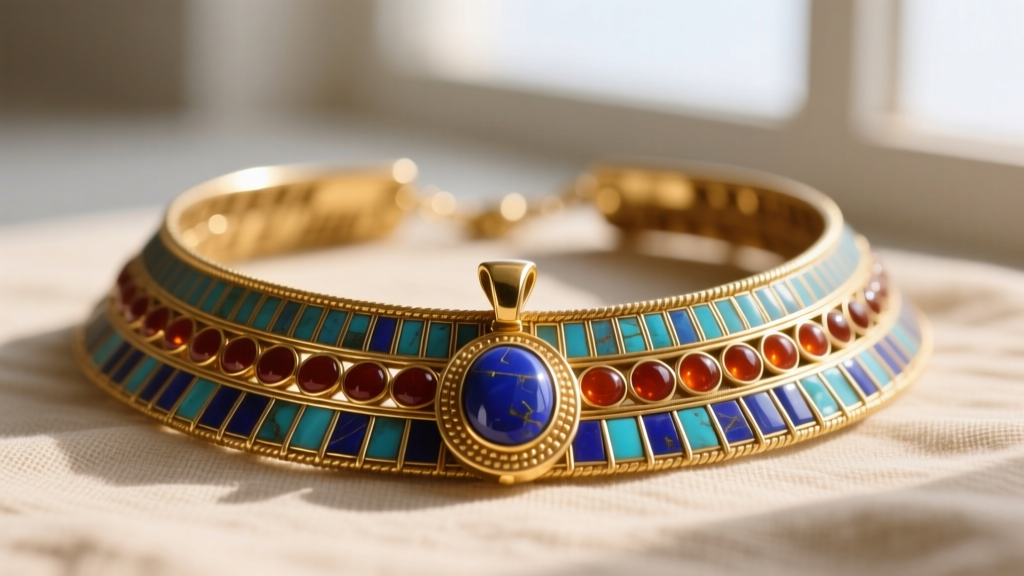
When Howard Carter unsealed the tomb of KV62 in 1922, the sheer volume of gold and gemstones found on the young pharaoh's mummy forever altered the trajectory of global jewelry design. Today, the King Tut necklace remains one of the most sought-after motifs in historical revival jewelry. However, the market is flooded with everything from museum-grade metallurgical replicas to mass-market costume pieces. For collectors and enthusiasts in 2026, understanding the material properties of these iconic broad collars and pectorals is essential for evaluating quality, authenticity, and long-term wearability.
The Anatomy of the Pharaoh’s Necklaces
To understand the materials, we must first understand the structure. The iconic necklaces worn by Tutankhamun primarily fall into two categories: the Wesekh (broad collar) and the Aegis or pectoral necklace. The Wesekh is a multi-strand, bib-like collar that rests on the clavicle and upper chest, often terminating in falcon-head clasps. Because these ancient pieces were incredibly heavy, they required a counterpoise (known as a menat) at the back of the neck to keep the collar balanced.
Modern reproductions of the King Tut necklace often scale down the Wesekh or focus entirely on the pectoral pendants—such as the famous winged scarab—to make them wearable for contemporary fashion. This scaling drastically changes the material requirements, shifting the focus from sheer structural weight to intricate inlay work and metal casting precision.
Historical Materials: The 18th Dynasty Standard
The master jewelers of the 18th Dynasty did not merely use materials for their beauty; they utilized them for their metaphysical properties and geological rarity. According to the Metropolitan Museum of Art, the color palette of Egyptian jewelry was strictly codified, representing cosmic forces.
Gold and Electrum
While we associate Tutankhamun with pure gold, many of his structural necklace components were actually crafted from electrum—a natural alloy of gold and silver containing up to 20% silver. This alloy provided a slightly paler, highly reflective finish and, crucially, increased the Mohs hardness of the metal from 2.5 (pure 24k gold) to roughly 3.5, allowing the collar to support the heavy stone inlays without warping. The gold foil used for decorative layering, however, was often 22k to 23k purity, hammered to fractions of a millimeter.
The Sacred Triad: Lapis, Carnelian, and Turquoise
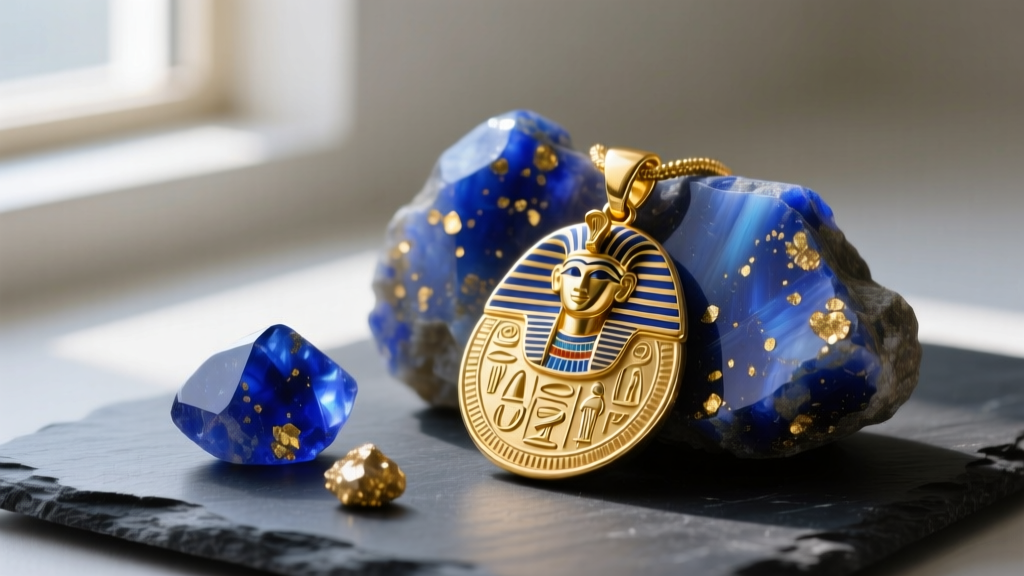
- Lapis Lazuli (Mohs 5-5.5): Sourced exclusively from the Sar-e-Sang mines in Badakhshan, Afghanistan. High-quality historical lapis contains golden pyrite flecks and minimal white calcite. It represented the night sky and the heavens.
- Carnelian (Mohs 6.5-7): A variety of chalcedony colored by iron oxide impurities. Egyptian lapidaries routinely heat-treated carnelian to deepen its red-orange hue, symbolizing the sun and lifeblood.
- Turquoise (Mohs 5-6): Mined in the Sinai Peninsula. Its porous nature made it susceptible to dehydration, which is why many ancient turquoise inlays have faded or cracked over millennia.
Faience: The First Synthetic Material
Because genuine turquoise was rare and difficult to carve into the tiny tesserae required for cloisonné work, Egyptian artisans perfected faience. This is not the tin-glazed pottery associated with Renaissance Europe, but a sintered-quartz ceramic. By mixing crushed quartz sand with copper oxide and natron (a natural salt), and firing it at approximately 900°C, they created a vibrant blue-green glaze that symbolized fertility and the Nile. The Griffith Institute notes that faience was the primary inlay material for the majority of the broad collars found in KV62.
Modern Reproduction Materials: What You Actually Buy
If you are purchasing a King Tut necklace today, you are almost certainly buying a reproduction. The material quality of these reproductions varies wildly based on the price point and the manufacturer's dedication to historical accuracy.
Metallurgical Substitutes
High-end artisan replicas utilize 18k or 22k gold vermeil over a sterling silver (925) base. To meet modern vermeil standards, the gold layer must be at least 2.5 microns thick, providing a durable, rich yellow hue that closely mimics ancient high-karat gold. Mid-tier pieces often use gold-plated brass, which is prone to oxidation and can cause skin discoloration as the copper in the brass reacts with sweat. Mass-market tourist replicas rely on cast pewter or zinc alloys, which lack the structural integrity to hold heavy stone inlays securely.
Gemstone and Inlay Substitutes
Sourcing genuine lapis lazuli and carnelian in the massive quantities required for a full Wesekh collar is cost-prohibitive for all but the most elite bespoke jewelers. Therefore, modern manufacturers rely on advanced lapidary treatments and synthetics:
- Dyed Howlite: A porous white borate mineral that readily absorbs blue dye, serving as the primary substitute for lapis lazuli. It lacks the golden pyrite flecks unless artificially painted.
- Dyed Agate and Glass: Red-dyed agate is frequently used to replace carnelian, while opaque Czech glass or cold enamel (epoxy resin) is used to replicate the vibrant blue-green of ancient faience.
Material Comparison Matrix: Authentic vs. Replica
Use the following table to evaluate the material properties of the King Tut necklace you are considering purchasing.
| Component | Historical 18th Dynasty Material | High-End Modern Replica | Mass-Market Substitute | Durability Risk |
|---|---|---|---|---|
| Base Metal | Electrum / 18k-22k Gold | Sterling Silver with 2.5μ 18k Vermeil | Cast Brass or Zinc Alloy | Brass tarnishes and causes skin irritation. |
| Blue Inlay | Afghan Lapis Lazuli | Reconstituted Lapis or High-Grade Sodalite | Dyed Howlite or Blue Resin | Dyed howlite fades under UV light exposure. |
| Red Inlay | Heat-Treated Nubian Carnelian | Natural Carnelian or Red Agate | Opaque Red Glass or Enamel | Glass is brittle and shatters upon impact. |
| Green/Teal Inlay | Sinai Turquoise or Copper Faience | Stabilized Turquoise or Amazonite | Dyed Quartz or Cold Enamel | Stabilized turquoise resists cracking and sweat. |
| Setting Technique | Gold Cloisonné (Soldered walls) | Bezel Settings or Soldered Bezels | Glued Inlays (Epoxy) | Glued inlays fail when exposed to heat or water. |
Evaluating Quality in Egyptian Revival Jewelry
When shopping for a premium King Tut necklace, the setting technique is just as important as the raw materials. Ancient Egyptian jewelers used a technique called cloisonné, where thin strips of gold were soldered to a backplate to create tiny cells (cloisons) into which the stones were set. According to the British Museum collection archives, these stones were often backed with colored resins or foils to enhance their vibrancy, and held in place by a combination of precise friction fitting and natural adhesives.
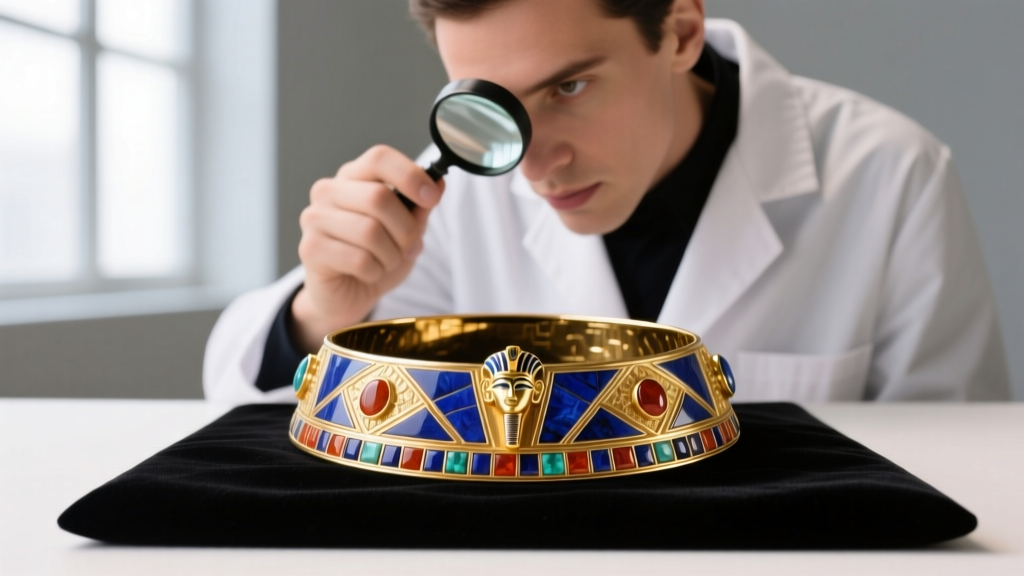
In modern high-quality reproductions, you should look for mechanical bezel settings where the metal is physically pushed over the edge of the stone. If you examine the necklace under a jeweler's loupe and see a visible seam of clear epoxy or glue around the edges of the lapis or carnelian inlays, you are looking at a lower-tier piece. Glue degrades over time, especially when exposed to the oils in human skin and the temperature fluctuations of daily wear.
The Importance of Drape and Counterpoise
A true Wesekh collar is rigid and structured. If a modern replica is made with thin, stamped sheet metal, it will buckle and warp under the weight of the glass or stone inlays. High-end replicas use cast or die-struck segments linked by flexible jump rings, allowing the collar to articulate and drape smoothly over the clavicle without kinking. Furthermore, premium broad collars will include a hidden counterweight or a heavy, decorative clasp at the nape of the neck to prevent the necklace from choking the wearer or sliding forward.
Care and Maintenance for Inlay Necklaces
The mixed-material nature of a King Tut necklace makes cleaning a delicate process. Never place an inlay necklace in an ultrasonic cleaner. The high-frequency vibrations will easily dislodge stones that are held in place by friction or modern adhesives, and the heat can fracture natural carnelian or dyed howlite.
Instead, clean the gold or vermeil components with a soft, lint-free microfiber cloth. If the metal is heavily tarnished, use a mild, phosphate-free dish soap and lukewarm water, gently brushing the metal with a soft-bristled baby toothbrush while strictly avoiding the porous stone inlays. Always dry the piece immediately and store it flat in an anti-tarnish pouch to prevent the silver base metal from oxidizing and pushing black tarnish up into the crevices of the gold cloisonné.
Final Thoughts on Material Authenticity
The allure of the King Tut necklace lies in its masterful juxtaposition of luminous gold and deeply saturated gemstones. While few modern buyers will acquire a piece featuring solid 22k gold and untreated Afghan lapis, understanding the historical and metallurgical benchmarks allows you to identify reproductions that honor the craftsmanship of the 18th Dynasty. By prioritizing thick gold vermeil, mechanically set stones, and structurally sound articulation, you can secure an Egyptian revival piece that is as enduring as it is visually striking.


