Large Bow Necklace Troubleshooting: Fixes & Styling
Is your large bow necklace drooping, tangling, or tarnishing? Discover expert troubleshooting fixes, chain upgrades, and styling solutions for heavy pendants.

The Anatomy of a Bow Necklace Failure
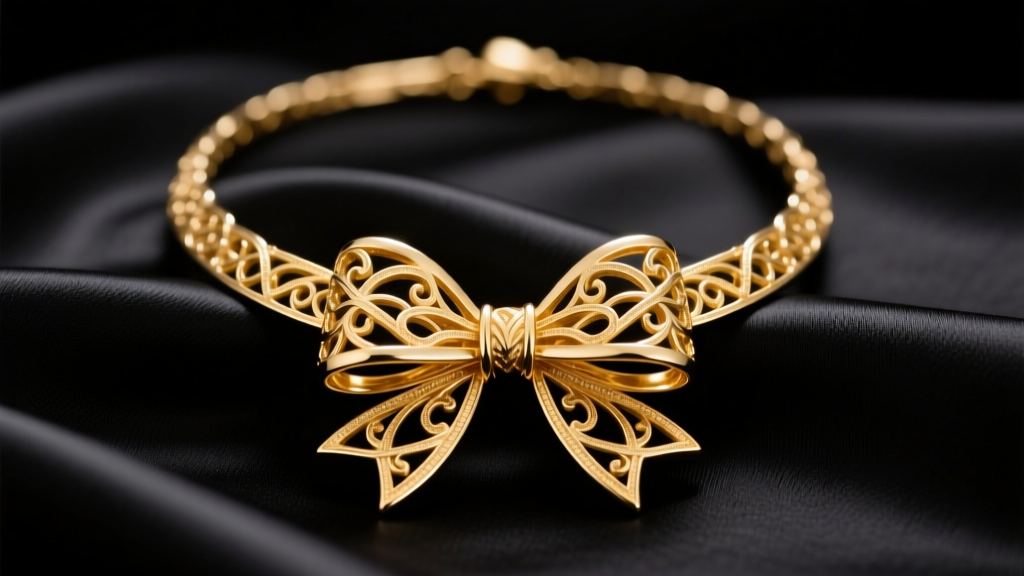
The large bow necklace has cemented its status as a defining silhouette in contemporary jewelry, evoking a blend of coquette aesthetics and high-fashion elegance. However, the very physics that make a large bow necklace so striking—its expansive surface area, intricate loops, and substantial weight—often lead to a host of functional and aesthetic failures. From pendants that stubbornly flip upside down to chains that snap under the dynamic load of a heavy centerpiece, wearing a statement bow requires more than just an eye for style; it demands an understanding of jewelry mechanics.
As a senior stylist and jewelry technician, I frequently see clients frustrated by their investment pieces. A poorly engineered large bow necklace will slide off-center, tarnish rapidly at the solder joints, or overwhelm delicate necklines. This comprehensive troubleshooting guide addresses the most common structural and styling failures associated with large bow pendants, providing actionable, expert-level solutions to restore both the function and beauty of your favorite statement piece.
Problem 1: The Pendant Flips and Slides Off-Center
The most frequent complaint regarding a large bow necklace is the 'pendulum effect.' Because the bow's center of gravity is typically located in the lower, wider loops rather than at the top bail (the loop connecting the pendant to the chain), the necklace becomes top-heavy. As you move, the chain slides through the bail, and the bow flips upside down or rests awkwardly on your collarbone.
The Physics of the Bail and the Counterweight Solution
The root of this issue lies in the bail design. Many mass-produced bow necklaces feature a simple, narrow soldered ring at the top center. When the bow's mass exceeds 15 grams, this single pivot point cannot maintain equilibrium against the friction of the chain.
The Fix: You have two primary options to stabilize the pendant. First, consult a bench jeweler to solder a small, dense counterweight—such as a 2-3 gram sterling silver or 14k gold bead—directly to the back of the bow's top knot. This shifts the center of gravity upward, anchoring the bow flat against the chest. Second, upgrade the bail to a 'Y-drop' or 'hidden bail' design that wraps around the back of the top loops, distributing the chain's tension across a wider surface area and preventing the chain from slipping through the pivot point.
Problem 2: Chain Snapping and Clasp Fatigue
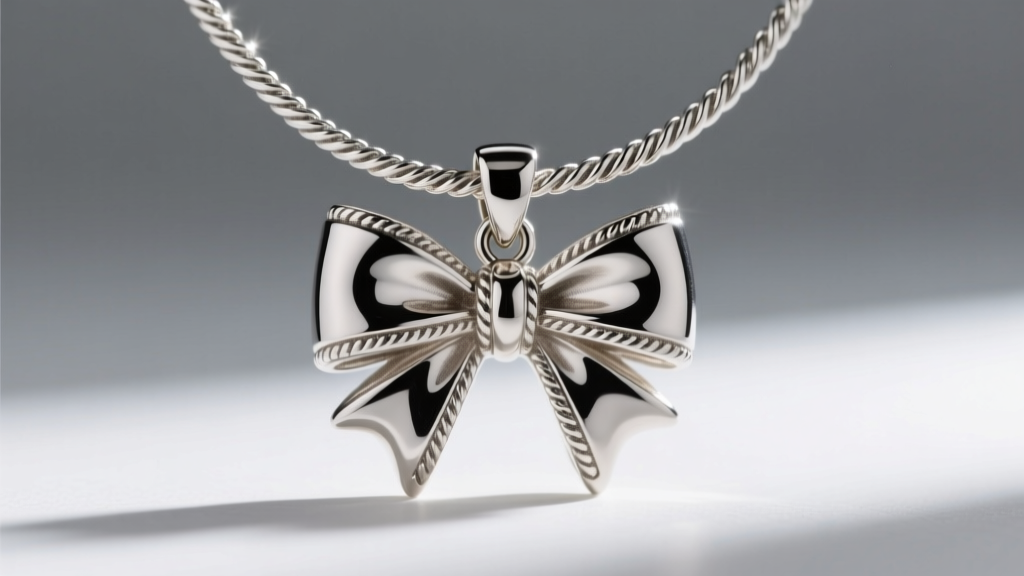
A large bow necklace acts as a dynamic weight. Every time you lean forward, walk, or adjust your clothing, the sudden kinetic energy transfers directly to the chain and the clasp. Standard 0.8mm or 1.0mm chains, often included with boutique bows to keep retail costs down, are entirely insufficient for pendants weighing over 20 grams. Over time, the links stretch, the metal fatigues, and the necklace snaps.
Matching Chain Gauge to Pendant Weight
To troubleshoot and prevent chain failure, you must match the chain's gauge (thickness) and style to the exact weight of your bow. Cable and rope chains offer superior tensile strength compared to delicate box or snake chains, which are prone to kinking and permanent deformation under heavy loads.
| Chain Thickness (Gauge) | Recommended Chain Style | Max Pendant Weight Capacity | Ideal Clasp Type |
|---|---|---|---|
| 0.8mm - 1.0mm | Cable / Rolo | Up to 8 grams (Micro Bows) | 8mm Spring Ring |
| 1.2mm - 1.5mm | Rope / Curb | 8 to 18 grams (Medium Bows) | 10mm Lobster Clasp |
| 1.8mm - 2.5mm | Wheat / Figaro | 18 to 35 grams (Large Bows) | 14mm Heavy Lobster |
| 3.0mm+ | Cuban Link | 35+ grams (Oversized Bows) | Box Clasp with Safety |
The Fix: Remove the original chain. Invest in a solid 1.8mm to 2.0mm wheat or rope chain. Furthermore, inspect the clasp. According to the Jewelers of America, the internal spring mechanism of a standard lobster clasp can fail if subjected to lateral pulling from a heavy pendant. Upgrade to a 14mm or 16mm heavy-duty lobster clasp with a stainless steel or titanium internal spring to ensure the necklace remains securely fastened.
Problem 3: Rapid Tarnishing at the Solder Joints
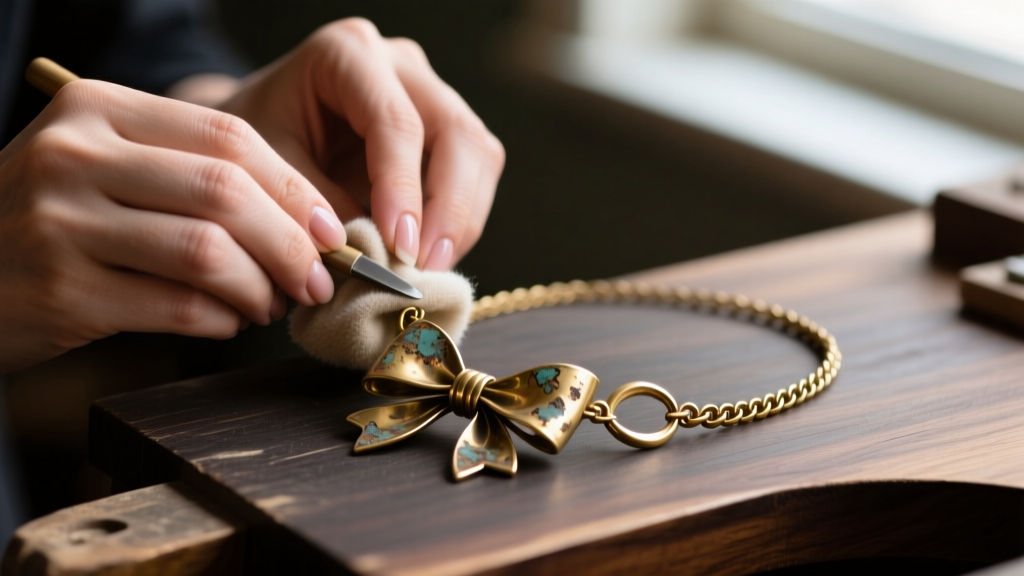
If your large bow necklace is turning your skin green or developing dark, crusty spots specifically where the metal ribbon loops intersect, you are witnessing galvanic corrosion at the solder joints. Many fashion-forward bows are cast from Zamac (a zinc-aluminum alloy) or brass, then plated with a micro-thin layer (0.1 to 0.5 microns) of gold or silver.
The Dip Test and Metallurgical Fixes
When the piece is assembled, the jeweler must use high-heat solder to connect the loops. This heat burns away the plating at the joints, exposing the base metal. When exposed to the sulfur and moisture in human sweat, these exposed nodes tarnish aggressively, eventually spreading beneath the plating and causing it to flake.
The Fix: For existing tarnish on base-metal bows, avoid harsh liquid silver dips, which can strip the remaining plating entirely. Instead, use a specialized jewelry polishing cloth impregnated with mild micro-abrasives. To prevent future corrosion, apply a thin coat of a jewelry-safe polymer sealant, such as ProtectaClear, directly to the solder joints and the back of the pendant. If you are purchasing a new large bow necklace, consult the Gemological Institute of America (GIA) guidelines on metal properties and insist on solid 925 sterling silver or 14k gold-filled constructions, which do not suffer from base-metal galvanic reactions.
Problem 4: Neckline Clashing and Visual Overload
A large bow necklace is an unapologetic focal point. The most common styling error is pairing it with garments that compete for visual real estate, resulting in a cluttered, overwhelming silhouette. Troubleshooting your wardrobe pairings is just as critical as fixing the hardware.
The Neckline Mapping Framework
To ensure your large bow necklace elevates rather than suffocates your outfit, follow this structural mapping framework:
- The Sweetheart & V-Neck: Ideal. The open negative space of a V-neck or sweetheart neckline perfectly frames the triangular geometry of a bow, allowing the pendant to sit flush against the skin without tangling in fabric.
- The Crew Neck & High Collar: Avoid. A large bow resting on top of a tight crew neck creates a 'choking' visual effect and causes the metal to catch on the collar seam, accelerating wear on the plating.
- The Button-Down Shirt: Context-dependent. Unbutton the shirt to the mid-chest to create an artificial V-neck. Never wear a large bow over a fully buttoned collared shirt; the bow's loops will clash with the shirt's collar points, creating visual dissonance.
- The Halter & Asymmetric: Avoid. The asymmetry of the neckline will fight the symmetry of the bow, making the entire outfit look unbalanced and poorly tailored.
Expert Maintenance Checklist
To keep your large bow necklace in pristine, wearable condition, implement this bi-annual maintenance routine:
- Bail Inspection: Use a jeweler's loupe to check the bail ring for thinning. If the metal has worn down by more than 20%, have it re-tipped or replaced before it snaps.
- Ultrasonic Avoidance: Never place a plated or hollow-cast large bow in an ultrasonic cleaner. The high-frequency vibrations can shatter hollow resin-filled loops and strip micro-plating.
- Storage Protocol: Store the necklace flat in an anti-tarnish flannel pouch. Hanging a heavy bow by its chain in a jewelry box places constant, unnecessary tension on the clasp spring and stretches the chain links over time.
'A large bow necklace is an architectural piece. You cannot treat it like a delicate slip chain. Respect the weight, upgrade the hardware, and give it the negative space it demands to truly shine.' — Master Bench Jeweler & Stylist
By addressing the mechanical flaws and styling missteps outlined above, your large bow necklace will transition from a frustrating, high-maintenance accessory into a reliable, show-stopping cornerstone of your jewelry collection. Always prioritize structural integrity and proportional styling to ensure your statement pieces stand the test of time.


