Styling a Large Cross Necklace for Women: The Beginner's Guide
Discover how to choose and style a large cross necklace for women. Learn about chain gauges, metal grades, and proportion tips for statement pendants.


The Resurgence of the Statement Cross
In the contemporary jewelry landscape of 2026, the large cross necklace for women has transcended its traditional religious boundaries to become a cornerstone of statement styling. From minimalist solid-block designs seen on high-fashion runways to intricate, gothic-inspired diamond-encrusted pieces favored by street-style icons, the oversized cross is a versatile anchor for any wardrobe. However, transitioning from a delicate, barely-there pendant to a bold, heavy statement piece requires an understanding of jewelry engineering, proportion, and material science. This beginner-friendly explainer will demystify the mechanics of wearing, styling, and maintaining heavy cross pendants, ensuring your investment looks intentional and lasts a lifetime.
Defining 'Large': Dimensions and Weight Metrics
When shopping for a statement piece, the term 'large' can be highly subjective. In the jewelry industry, pendant dimensions are measured in millimeters (mm). A standard, everyday cross typically measures between 15mm and 25mm in height. When we classify a piece as a 'large' cross necklace, we are generally referring to pendants that range from 50mm (approximately 2 inches) to 85mm (3.3 inches) in vertical drop.
The Weight Factor: Solid Cast vs. Hollow Stamped
Dimension is only half the equation; weight dictates how the necklace drapes and what chain is required to support it. A 60mm cross made from hollow-stamped sterling silver might weigh a mere 4 to 6 grams, allowing it to hang effortlessly on a thin 1.5mm cable chain. Conversely, a 60mm solid-cast 14k gold cross can easily exceed 25 grams. This massive weight differential introduces the 'pendulum effect'—the tendency of a heavy pendant to swing and pull on the neckline during movement. Understanding the weight of your pendant is the critical first step in selecting the correct chain architecture.
Chain Engineering: Matching Gauge to Pendant Weight
The most common mistake beginners make when buying a large cross necklace for women is pairing a heavy, oversized pendant with an inadequate chain. When a heavy pendant is placed on a thin chain, the friction and dynamic load can cause the chain links to stretch, warp, or snap entirely. To prevent catastrophic failure, you must match the chain's gauge (thickness) and tensile strength to the pendant's weight.
| Chain Style | Gauge (mm) | Max Weight Capacity | Best Pendant Type |
|---|---|---|---|
| Cable / Curb | 1.5 - 2.0mm | Under 10g | Hollow-stamped, lightweight crosses |
| Figaro / Mariner | 2.5 - 3.5mm | 15g - 25g | Solid medium-weight crosses |
| Cuban Link | 4.0 - 6.0mm | 30g - 50g+ | Heavy, oversized solid cast crosses |
| Rope | 3.0 - 5.0mm | 25g - 40g | Intricate, diamond-cut statement crosses |
For a true statement piece weighing over 20 grams, a 4mm to 5mm Cuban link or Rope chain is highly recommended. These styles feature interlocking links that distribute the pendant's weight evenly across the collarbone, preventing the chain from biting into the skin at the nape of the neck.
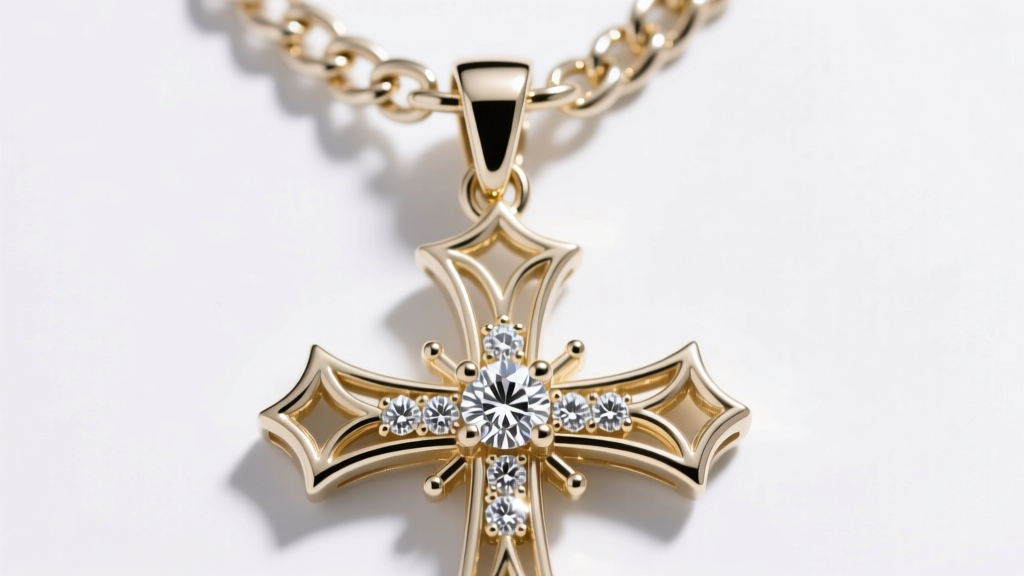
The Bail: The Unsung Hero of Proportion
The bail is the loop at the top of the pendant that connects it to the chain. When dealing with large crosses, the bail must be proportionally sized to both the pendant body and the chain gauge. A common design flaw in mass-market jewelry is attaching a massive 70mm cross to a tiny, 3mm bail. This creates a visual bottleneck and a physical weak point.
Furthermore, the inner diameter of the bail must comfortably accommodate your chosen chain. If you are using a 4.5mm Cuban link chain, the bail's inner diameter must be at least 5.5mm by 7mm to allow the chain to lay flat and flex naturally without kinking. Always check the bail dimensions before purchasing a large pendant and chain separately.
Material Grades and Hallmark Verification
Because large cross necklaces require more raw material, the cost difference between base metals and precious metals is magnified. Understanding material grades ensures you are paying for genuine quality. According to the Federal Trade Commission Jewelry Guides, all precious metals sold in the US must be accurately hallmarked.
- Sterling Silver (925): Composed of 92.5% pure silver and 7.5% copper. Ideal for large, oxidized, or gothic-style crosses. Note that heavy silver pieces can tarnish and require regular polishing.
- 14k Gold (585): Containing 58.5% pure gold, this is the industry standard for durable, everyday statement jewelry. It provides the necessary structural rigidity to support heavy diamond or gemstone settings on a large cross.
- 18k Gold (750): Softer and richer in color, 18k gold is beautiful but more prone to scratching. As detailed by the Gemological Institute of America (GIA), higher karat gold requires more careful handling, especially on heavy pendants that may swing and strike surfaces.
- Surgical Steel (316L): A fantastic budget-friendly alternative. 316L steel is highly resistant to tarnish, hypoallergenic, and possesses immense tensile strength, making it perfect for massive, heavy industrial crosses.
Neckline Mapping: A Proportional Framework
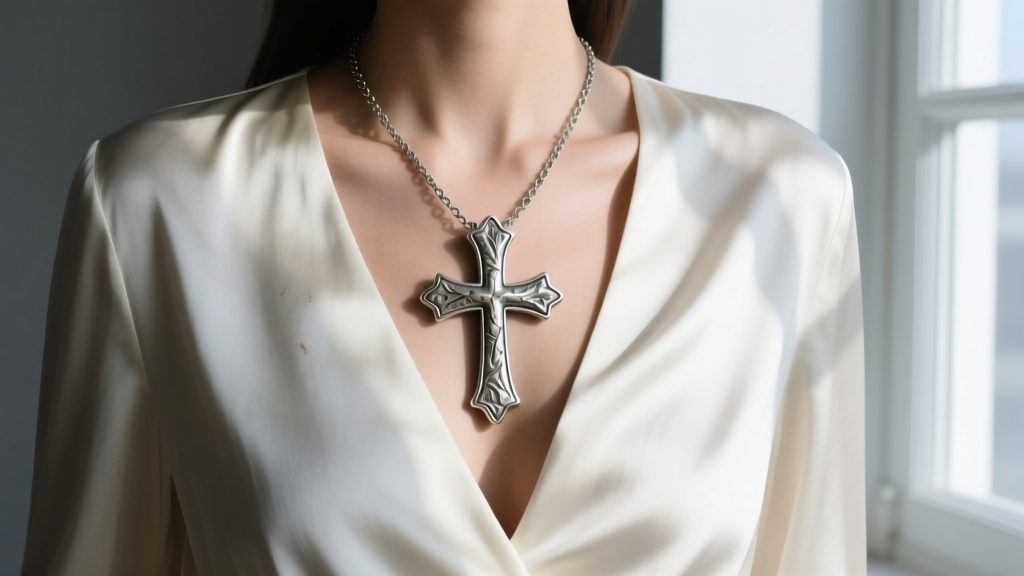
Styling a large cross necklace for women requires an understanding of torso proportions and neckline geometry. The goal is to create a harmonious visual flow rather than letting the jewelry overwhelm the wearer.
- The Deep V-Neck: The ideal canvas for a 60mm-80mm cross. The V-shape of the clothing mimics and frames the geometry of the pendant, drawing the eye downward and elongating the neck.
- The Crew Neck / Turtleneck: Best suited for medium-large crosses (50mm-60mm). Wearing a heavy, long-chain cross over a tight turtleneck creates a striking, layered streetwear aesthetic, but ensure the chain is at least 24 inches long so the pendant rests on the sternum, not the throat.
- The Button-Down Shirt: Leave the top two or three buttons undone to create an artificial V-neck. A delicate-to-medium large cross (around 45mm) in yellow gold resting against the skin provides a sophisticated, eclectic contrast to structured cotton or silk.
Clasp Mechanics and Failure Points
The clasp is the single most vulnerable point of any necklace, and heavy pendants exacerbate the stress placed upon it. The standard 'spring ring' clasp—commonly found on lightweight chains—is entirely inadequate for a large cross necklace. The internal spring mechanism and thin wire casing will easily warp under the 20+ gram dynamic load of a swinging statement pendant.
Always upgrade to a Lobster Clasp (minimum 12mm in size for heavy chains) or a Box Clasp with a Figure-8 Safety. Lobster clasps feature a solid, spring-loaded jaw that locks securely, while box clasps provide a mechanical interlock that is virtually impossible to pull apart under normal wearing conditions. If your chosen chain comes with a flimsy spring ring, take it to a local jeweler to have a heavy-duty lobster clasp soldered on before wearing your large cross out in public.
Maintenance and Care for Heavy Pendants
Large crosses, particularly those with intricate detailing, diamond pavé, or oxidized finishes, require specific maintenance routines. Because they rest against the chest, they are constantly exposed to body oils, perfumes, and friction. For solid gold and silver crosses, use a soft microfiber cloth for weekly wiping. If your piece features an intentional oxidized (blackened) silver finish, avoid ultrasonic cleaners and liquid silver dips, as these will strip the dark patina from the crevices, ruining the contrast of the design. Instead, use a dry, soft-bristled jewelry brush to gently remove dust and debris from the detailed grooves of your statement piece.


