How to Style a Moon and Star Necklace Gold: The Layering Guide
Learn how to style and layer a moon and star necklace gold piece. Discover karat differences, chain types, and neckline pairings in our expert guide.

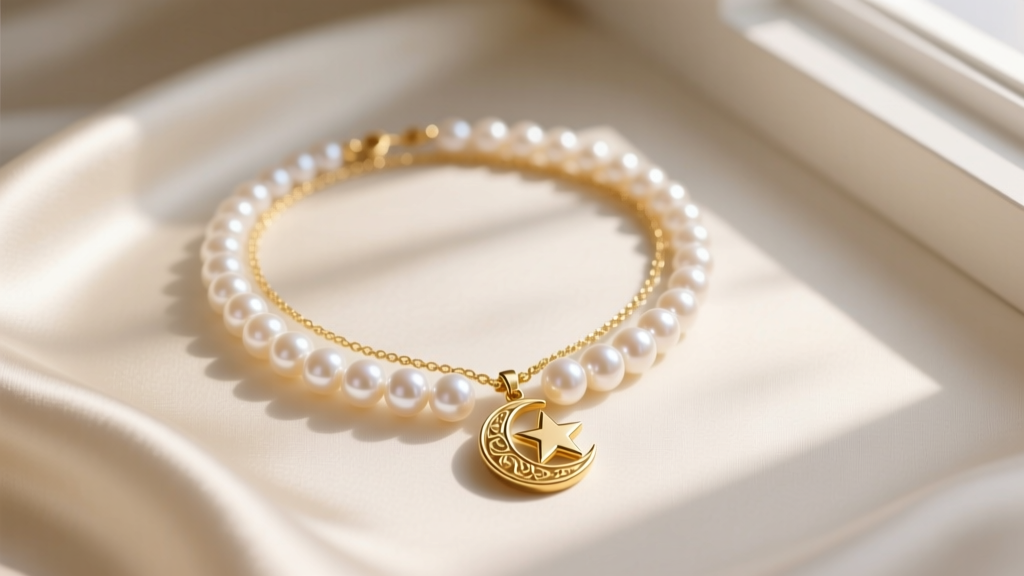
The Enduring Appeal of Celestial Jewelry
Celestial motifs have transcended seasonal fads to become permanent fixtures in fine jewelry. As we navigate the styling landscape of 2026, the emphasis has shifted heavily toward personalized, modular layering. A moon and star necklace gold piece is arguably the most versatile anchor for these curated stacks. The interplay between the crescent moon's soft curves and the star's sharp geometric points creates a visual tension that draws the eye, making it an ideal focal point for any neckline. However, simply throwing a pendant on a chain and calling it a day is a missed opportunity. True styling requires an understanding of metallurgy, chain mechanics, and spatial proportion. This comprehensive guide will walk you through the exact steps to select, layer, and maintain your celestial gold jewelry like a professional stylist.
Step 1: Selecting the Right Gold Karat for Pendants
Before you begin layering, you must understand the material you are working with. Gold purity, measured in karats, directly impacts the durability of delicate celestial shapes. According to the Gemological Institute of America (GIA), pure 24k gold is far too soft for intricate pendants. The delicate points of a star motif will easily bend, warp, or snap if cast in high-karat gold.
The Karat Comparison Framework
| Gold Karat | Purity | Durability & Tensile Strength | Best Application |
|---|---|---|---|
| 10k Gold | 41.7% | Extremely High (Prone to tarnishing) | Heavy, chunky chains; not recommended for fine pendants. |
| 14k Gold | 58.5% | High (Excellent alloy balance) | The Sweet Spot: Ideal for a moon and star necklace gold pendant. Resists bending at the star points. |
| 18k Gold | 75.0% | Moderate (Rich color, softer) | Special occasion pieces; requires careful storage to avoid scratching. |
| 22k/24k Gold | 91.6% - 99.9% | Very Low (Highly malleable) | Solid bangles or plain bands; never use for detailed star pendants. |
For daily wear, a 14k gold alloy (typically mixed with copper, silver, and zinc) provides the necessary tensile strength to keep the sharp points of your star pendant intact while maintaining a warm, luxurious hue.
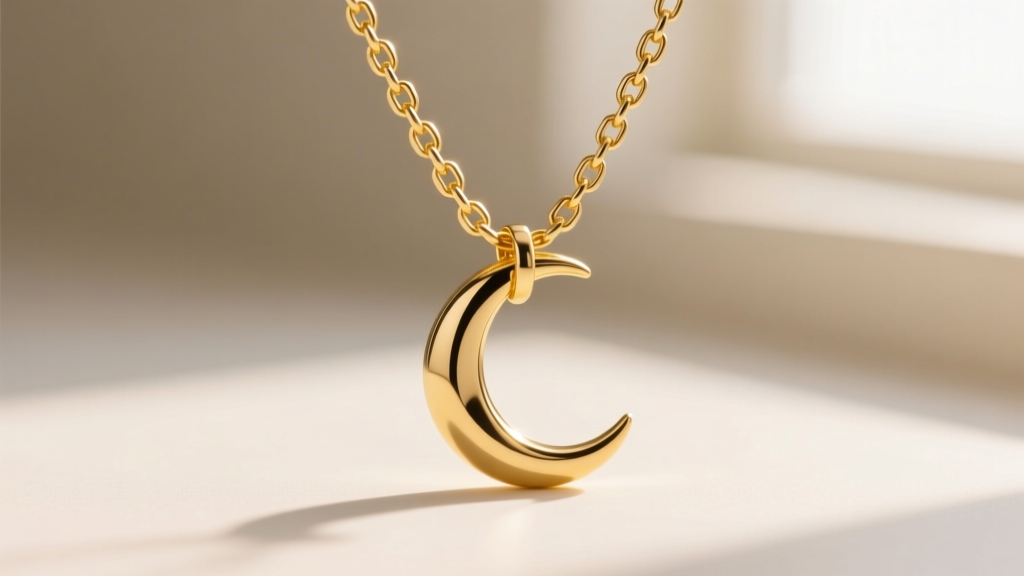
Step 2: Mastering Chain Mechanics and Bail Sizing
The structural integrity of your necklace relies on the relationship between the pendant's bail (the loop that connects the charm to the chain) and the chain itself. A common mistake is pairing a heavy celestial pendant with a micro-thin chain, leading to premature stretching or snapping.
- The Bail-to-Chain Ratio: A standard moon and star pendant features a bail measuring between 3mm and 5mm. Your chain should be no thicker than 60% of the bail's inner diameter to allow the pendant to slide freely and lay flat against the collarbone.
- Chain Types: For lightweight celestial pieces (under 3 grams), a 1.2mm box chain or 1.5mm cable chain offers excellent light reflection and flexibility. For heavier, gemstone-encrusted moon and star pieces, upgrade to a 2.0mm rope chain to distribute the weight evenly.
- Clasp Mechanics: Always inspect the clasp. A standard spring-ring clasp is sufficient for chains under 1.5mm. However, if your gold chain exceeds 2.0mm in thickness, you must upgrade to a lobster clasp to ensure the internal spring mechanism can handle the tension of daily wear.
Step 3: The 2-Inch Layering Rule
Layering is where a moon and star necklace gold piece truly shines. To avoid the dreaded "tangled mess" effect, professional stylists rely on the 2-inch rule. This framework ensures each piece occupies its own visual tier, preventing the pendants from overlapping and scratching one another.
Building the Celestial Stack
- The Base Layer (14" - 15"): Start with a simple gold choker or a delicate pearl strand. This frames the face and draws the eye upward. Avoid pendants on this layer.
- The Anchor Layer (16" - 17"): This is where your moon and star necklace gold piece lives. A princess-length chain allows the crescent moon to rest perfectly in the hollow of the collarbone. As noted in Vogue's definitive layering guide, the middle tier should always feature your most meaningful or visually complex pendant.
- The Extension Layer (20" - 22"): Finish with a longer matinee chain featuring a simple, minimalist element like a solitary gold bead, a tiny diamond solitaire, or a plain bar necklace. This elongates the torso and provides a visual resting place below the main celestial motif.
Pro-Tip: If your necklaces refuse to stay separated, invest in a specialized layering clasp. These findings feature multiple integrated loops spaced exactly two inches apart, guaranteeing your moon and star pendants never cross paths or tangle.
Step 4: Matching Pendants to Necklines
The geometry of your clothing should dictate how you position your celestial jewelry. A moon and star necklace gold design has distinct directional lines that can either harmonize with or clash against your outfit's architecture.
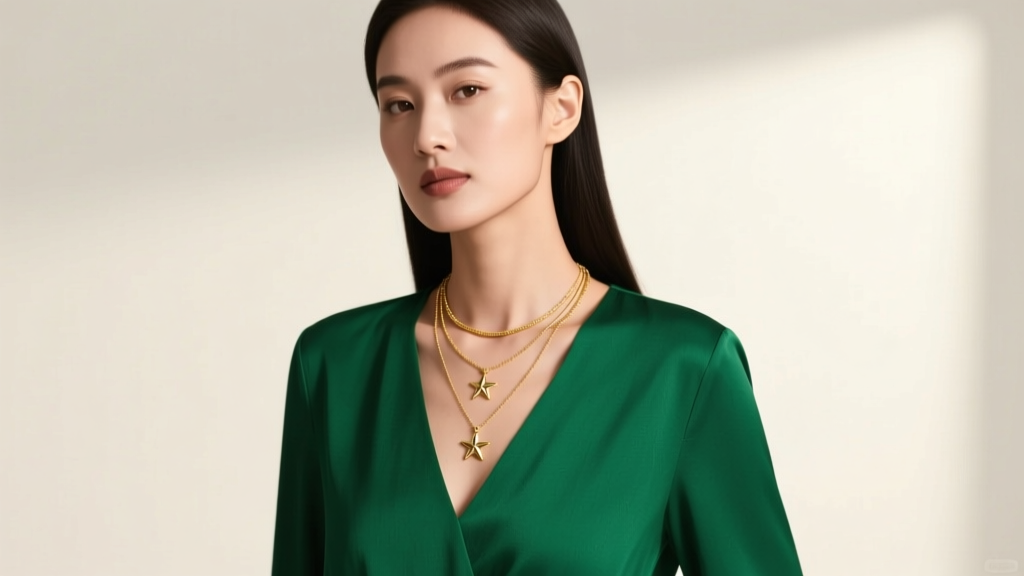
V-Necks and Deep Scoops
A V-neck blouse creates a natural downward arrow. To complement this, wear your star pendant on an 18-inch chain so the bottom point of the star parallels the V of the neckline. The moon pendant can be layered slightly higher at 16 inches to fill the negative space without competing with the garment's hem.
Crew Necks and Turtlenecks
High, tight necklines require a different strategy. Avoid 16-inch chains, as they will sit awkwardly against the fabric seam. Instead, bypass the collar entirely. Wear a tight 14-inch gold choker above the neckline, and let your moon and star necklace gold piece hang long on a 24-inch chain over the fabric. This creates a striking, bohemian silhouette that breaks up the solid block of color in your sweater or tee.
Off-the-Shoulder and Sweetheart Necklines
When the collarbone is fully exposed, you have a blank canvas. Utilize the full 3-tier layering framework described in Step 3. Ensure the metals match perfectly; mixing a warm 14k yellow gold moon pendant with a cool white gold star chain can look disjointed unless intentionally bridged by a two-tone accessory.
Step 5: Gemstone Accents and Material Care
Many premium moon and star necklace gold designs incorporate gemstones. If your moon features a cabochon moonstone, be aware that moonstone ranks only 6 to 6.5 on the Mohs hardness scale. It must be set in a bezel rather than prongs to protect the edges from chipping during daily activities. If your star features diamond accents, melee diamonds (under 0.05 carats) do not require high clarity grades; SI1-SI2 is perfectly sufficient as inclusions are invisible to the naked eye at that scale.
Maintenance Protocol
Gold and celestial crevices easily trap lotions, perfumes, and dead skin cells, dulling the metal's brilliance. Never use ultrasonic cleaners on necklaces featuring moonstone, opal, or turquoise accents, as the high-frequency vibrations can fracture the stones. Instead, create a lukewarm bath of distilled water and a few drops of mild, phosphate-free dish soap. Soak the necklace for 10 minutes, then gently agitate the crevices of the star and moon with a baby-soft toothbrush. Rinse thoroughly and pat dry with a microfiber cloth to prevent water spots.
By understanding the metallurgical properties of your gold, respecting the spatial rules of layering, and matching your pendants to your wardrobe's geometry, your moon and star necklace gold piece will evolve from a simple accessory into a masterclass in personal styling.


