Layered Charm Necklace Buying Guide: What to Look For
Discover what to look for in a layered charm necklace. Learn about chain weights, clasp types, tangling prevention, and metal grades in our expert guide.


The Anatomy of a Perfect Layered Charm Necklace
The art of stacking jewelry has evolved significantly. As we navigate the style landscape of 2026, the layered charm necklace has transitioned from a haphazard assortment of chains into a highly curated medium for personal storytelling. However, building a multi-strand setup that is both visually striking and mechanically durable requires a deep understanding of jewelry engineering. A poorly planned layered charm necklace will tangle within minutes, suffer from kinetic friction wear, and ultimately break. This comprehensive buying guide breaks down the exact specifications, material grades, and structural considerations you need to evaluate before investing in your next layered set.
Chain Selection: Weight, Gauge, and Link Styles
The foundation of any successful layered charm necklace lies in the chain gauge (thickness) and link architecture. Using chains that are too delicate for their designated charms will lead to snapped links, while overly thick chains will overwhelm the neckline.
The Gauge Hierarchy
- Top Layer (14-15 inches): Opt for a 0.9mm to 1.2mm gauge. This delicate thickness sits flush against the collarbone and is designed to hold lightweight charms (under 3 grams), such as tiny bezel-set diamonds or minimalist initials.
- Middle Layer (17-18 inches): A 1.5mm to 2.0mm gauge provides the necessary tensile strength for medium-weight pendants (3 to 8 grams), like coin medallions or zodiac signs.
- Bottom Layer (20-22 inches): Require a 2.5mm to 3.5mm gauge. This heavier chain anchors the ensemble and can support substantial statement pieces (10+ grams) without warping.
Preventing the 'Zipper Effect' with Link Diversity
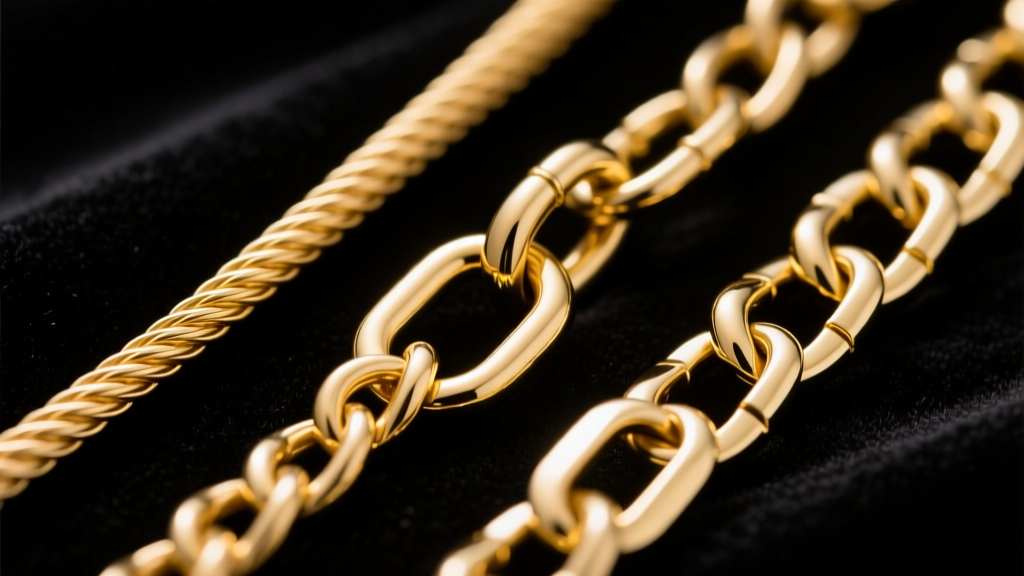
One of the most common mistakes buyers make is selecting the same link style for every layer. When identical chains (e.g., three standard cable chains) rub against each other, their uniform links interlock, creating a frustrating phenomenon known as the 'zipper effect.' To naturally deter tangling, you must mix link architectures. Pair a smooth cable chain on top, a rounded rolo chain in the middle, and a flat curb chain on the bottom. The differing surface geometries prevent the links from catching on one another.
Charm Proportions and Weight Distribution
When selecting charms for your layered charm necklace, the connection point—the bail—is just as critical as the pendant itself. The bail is the loop that allows the charm to slide onto the chain.
The Bail-to-Chain Ratio
For smooth articulation and to prevent localized stress fractures, the inner diameter of the charm's bail must be at least 0.5mm larger than the outer width of the chain. If you are using a 2.0mm rolo chain, ensure the bail opening is a minimum of 2.5mm. A tight fit creates constant friction every time the wearer moves, eventually wearing through the gold plating or weakening a solid gold link.
Kinetic Weight Limits
Heavy charms act as pendulums. If a 10-gram pendant is attached to a 1.2mm chain, the kinetic energy generated by walking or bending will slowly stretch the individual links directly above and below the bail. Always match the charm's gram weight to the chain's tensile rating. When in doubt, utilize a reinforced jump ring (soldered closed) to attach heavy pendants to the chain, rather than relying on a standard split ring.
The Tangling Factor: Spacing and Swivels
Even with mixed link styles, improper length differentials will guarantee a tangled mess. The golden rule of layering is the 2-inch minimum differential. Your top chain should be at least two inches shorter than the middle chain, and the middle at least two inches shorter than the bottom. For example, a 15-inch, 17-inch, and 19-inch combination allows each layer to rest in a distinct anatomical zone (collarbone, upper sternum, lower sternum).
For those who prefer a unified clasp mechanism, look for a layered charm necklace that utilizes a multi-strand separator clasp. These specialized findings feature a single magnetic or lobster-claw closure that branches out into multiple swivel rings. The integrated micro-swivels allow the chains to rotate independently, dissipating the torsional tension that causes knotting.

Metal Grades and Durability Matrix
Understanding metallurgy is essential when investing in layered sets, as the cost and longevity vary drastically. According to the Federal Trade Commission (FTC) Jewelry Guidelines, specific terminology must be met for gold-plated alternatives. Furthermore, the Gemological Institute of America (GIA) outlines the precise alloy compositions of solid karat gold. Below is a comparative matrix to guide your purchasing decision:
| Metal Type | Composition Standard | Estimated Lifespan | Average Price Range (USD) |
|---|---|---|---|
| Solid 14k Gold | 58.5% pure gold alloyed with copper/silver/zinc | Lifetime (Heirloom) | $400 - $1,500+ |
| Gold Vermeil | Minimum 2.5 microns of 10k+ gold over sterling silver | 2 - 5 years (Daily wear) | $90 - $300 |
| Gold-Filled | 1/20th 12k or 14k gold mechanically bonded to brass | 5 - 10 years | $70 - $200 |
| Sterling Silver | 92.5% pure silver, 7.5% copper alloy | Lifetime (Requires polishing) | $50 - $180 |
Expert Tip: If you are buying a layered charm necklace intended for daily, never-take-off wear, bypass vermeil and gold-filled options. The constant friction between layered chains will wear through micron-thin plating within months. Invest in solid 14k gold or high-quality sterling silver.
Clasp Mechanisms: Lobster vs. Spring Ring vs. Magnetic
The clasp is the most frequent point of failure in any necklace. When managing the combined weight of a three-strand layered charm necklace, standard 5mm spring rings are inadequate; their internal springs frequently fail under multi-chain tension.
- Lobster Clasps (10mm - 12mm): The industry standard for durability. The elongated shape provides a secure grip and a robust internal spring mechanism capable of handling the weight of three chains and multiple charms.
- Magnetic Clasps: Highly convenient for multi-strand setups, but ensure the magnets are encased in solid metal with a secondary safety catch. Neodymium magnets offer the strongest hold, but they can attract metallic dust and debris over time.
- Box Clasps with Safety Eight: Typically found on high-end, heavy layered sets. The tongue-and-groove mechanism provides a mechanical lock, supplemented by a figure-eight safety wire to prevent accidental drops.
Expert Maintenance and Storage Framework
To preserve the structural integrity and finish of your layered pieces, implement the following maintenance protocols:
- Storage: Never toss a layered set into a jewelry box. Hang the necklace on a multi-tiered velvet bust or lay it completely flat in a compartmentalized tray. Hanging utilizes gravity to keep the chains separated and tangle-free.
- Cleaning: Avoid ultrasonic cleaners if your charms feature porous gemstones (like opals, pearls, or turquoise) or if the chains are gold-plated. The high-frequency vibrations can shatter delicate stones and strip thin gold layers. Instead, use a soft-bristled baby toothbrush with a few drops of mild dish soap and warm water.
- Polishing: When polishing sterling silver layers, use a treated jeweler's cloth rather than liquid dips. Liquid dips can become trapped in the crevices of rolo or curb links, leading to accelerated tarnishing and chemical degradation.
"A truly exceptional layered charm necklace is not just about the aesthetic cascade of gold and gemstones; it is an exercise in structural harmony. When the gauge, link style, and clasp are perfectly calibrated to the weight of the charms, the piece moves with the wearer rather than against them." — Master Jeweler & Appraiser
By prioritizing mechanical compatibility and high-grade metallurgy over fleeting micro-trends, you will build a layered charm necklace collection that remains both visually captivating and physically resilient for decades to come.


