Authentic Lei Necklace Hawaii: Ni'ihau Shell Grading & Stringing
Discover the technical craftsmanship behind an authentic lei necklace Hawaii. Explore Ni'ihau shell grading, stringing methods, and valuation.

The Anatomy of an Authentic Hawaiian Lei Necklace
When collectors, gemologists, and cultural historians search for a permanent lei necklace Hawaii artisans produce, they are not looking for temporary floral arrangements. They are seeking high-end organic jewelry that requires thousands of hours of labor, precise gemological grading, and advanced structural engineering. While the traditional floral lei is a beautiful, ephemeral expression of aloha, the permanent lei necklace—crafted from rare shells, seeds, and bone—represents the pinnacle of Hawaiian lapidary and textile arts.
Unlike mass-produced bead necklaces, an authentic Hawaiian shell lei is a masterclass in micro-jewelry. The creation of a single 18-inch multi-strand piece can require the sorting, drilling, and stringing of over 10,000 individual micro-shells. This guide deconstructs the technical specifications, material grades, and stringing mechanics that separate museum-quality heirlooms from tourist-grade imitations.
Pupu Ni'ihau: The Gemological Standard
The most valuable and technically demanding material used in Hawaiian lei jewelry is the Pupu Ni'ihau (Ni'ihau shell). Despite the name, these shells are primarily gathered from the shores of Ni'ihau and the neighboring western coast of Kauai. The Bishop Museum notes that the unique oceanic currents and volcanic sand compositions in this region yield shells with unmatched luster and color saturation.
Gathering is highly seasonal. Winter swells churn the ocean floor, depositing microscopic shells onto the beaches. Artisans must sift through tons of sand and coral debris to find intact specimens. Because the shells are organic gemstones, they are subject to rigorous grading criteria based on size, color, surface blemishes, and luster.
Shell Taxonomy and Metric Sizing
There are three primary classifications of Ni'ihau shells used in fine jewelry. Understanding their metric dimensions and market scarcity is critical for appraisal and authentication.
| Shell Type | Avg Size (mm) | Color Profile | Rarity & Market Metric |
|---|---|---|---|
| Kahelelani | 1.5mm - 3.0mm | Golden, Hot Pink, Deep Brown | Highest rarity. Flawless strands command $15,000 - $40,000+. |
| Laiki | 3.0mm - 5.0mm | Porcelain White, Ivory | Moderate rarity. Prized for high-contrast multi-strand designs. |
| Kamoa | 5.0mm - 8.0mm | Orange, Yellow, Rust | Most abundant. Often used as accent shells or in single-strand chokers. |
The Kahelelani is the undisputed king of the lei world. Because they are so small, drilling them without shattering the calcium carbonate structure requires specialized micro-lathes and diamond-coated drill bits measuring less than 0.8mm in diameter.
Structural Engineering: Stringing and Knotting
The structural integrity of a lei necklace is paramount. A single strand of Kahelelani shells can weigh upwards of 40 grams, and multi-strand pieces can exceed 150 grams. Relying on standard jewelry thread is a recipe for catastrophic failure. Artisans employ specific textile engineering techniques to ensure the necklace survives decades of wear.
Thread Tensile Strength and Needle Gauges
Historically, artisans used hand-spun cotton or silk. Today, master stringers utilize advanced synthetic polymers that resist UV degradation and moisture stretching. The industry standard for high-end Ni'ihau lei is Nymo Size D (100% bonded nylon, 0.30mm diameter) or Fireline 6lb (gel-spun polyethylene). These threads offer a tensile strength exceeding 6 pounds, which is critical when supporting the cumulative weight of thousands of shells.
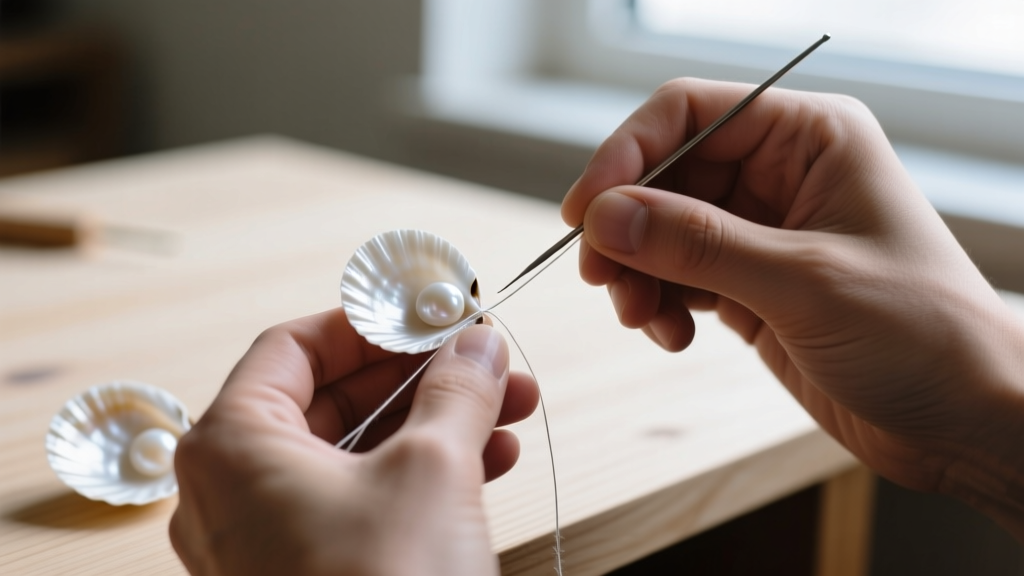
Threading these microscopic shells requires Japanese beading needles, typically Size #12 or #13. These needles have an ultra-fine shaft (0.46mm) and a collapsible eye that can pass through a 1.5mm Kahelelani shell without catching or cracking the inner nacre.
Traditional Knotting Matrices
According to the Ulukau Hawaiian Electronic Library, traditional stringing methods dictate the drape and flexibility of the final piece:
- Kui (Piercing): The shells are strung straight through the center. This creates a fluid, rope-like drape ideal for multi-strand chokers.
- Wili (Winding): Shells are wrapped diagonally with thread, creating a rigid, spiral-staircase effect. This requires immense tension control to prevent the thread from sawing through the shell's drill hole over time.
- Hilo (Twisting): Multiple strands of shells are twisted together, requiring a specialized jig to maintain uniform tension across all axes.
Seed, Bone, and Wood: Alternative Matrices
While shells dominate the luxury market, authentic lei necklaces also incorporate other organic matrices. Koa seeds and Job's Tears (Pua Kala) are carved, polished, and strung using heavier gauge leather or waxed linen cord. These pieces rely on the natural geometry of the seed for their aesthetic, often requiring no drilling if the natural hilum (the seed's attachment scar) can be pierced.
Bone carving, particularly fossilized whale bone (Iwi Koholā), is highly regulated. Modern artisans legally source fossilized bone or use ethically harvested bovine bone, carving interlocking pendants that serve as the centerpiece of a braided sennit (coconut fiber) or Olonā (native nettle fiber) cord. The cordage itself is a technical marvel, with Olonā being one of the strongest natural plant fibers in the world, boasting a tensile strength that historically rivaled early synthetic nylons.
Authentication and Market Valuation
The secondary market for Hawaiian shell jewelry is plagued by high-quality polymer resins and dyed glass imitations. Appraisers and buyers must utilize a strict authentication framework to verify provenance and material authenticity.
The Gemological Testing Protocol
The Gemological Institute of America (GIA) outlines several non-destructive tests for identifying organic gemstones versus synthetic simulants:
- Thermal Conductivity: Genuine calcium carbonate shells feel distinctly cool to the touch and take longer to warm against the skin compared to plastic resins, which are thermal insulators.
- UV Fluorescence: Under long-wave (365nm) ultraviolet light, authentic Ni'ihau shells exhibit a subtle, chalky blue-white fluorescence due to their organic protein matrix. Dyed plastics often show no reaction or an unnatural, overly bright glow.
- Drill Hole Magnification: Using a 10x loupe, examine the drill hole. Genuine shells will show microscopic chipping and a distinct layered nacre structure. Molded glass or plastic will have perfectly smooth, melted-looking edges around the hole.
- The Clasp Hardware: A true masterwork lei will never be finished with a base-metal lobster clasp. Authentic pieces utilize custom-machined 14k or 18k gold hidden bayonet clasps or threaded screw-barrels, often stamped with the artisan's unique hallmark.
Archival Care and Preservation Protocols
Organic jewelry is highly susceptible to environmental degradation. The acids in human sweat, combined with aerosolized cosmetics and perfumes, can etch the surface of the shells, destroying their natural luster and causing the calcium carbonate to chalk.
Maintenance Rules:
- Never use ultrasonic cleaners. The high-frequency cavitation will shatter the micro-shells and fray the nylon stringing material.
- Post-Wear Cleaning: Gently wipe the necklace with a lint-free microfiber cloth lightly dampened with distilled water to remove skin oils. Allow it to air dry completely flat before storage.
- Storage Environment: Store the lei in an archival-quality, acid-free tissue pouch inside a climate-controlled safe. Maintain a relative humidity of 45-55%. Extreme dryness will cause the shells to become brittle, while high humidity will promote mold growth on the organic thread.
- Restringing Schedule: Even with advanced synthetic threads, the friction of the shell edges will eventually compromise the fibers. A professional restringing by a certified Hawaiian lei artisan is recommended every 7 to 10 years, depending on wear frequency.
By understanding the meticulous grading, structural engineering, and preservation requirements of these pieces, collectors can properly appreciate and protect the profound cultural and gemological heritage embedded in every authentic Hawaiian lei necklace.


