How a Pro Stylist Stacks Necklaces: 2026 Material Guide
Discover the metallurgical secrets behind layered jewelry. Learn how a pro stylist stacks necklaces using Mohs hardness, gauges, and tensile data.

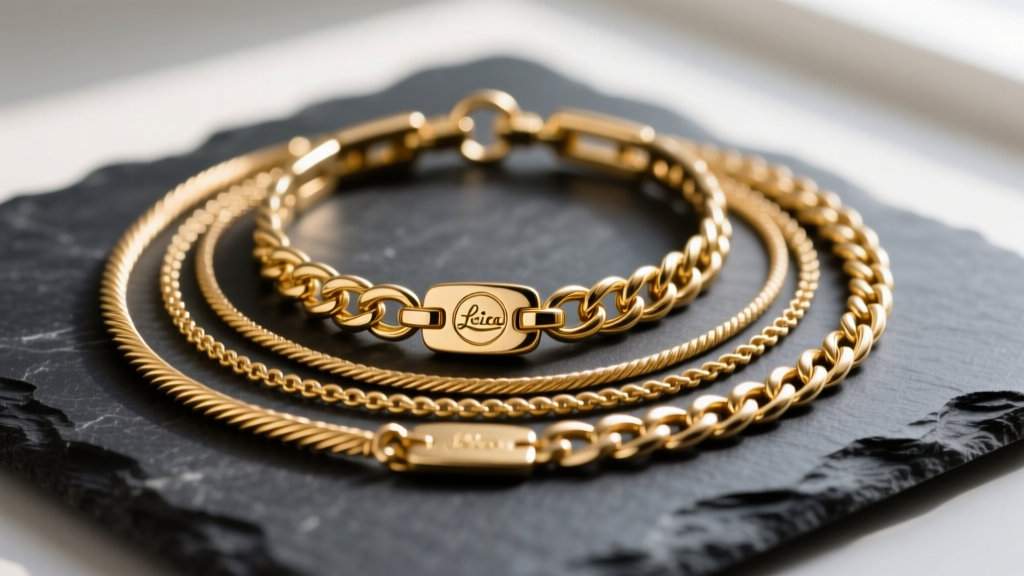
The Physics of Friction: Mohs Hardness in Layering
Layering jewelry is an art form that transcends mere aesthetics; it is an exercise in applied metallurgy. Anyone can throw three chains together, but when a professional stylist stacks necklaces, they are engineering a micro-environment of friction, weight distribution, and galvanic compatibility. In 2026, the trend has decisively shifted away from haphazard, tangled layering toward engineered curation. Understanding the physical properties of your metals is the difference between a curated stack that lasts a lifetime and one that destroys itself through microscopic abrasion.
The most critical metric for layering is the Mohs scale of mineral hardness, which applies to metals just as it does to gemstones. When two chains of different hardness levels rest against each other—particularly at the nape of the neck where movement is constant—the harder metal acts as an abrasive file against the softer one. According to data from the Gemological Institute of America (GIA), pure 24k gold sits at a mere 2.5 on the Mohs scale, while 14k gold alloyed with copper and zinc reaches approximately 3.5 to 4. Platinum, a popular choice for durable everyday stacks, sits between 4 and 4.5.
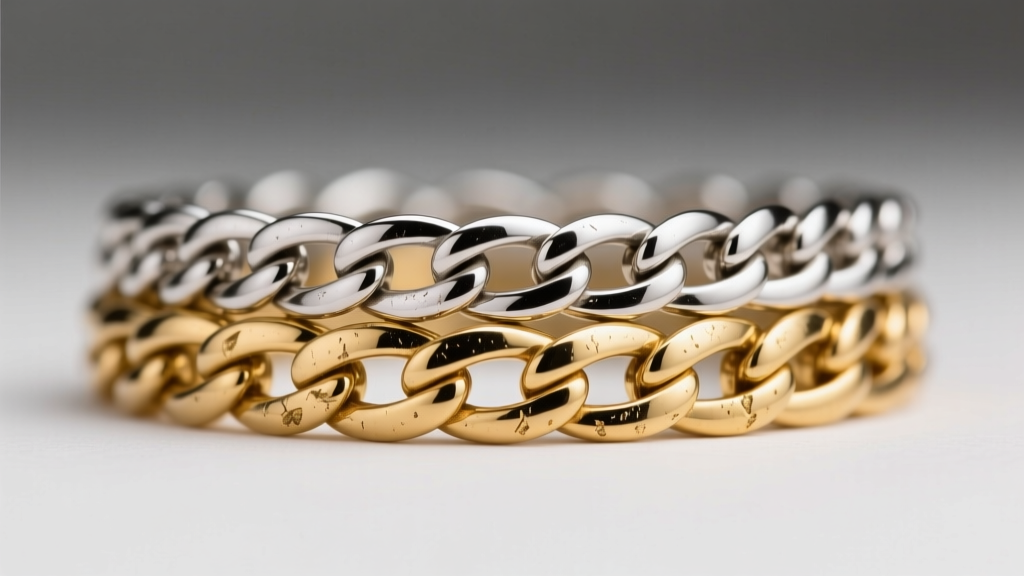
If you layer a 14k white gold cable chain (Mohs ~4) directly against an 18k yellow gold herringbone chain (Mohs ~2.5 to 3), the white gold will systematically sand away the surface of the herringbone. Over a period of six to twelve months of daily wear, this friction will result in a measurable loss of gold weight, thinning the links and eventually causing catastrophic structural failure. Professional stylists mitigate this by keeping the Mohs variance between stacked chains under 1.0, or by utilizing physical spacers like gemstone pendants to prevent direct metal-on-metal contact.
Material Compatibility Matrix for Everyday Stacks
To build a resilient stack, you must understand how different alloys interact under the stress of daily movement. The following matrix outlines the safety of layering specific metal grades directly against one another without intermediate spacers.
| Metal A (Base Chain) | Metal B (Layered Chain) | Mohs Variance | Stacking Verdict | Failure Mode Risk |
|---|---|---|---|---|
| 14k Yellow Gold | 14k Rose Gold | ~0.0 | Highly Safe | None; uniform wear |
| Platinum 950 | 18k Yellow Gold | ~1.5 | Avoid Direct Contact | Abrasive thinning of 18k gold |
| Sterling Silver 925 | Gold Vermeil | ~0.5 | Moderate Risk | Friction strips vermeil plating |
| Grade 5 Titanium | Any Gold/Silver Alloy | >2.0 | Never Stack | Severe laceration of softer metals |
| Argentium 960 | Sterling Silver 925 | ~0.0 | Highly Safe | None; Argentium resists tarnish |
Tensile Strength, Gauges, and Break Points
Beyond surface hardness, the tensile strength and gauge (thickness) of the chain dictate how much weight a stack can bear. When building a multi-tiered stack, the bottom layer (usually 20 to 24 inches) bears the brunt of the kinetic swing. If this foundational chain is too delicate, the added weight of the upper layers will cause the jump rings to pull apart.
According to Rio Grande's metallurgy guides, the yield strength of standard sterling silver is significantly lower than that of work-hardened 14k gold or heat-treated Argentium silver. A standard 0.8mm sterling silver cable chain has a break point of roughly 4 to 5 pounds of force. While that sounds like plenty for a necklace, the sudden kinetic shock of bending over or catching the chain on a garment can generate momentary force spikes that exceed this threshold.
For a structurally sound stack, adhere to these gauge minimums based on material:
- Sterling Silver (925): Minimum 1.2mm gauge for the base layer; 0.9mm for upper layers. Standard silver suffers from fatigue cracking at the solder points of the jump rings.
- Argentium Silver (960): Can safely be worn at 1.0mm for the base layer due to its superior elasticity and work-hardening properties.
- 14k Solid Gold: Minimum 0.9mm gauge for the base layer. The copper and zinc alloys provide excellent tensile memory, allowing the metal to stretch slightly and return to shape rather than snapping.
- Platinum 950: Can be worn as thin as 0.7mm for upper layers. Platinum's unique property of 'gall and tear' means it displaces rather than chips, making it incredibly forgiving for micro-gauges.
Furthermore, clasp selection is vital. Spring ring clasps are notorious for failing in stacked configurations due to the uneven tension distribution caused by multiple chains pulling on the neckline. Always upgrade the base layer of your stack to a lobster clasp or a magnetic neodymium clasp with a tensile rating exceeding 15 pounds.
Environmental Degradation and Tarnish Transfer
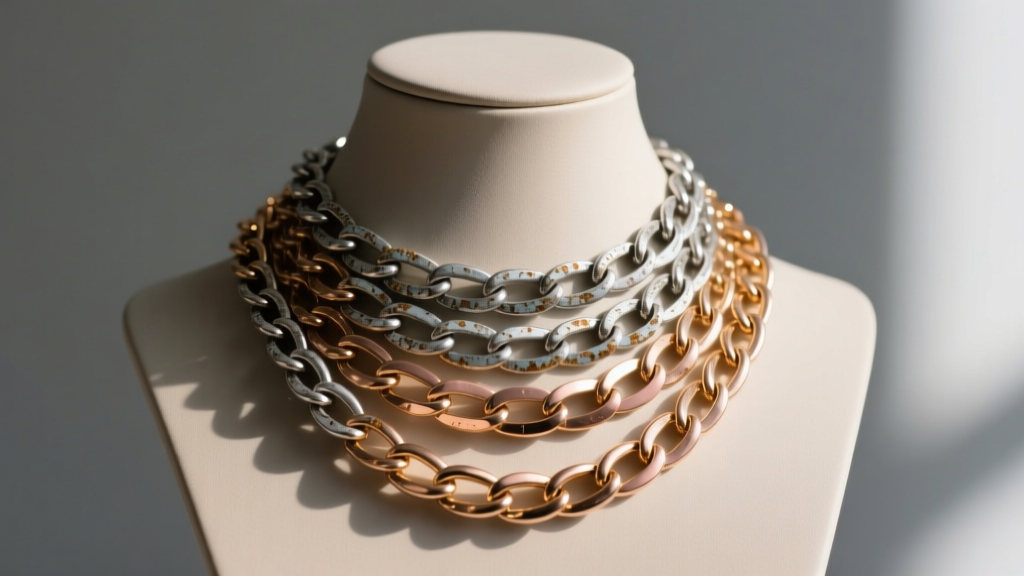
A frequently overlooked aspect of material compatibility is galvanic corrosion and tarnish transfer. When you stack necklaces, you are creating a closed loop against human skin, which acts as an electrolyte due to its natural moisture, salts, and varying pH levels. If you mix metals with vastly different copper contents, you can accelerate the oxidation process of the more reactive alloy.
For example, rose gold achieves its pink hue through a high copper content (often up to 20% in 14k alloys). Sterling silver is highly susceptible to sulfur and copper-induced oxidation. When a 14k rose gold chain is layered tightly against a sterling silver chain, the microscopic transfer of copper ions, facilitated by sweat, can cause the silver to develop a dark, uneven patina at the exact points of contact. This is not a defect in the silver, but a predictable chemical reaction.
To combat this in 2026, master jewelers recommend utilizing Argentium silver for mixed-metal stacks. Argentium replaces a portion of the copper alloy with germanium, which forms a transparent, self-healing layer of germanium dioxide on the surface. This virtually eliminates tarnish and prevents the galvanic transfer that plagues traditional sterling and rose gold combinations. While Argentium carries a 15% to 20% price premium over standard sterling (typically pricing a 1.2mm 18-inch cable chain between $85 and $130, compared to $60 for standard silver), the reduction in maintenance and polishing makes it the superior choice for permanent stacks.
The 2026 Engineer's Framework for Building a Stack
To synthesize these metallurgical principles into a wearable, durable reality, follow this three-step framework for engineering your next necklace stack:
- Establish the Anchor (20-24 inches): Select a chain with high tensile strength and a Mohs hardness of at least 3.5. A 1.2mm 14k yellow gold rope chain or a 1.0mm Argentium silver box chain provides the necessary kinetic stability. Equip it with a reinforced lobster clasp. Estimated Investment: $180 - $350.
- Introduce the Variable (18 inches): This is your focal point, often featuring a pendant. Ensure the chain material matches the Mohs hardness of your anchor chain to prevent abrasive wear. If using a gemstone pendant, verify that the bail (the loop connecting the stone to the chain) is lined with a compatible metal or a protective resin insert to prevent the stone's hardness (e.g., a diamond at Mohs 10) from grinding through the chain links.
- Apply the Choker Tier (14-16 inches): Because this chain sits higher on the neck and experiences less pendulum-like swing, you can utilize softer, more delicate metals or lower gauges (0.7mm to 0.9mm). This is the ideal placement for 18k gold or platinum herringbone chains, provided they are not resting directly on top of a harder, textured chain below.
By treating your jewelry wardrobe as an exercise in material science rather than just visual styling, you ensure that your curated stacks remain pristine, structurally sound, and visually striking for decades. The secret to a flawless stack isn't just in the lengths you choose, but in the microscopic compatibility of the metals you wear.


