Lola Necklace Deep Dive: Link Anatomy, Wire Gauges & Clasp Mechanics
Explore the technical anatomy of the Lola necklace. We analyze link geometry, wire gauges, metallurgy, and clasp mechanics for bench jewelers.

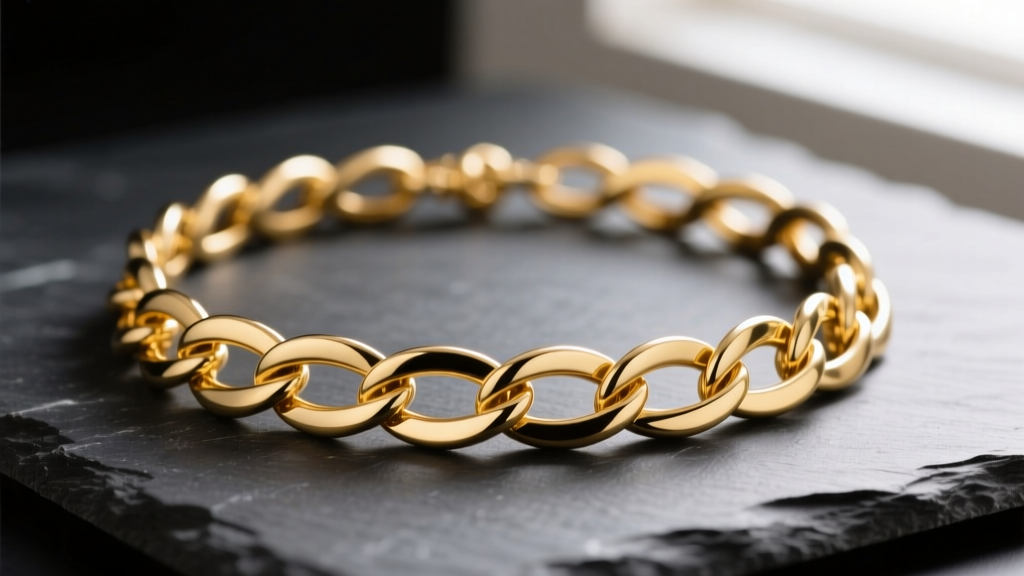
The Engineering Behind the Lola Necklace
The Lola necklace has transcended its origins as a boutique trend to become a staple in fine jewelry, prized for its exceptional light refraction and fluid drape. However, beneath its elegant exterior lies a complex feat of bench jewelry engineering. Unlike standard cable or curb chains, the Lola chain relies on a precise sequence of twisted, elongated oval links that interlock without the need for excessive soldering. For jewelers, metallurgists, and serious collectors, understanding the technical anatomy of a Lola necklace is crucial for evaluating quality, predicting wear patterns, and executing flawless repairs. This deep dive explores the exact geometry, wire gauge specifications, and mechanical failure points that define a master-crafted Lola link chain.
Link Geometry and Aspect Ratios
The defining characteristic of the Lola necklace is its twisted oval link. To achieve the signature "figure-eight" light catch, the wire must be coiled around a mandrel to create an elongated oval before being individually twisted. The critical metric here is the Aspect Ratio (AR)—the relationship between the inner diameter of the link and the thickness of the wire. For a high-quality Lola chain, the pre-twist AR typically sits between 3.8:1 and 4.2:1. If the AR is too low, the links bind and the chain loses its fluid drape; if it is too high, the chain becomes structurally fragile and prone to snagging.
The twist itself is rarely a full 360-degree rotation. Master chain-makers employ a precise 180-degree twist along the longitudinal axis of the oval. This specific half-twist maximizes the surface area exposed to ambient light while maintaining a flat profile against the clavicle. The transition zones—where the straight sides of the oval meet the curved apices—must be filed or tumbled to remove micro-burrs created during the mandrel coiling process. Failure to deburr these transition zones results in premature wear on adjacent links and microscopic metal dust accumulation that dulls the chain over time.
Metallurgy and Wire Gauge Specifications
The choice of alloy and wire gauge directly dictates the tensile strength and work-hardening behavior of the Lola necklace. Because the 180-degree twist introduces significant torsional stress into the metal lattice, the wire must possess adequate yield strength to prevent unwinding under load. Below is a technical comparison of standard materials used in premium Lola chains.
| Material Alloy | Standard Wire Gauge | Vickers Hardness (HV) | Yield Strength (MPa) | Annealing Temp (°C) |
|---|---|---|---|---|
| 925 Sterling Silver | 1.20mm (16 AWG) | 60 - 140 (Work Hardened) | 120 - 300 | 593°C (1100°F) |
| 14k Yellow Gold | 1.00mm (18 AWG) | 110 - 160 | 250 - 450 | 650°C (1200°F) |
| 18k Rose Gold | 1.10mm (17 AWG) | 130 - 180 | 350 - 500 | 600°C (1112°F) |
| Platinum 950/Ru | 0.90mm (19 AWG) | 120 - 150 | 400 - 600 | 900°C (1650°F) |
As noted by the Gemological Institute of America (GIA), the copper content in 14k and 18k rose gold alloys significantly increases work hardening during the twisting phase. Bench jewelers fabricating custom Lola necklaces in rose gold must perform intermediate annealing cycles to prevent the wire from snapping at the twist apex. Sterling silver, while more forgiving during the initial coiling, is highly susceptible to torsional fatigue if the twist is applied too rapidly without proper lubrication on the mandrel.
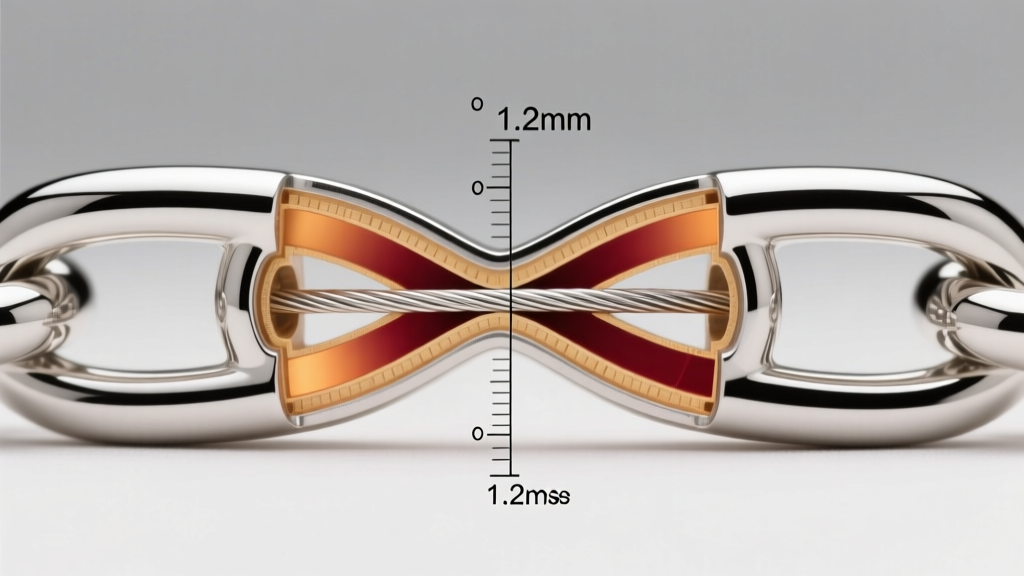
Soldered vs. Unsoldered Links: Failure Mode Analysis
A persistent debate in chain manufacturing is whether Lola links should be soldered. Due to the 180-degree twist, the seam of the link is often rotated away from the primary stress vectors, leading some mass manufacturers to leave Lola chains unsoldered to reduce production costs. However, from a structural engineering perspective, unsoldered Lola links present a critical failure mode.
When subjected to sudden tensile shock—such as the chain catching on a garment—the unsoldered seam acts as a hinge. The torsional energy stored in the twist forces the seam open, resulting in a localized uncoiling that is nearly impossible to repair without visible scarring. High-end Lola necklaces utilize laser welding to close the seams. Laser welding is preferred over traditional torch soldering because the focused beam can penetrate the seam without melting the adjacent twisted ridges, preserving the sharp, light-catching edges of the link. According to technical guidelines from Rio Grande, laser welding 14k gold Lola links requires a pulse duration of 2.5 to 3.0 milliseconds to ensure adequate penetration without blowing through the 1.0mm wire cross-section.
Clasp Integration and Catch Mechanics
The drape of a Lola necklace is inherently front-heavy due to the density of the interlocking twisted ovals. This weight distribution renders standard 5mm spring ring clasps entirely inadequate, both mechanically and aesthetically. A spring ring lacks the internal spring tension to securely hold the flattened jump rings required for Lola end caps, frequently leading to accidental unclasping.
- Recommended Clasp: 7mm to 9mm Teardrop Lobster Clasp. The teardrop geometry mirrors the elongated oval of the Lola link, providing visual continuity.
- Jump Ring Sizing: The end link of a Lola chain must be slightly compressed or paired with a custom 3mm x 5mm oval jump ring to interface cleanly with the lobster clasp without binding.
- Counterweighting: For Lola chains exceeding 20 inches in length, a 2mm to 3mm gold bead or custom drop tag should be added to the clasp end to act as a counterweight, ensuring the clasp remains at the nape of the neck rather than migrating to the front of the collarbone.
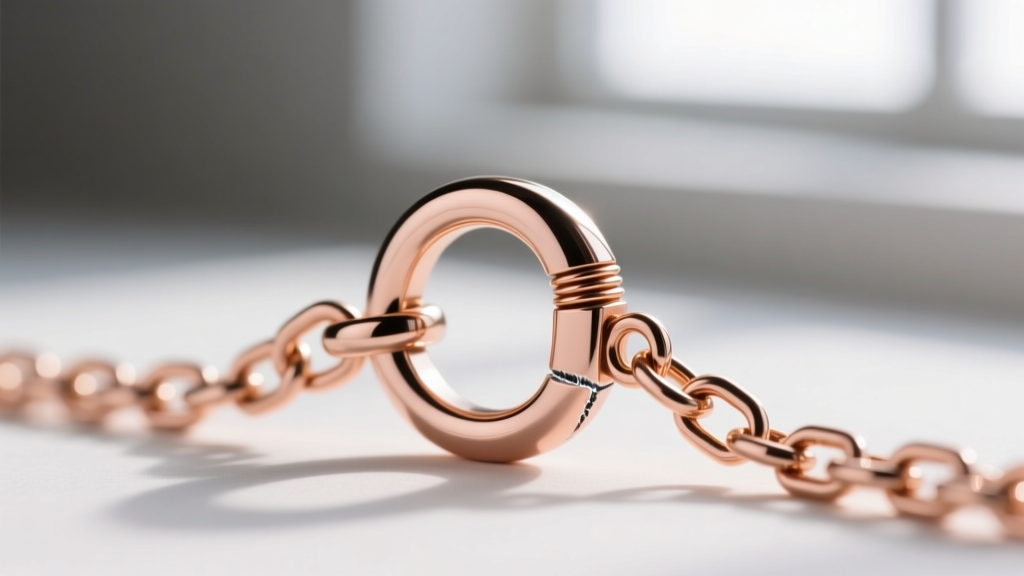
Tensile Load and Everyday Wear Tolerances
Testing the tensile load of a 16-inch, 14k yellow gold Lola necklace with 1.0mm wire reveals a yield point at approximately 14.5 pounds (6.5 kg) of continuous static force. However, dynamic shock loads—such as a sudden tug—can cause link deformation at forces as low as 5 pounds. The most vulnerable point is not the seam, but the inner curvature of the oval where it interfaces with the adjacent link. Over years of wear, friction at these contact points can reduce the wire thickness by up to 15%, necessitating periodic ultrasonic inspection by a bench jeweler to measure wire degradation before catastrophic failure occurs.
Advanced Polishing Techniques for Twisted Links
Polishing a Lola necklace requires extreme care to avoid rounding the sharp ridges created by the 180-degree twist. Traditional rotary tumbling with abrasive walnut shells or ceramic media will inevitably soften the geometric edges, reducing the chain's brilliance and altering its light-refraction profile.
"For twisted link chains like the Lola, magnetic pin tumbling is the only acceptable mass-finishing technique. Using 0.6mm stainless steel pins in a mild alkaline solution for exactly 45 minutes burnishes the microscopic pores of the gold or silver without removing base metal or rounding the twist apexes." — Master Bench Jeweler Protocol
For hand-finishing, jewelers should utilize soft-bristled brass brushes loaded with rouge compound, working strictly along the longitudinal axis of the twist. Cross-grain polishing will result in visible striations that catch the light improperly, destroying the optical illusion of continuous fluid metal that makes the Lola necklace so highly coveted in contemporary fine jewelry design.


