Love You Necklace Deep Dive: Projection Optics and Metal Durability
Explore the technical engineering of a love you necklace, from projection lens optics and micro-engraving to metal alloy durability and chain clasps.

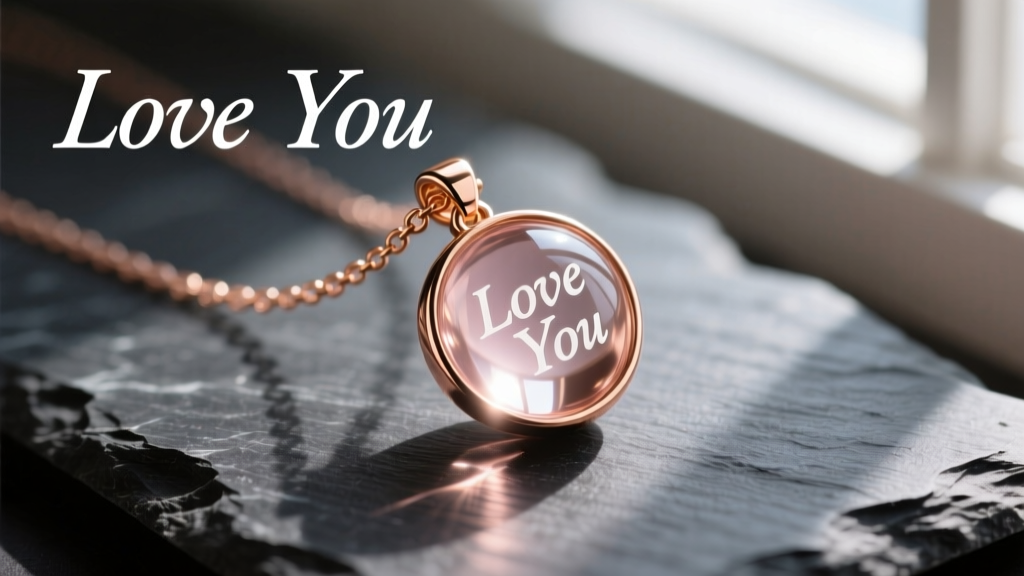
The Anatomy of a Projection Love You Necklace
The modern love you necklace has evolved far beyond simple engraved charms. Today's market is dominated by projection pendants—intricate pieces of wearable micro-engineering that conceal a message (often "I love you" in 100 languages) within a central bead. While they are incredibly popular as romantic gifts, the vast majority of consumers are entirely unaware of the optical physics and metallurgical realities that dictate whether these necklaces will last a lifetime or degrade in a matter of months.
As jewelry manufacturing techniques have advanced, the gap between high-end optical jewelry and mass-produced drop-shipped trinkets has widened. To truly understand the value and longevity of a love you necklace, we must deconstruct its three core components: the projection bead, the metal casing, and the structural chain mechanics.
Optical Engineering: Glass vs. Resin Beads
The heart of a projection love you necklace is the convex micro-lens. In premium pieces, this is an optical glass bead, typically 8mm to 10mm in diameter, with a precisely calculated focal length of roughly 15mm. The text is nano-laser-etched onto the flat posterior surface of the bead. When a light source (like a smartphone flashlight) hits the convex anterior, the refractive index of the glass (typically 1.52) magnifies and projects the etching onto a flat surface.
However, to cut costs, many manufacturers substitute optical glass with epoxy resin. This creates several critical failure modes:
- Refractive Degradation: Resin has a lower refractive index (~1.49), resulting in a blurry, distorted projection with heavy chromatic aberration at the edges.
- UV Yellowing: Epoxy resins are highly susceptible to ultraviolet degradation. Prolonged sun exposure causes the bead to yellow, permanently obscuring the internal micro-carving.
- Scratch Vulnerability: Optical glass sits at a 5.5 on the Mohs hardness scale, resisting daily micro-abrasions from dust and clothing. Resin sits at a mere 2.5, meaning it will accumulate micro-scratches within weeks, scattering light and ruining the projection effect.

Metallurgical Breakdown: Casing and Plating Standards
The metal casing that cradles the projection bead is where the most egregious marketing deception occurs. A love you necklace advertised as "18k Gold" is rarely solid gold; it is almost always a base metal with a microscopic gold plating. Understanding plating thickness—measured in microns (µm)—is essential for evaluating durability.
According to the World Jewelry Confederation (CIBJO), true gold vermeil must feature a sterling silver (925) base with a minimum of 2.5 microns of gold plating. Most budget projection necklaces utilize brass or zinc alloy bases with "flash plating" (0.1 to 0.5 microns). Human skin has an average pH of 4.5 to 5.5, and the natural acidity, combined with friction, will strip flash plating in 60 to 90 days, exposing the base metal and often causing contact dermatitis.
Material Grade Comparison Chart
| Metal Composition | Plating Thickness | Expected Daily Wear Lifespan | Tarnish & Corrosion Resistance |
|---|---|---|---|
| Brass Base / Flash Gold | 0.1µm - 0.5µm | 2 - 4 Months | Poor (High allergy risk) |
| Sterling Silver / Gold Vermeil | 2.5µm+ | 2 - 5 Years | Excellent (Hypoallergenic) |
| Surgical Stainless Steel (PVD) | N/A (Solid Color) | Lifetime | Superior (Tarnish-free) |
| Solid 14k / 18k Gold | N/A (Solid Alloy) | Generational | Superior |
Structural Integrity: Bails, Jump Rings, and Chains
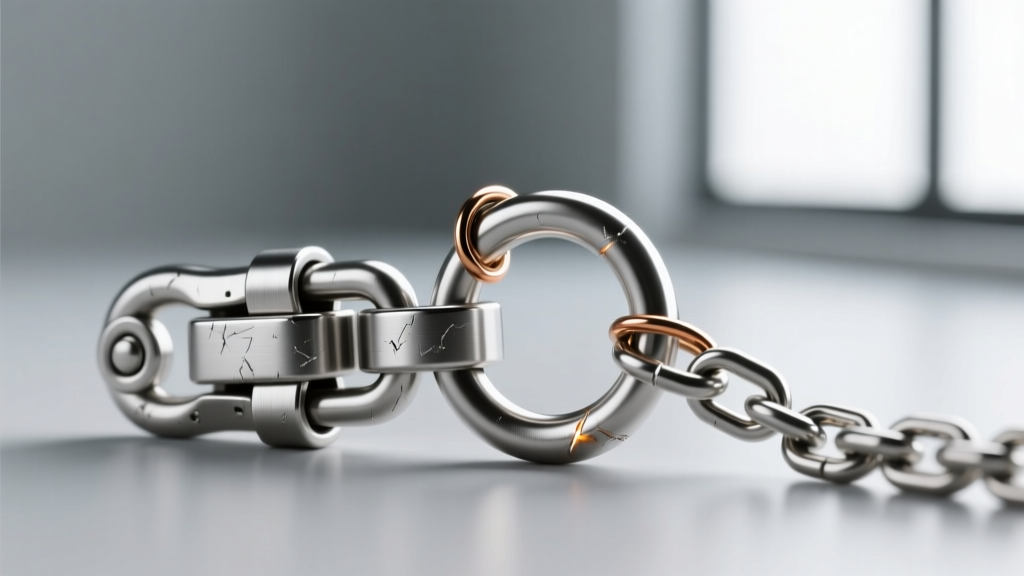
A common failure point in sentimental jewelry is the mechanical connection between the pendant and the chain. The "bail" is the loop at the top of the pendant. In cheap love you necklaces, the bail is attached to the casing via an unsoldered jump ring. Over time, the friction of the chain moving back and forth acts like a saw, slowly prying the jump ring open until the pendant slips off and is lost forever.
An expertly crafted pendant will feature a laser-welded or traditionally soldered bail, ensuring the metal loop is a continuous, unbroken circle. When inspecting a piece, always look for the tiny seam on the jump ring; if you can see a gap, or if the wire ends merely touch without being fused, the structural integrity is compromised.
Chain Gauge and Tensile Strength Data
The chain itself must be matched to the weight of the projection pendant, which is notoriously front-heavy due to the dense glass bead. Jewelry manufacturing suppliers categorize chain durability by tensile breaking points:
- 0.8mm Cable Chain: Breaking point of ~1.5 kg. Too delicate for heavy glass projection pendants; prone to kinking and snapping under sudden tension.
- 1.2mm Box Chain: Breaking point of ~4.0 kg. The geometric interlocking links distribute weight evenly, making it the ideal technical choice for projection pendants.
- 1.5mm Rope Chain: Breaking point of ~6.5 kg. Highly durable, but the twisted links can catch on the bail and cause micro-abrasions to the metal over time.
Authentication and Quality Verification
How can you verify the quality of a love you necklace before or immediately after purchase? First, perform the "pin test" on the bead. Gently tap the surface with a metal pin; optical glass will produce a high-pitched, sharp 'clink' and remain unmarred, while resin will emit a dull 'thud' and may show a micro-indentation. Second, examine the projection in a dark room using your phone's flashlight. A high-quality nano-carved glass bead will project crisp, sharply defined text with minimal light bleed. If the edges of the letters are fuzzy or exhibit rainbow-like halos, the manufacturer has used a poorly molded resin lens with an incorrect focal curve.
Expert Maintenance Protocols
Maintaining a projection necklace requires specific protocols to protect both the optical elements and the metallurgy. Never use ultrasonic cleaners on a love you necklace. The high-frequency acoustic cavitation can fracture the internal glass bead or shake loose the adhesive bonding the bead to the metal casing.
Expert Cleaning Tip: To clean the projection bead, use a microfiber cloth dampened with a 50/50 mix of distilled water and isopropyl alcohol. Wipe in a single, circular motion. Avoid commercial silver dips, as the harsh thiourea chemicals can seep into the bezel setting and permanently cloud the flat posterior side of the lens, destroying the projection capability.
By understanding the optical physics, metallurgical standards, and mechanical stress points of a love you necklace, you can transition from a passive consumer to an informed collector, ensuring that the sentimental message hidden within the pendant survives the test of time.


