Anatomy of a Fine Lunar Necklace: Meteorite & Moonstone Guide
Explore the gemological and metallurgical details of a fine lunar necklace. Learn about meteorite inlays, moonstone grades, and chain mechanics.

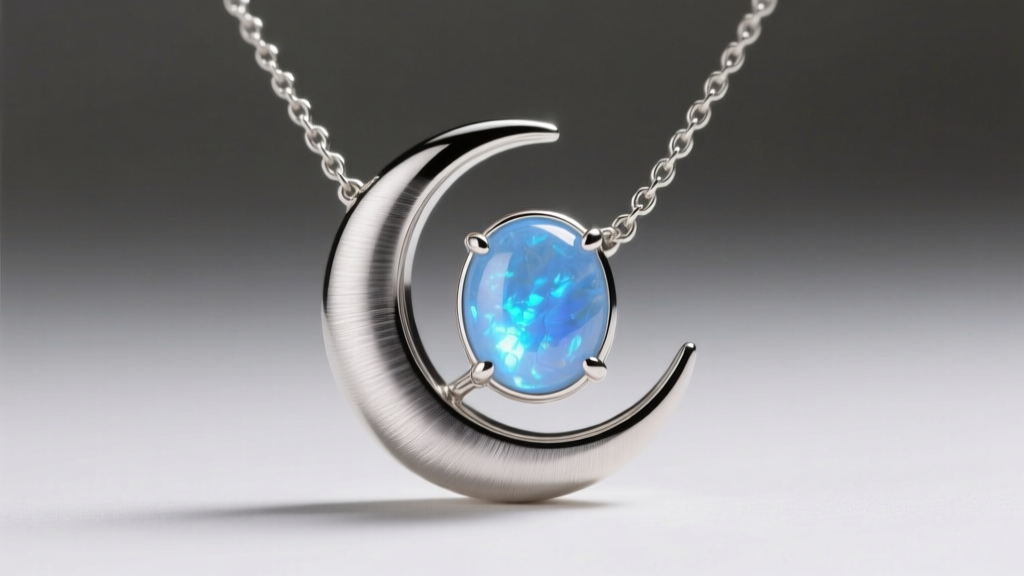
When evaluating a luxury lunar necklace, the untrained eye typically focuses solely on the celestial silhouette or the romantic symbolism of the moon phase. However, as a gemological and metallurgical artifact, the true value of a high-caliber lunar necklace lies in its structural integrity, material provenance, and optical phenomena. Whether the design features the ethereal adularescence of rainbow moonstone or the ancient geometric precision of a Gibeon meteorite inlay, separating fine jewelry from mass-produced costume pieces requires rigorous technical scrutiny.
In this expert deep dive, we deconstruct the anatomy of premium lunar necklaces, examining the gemological properties, setting mechanics, and chain engineering required to create a piece that is both astronomically inspired and horologically sound.
The Gemological Core: Moonstone Adularescence vs. Meteorite Inlays
The focal point of any lunar necklace is its center stone or inlay. The two most prominent materials used in high-end celestial jewelry are moonstone and meteorite, each presenting unique gemological challenges and optical rewards.
Rainbow Moonstone: The Physics of Adularescence
Moonstone is a variety of the feldspar-group mineral orthoclase. The coveted blue sheen, known as adularescence, is not a surface reflection but a subsurface optical phenomenon. It occurs when light scatters between alternating nanometer-thick layers of orthoclase and albite within the crystal lattice. According to the Gemological Institute of America (GIA), the thickness of these layers dictates the color of the schiller; layers approximately 200 nanometers thick produce the most prized blue flash, while thicker layers yield a silvery or white sheen.
When sourcing a lunar necklace featuring moonstone, demand AAA-grade cabochons. These should exhibit a centered, unbroken blue flash that rolls smoothly across the dome of the stone when tilted under a single light source. Beware of 'opalite'—a synthetic glass imitation that lacks the internal layering and exhibits a uniform, static glow rather than dynamic adularescence.
Meteorite: Widmanstätten Patterns and Cosmic Provenance
For a more literal interpretation of a lunar necklace, jewelers utilize iron-nickel meteorites, predominantly Gibeon (found in Namibia) or Muonionalusta (found in Scandinavia). These are classified as octahedrites, containing roughly 90% iron and 8% nickel, along with trace elements like cobalt and phosphorus.
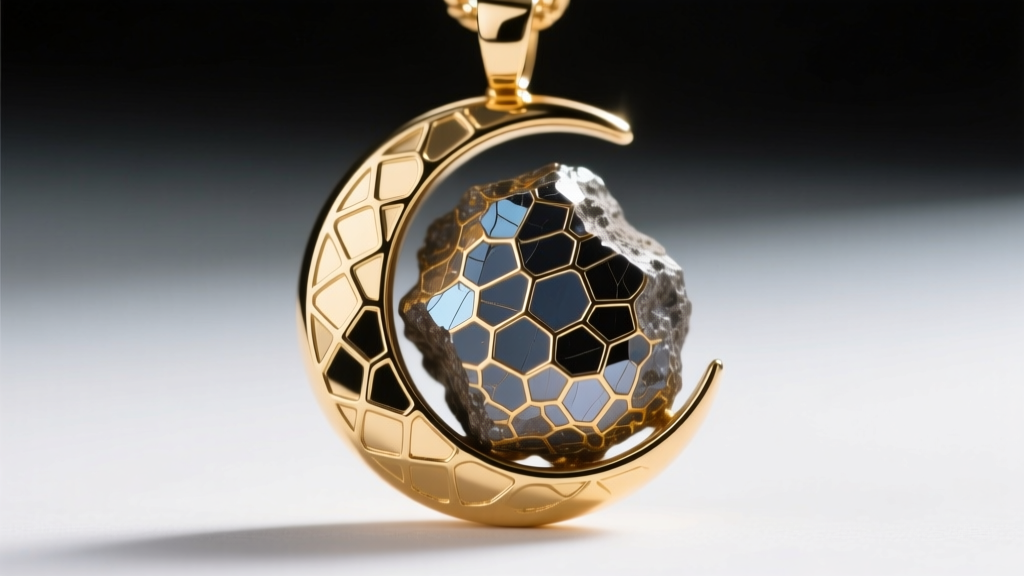
The defining characteristic of a genuine meteorite inlay is the Widmanstätten pattern. This intricate, intersecting geometric lattice is formed by the extremely slow cooling of the meteorite's parent body in the vacuum of space over millions of years. The pattern is revealed on Earth through careful polishing and etching with nitric acid. Because the crystalline structure requires millions of years to form, it is physically impossible to forge or replicate in a terrestrial laboratory, making meteorite a highly secure investment for luxury jewelry.
Metallurgical Framework: Setting the Lunar Motif
The setting of a lunar necklace must account for the specific vulnerabilities of both moonstone and meteorite. The Mohs hardness scale and thermal expansion coefficients dictate the engineering of the bezel or prong work.
Bezel vs. Prong Settings for Cabochons
Moonstone ranks between 6 and 6.5 on the Mohs scale and possesses two directions of perfect cleavage. This means a sharp blow to the girdle (the edge of the stone) can cause it to split cleanly in half. Therefore, prong settings are entirely inappropriate for moonstone cabochons in everyday-wear lunar necklaces. A full or half-bezel setting crafted from 950 Platinum or 18k gold is mandatory to protect the stone's perimeter from impact damage.
Thermal Expansion in Meteorite Housing
Setting meteorite requires navigating the disparate thermal expansion rates between the iron-nickel core and the precious metal housing. If a meteorite slice is set too tightly in a rigid 14k white gold bezel, temperature fluctuations can cause the gold to expand and contract at a different rate than the iron, leading to micro-fractures in the meteorite or warping of the pendant. Expert bench jewelers utilize microscopic tolerances and occasionally flexible jeweler's epoxy resins at the base of the inlay to absorb kinetic and thermal shock.
Chain Mechanics and Clasp Engineering
A heavy meteorite or solid moonstone pendant can easily weigh between 8 and 15 grams. Suspending this weight requires a chain with adequate tensile strength and a clasp engineered for security. The standard lobster clasp paired with a thin cable chain is a frequent point of failure in commercial lunar necklaces.
Matching Chain Gauge to Pendant Mass
The structural integrity of the chain is determined by its wire thickness (gauge) and link geometry. Box chains and rope chains distribute stress more evenly across multiple solder points compared to standard cable chains.
| Chain Type | Wire Thickness | Max Pendant Weight | Recommended Clasp |
|---|---|---|---|
| Cable Chain | 1.0mm - 1.2mm | Up to 4 grams | Standard Lobster |
| Box Chain | 1.5mm - 2.0mm | Up to 12 grams | Locking Lobster |
| Rope Chain | 2.0mm - 2.5mm | Up to 25+ grams | Folding Safety Clasp |
| Wheat Chain | 1.5mm | Up to 10 grams | Spring Ring (Heavy Duty) |
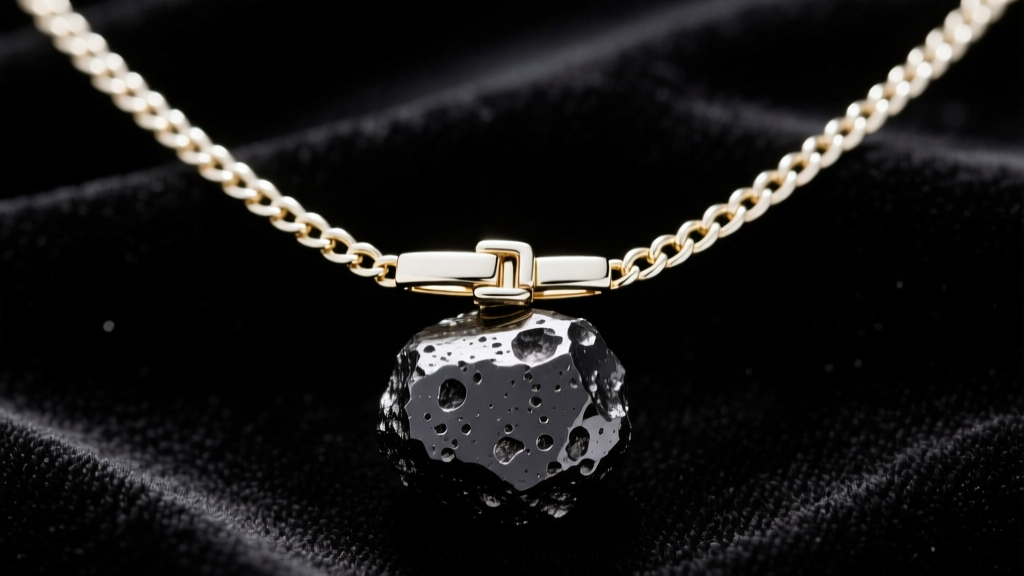
For a substantial Gibeon meteorite lunar pendant weighing 12 grams, a 2.0mm 18k white gold box chain paired with a folding clasp (often called a watch clasp) is the optimal configuration. Folding clasps utilize a hinged mechanism with a secondary figure-eight safety catch, virtually eliminating the risk of accidental unclasping.
Sourcing and Authentication: Avoiding Synthetic Traps
The market for celestial jewelry is saturated with deceptive imitations. Authenticating the materials in a lunar necklace requires an understanding of both gemological testing and metallurgical verification.
Spotting Fake Meteorites
Unscrupulous manufacturers sometimes use terrestrial steel or Damascus steel, etching it with acid to mimic the Widmanstätten pattern. However, true meteorites are highly magnetic due to their iron content, and more importantly, they contain significant nickel. A professional jeweler can perform an X-ray fluorescence (XRF) test to verify the presence of 7-10% nickel, which is the hallmark of a genuine octahedrite meteorite. For further verification, buyers should look for pendants accompanied by documentation from recognized bodies like The Meteoritical Society.
Identifying Glass Moonstone Imitations
As mentioned, synthetic opalite is frequently passed off as rainbow moonstone. Under 10x loupe magnification, opalite will reveal a completely homogeneous internal structure, sometimes with spherical gas bubbles trapped from the glass manufacturing process. Genuine moonstone will exhibit slight internal tension cracks (often called 'centipedes') and distinct layering that creates the adularescent flash.
Long-Term Care and Maintenance Protocols
The longevity of a lunar necklace depends heavily on adhering to strict maintenance protocols tailored to its specific materials.
- Ultrasonic Warnings: Never place a moonstone lunar necklace in an ultrasonic cleaner. The high-frequency vibrations can exploit the stone's perfect cleavage planes, causing internal fractures or completely shattering the cabochon.
- Chemical Exposure: Moonstone is sensitive to harsh acids and alkaline solutions. Clean it only with warm water, a mild phosphate-free dish soap, and a microfiber cloth.
- Meteorite Oxidation: Because meteorite is primarily iron, it is highly susceptible to oxidation (rust) when exposed to humidity and skin acids. To prevent this, meteorite inlays must be sealed with a microcrystalline jewelry wax (such as Renaissance Wax) every six months. If surface rust does appear, it can be gently polished away with a fiberglass scratch pen, followed by immediate re-waxing.
- Storage: Store the necklace in an anti-tarnish pouch with a silica gel desiccant packet to control ambient moisture, particularly if the piece features a meteorite inlay.
"A truly exceptional lunar necklace is not merely a decorative object; it is a convergence of planetary geology and master metallurgy. Treating it with the technical respect it demands ensures the piece will endure for generations."
By understanding the intricate gemological properties of moonstone, the cosmic origins of meteorite, and the vital engineering of chain mechanics, you can confidently acquire a lunar necklace that is as structurally impeccable as it is astronomically beautiful.


