Man Pulled Into MRI Machine By Necklace: A Guide To MRI-Safe Jewelry
Discover why the man pulled into MRI machine by necklace incident happens. Learn metallurgy, safe alloys, and how to buy truly MRI-safe jewelry.

The phrase man pulled into MRI machine by necklace sounds like a sensationalized urban legend, but to radiologists and medical physicists, it represents a terrifying, well-documented reality. Magnetic Resonance Imaging (MRI) suites are among the most strictly controlled environments in modern medicine, yet accidents involving ferromagnetic jewelry still occur. When a patient enters an active MRI bore wearing the wrong necklace, the results can range from severe localized burns to catastrophic projectile trauma.
As a jewelry buyer, understanding the metallurgy of your necklaces is no longer just about aesthetics or skin allergies; it is a matter of physical safety. This comprehensive buying guide deconstructs the physics behind MRI necklace hazards, identifies hidden ferromagnetic culprits in everyday chains, and provides a strict framework for sourcing truly MRI-safe jewelry.
The Physics of the Pull: Why Necklaces Become Projectiles
To understand the danger, you must understand the environment. A standard clinical MRI scanner operates at a magnetic field strength of 1.5 Tesla (T) to 3.0 T. To put this in perspective, the Earth’s magnetic field is approximately 0.00005 T. A 3.0 T MRI is roughly 60,000 times stronger than the Earth's magnetic field.
When a ferromagnetic object (like a steel chain) enters this field, it experiences a translational force pulling it toward the isocenter of the magnet. According to the FDA MRI Safety guidelines, a seemingly lightweight 50-gram steel pendant can accelerate to speeds exceeding 15 meters per second, striking the patient or the machine bore with the kinetic energy of a bullet. Furthermore, the intense Radio Frequency (RF) pulses used during imaging can induce electrical currents in conductive metal loops, leading to severe thermal burns on the skin beneath the necklace.
Case Analysis: Deconstructing the Incident
When reviewing case studies of a man pulled into an MRI machine by a necklace, investigators rarely find the patient was wearing a solid, obvious iron chain. The danger usually lies in deception—both intentional and unintentional.
Hidden Ferromagnetic Culprits in Everyday Chains
- Gold-Plated Steel: Many inexpensive chains are made of ferromagnetic carbon steel and electroplated with a microscopic layer of gold. To the naked eye (and a standard jewelry magnet test on the surface), it looks like safe gold, but the steel core turns it into a lethal projectile.
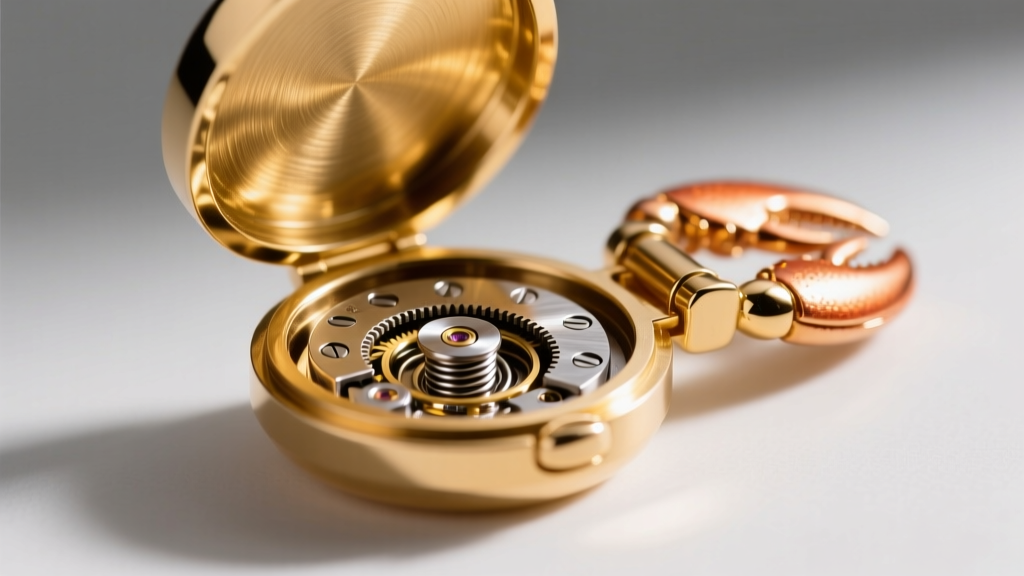
- The Lobster Clasp Spring: You may have a solid 14k gold chain, but the internal spring mechanism inside a standard lobster clasp is almost universally made of hardened steel. In a 3.0 T scanner, this tiny spring can exert enough localized pull to snap the chain or cause severe pinching and tissue trauma.
- Magnetic Clasps: Marketed as convenient for those with arthritis, magnetic clasps utilize Neodymium magnets. Neodymium is highly ferromagnetic and will violently react to the MRI’s magnetic field.
- Nickel-Heavy Solders: Traditional jewelry soldering often uses alloys containing nickel or iron to lower the melting point. While not always violently pulled, these solders can heat up rapidly under RF pulses, causing second-degree burns at the link joints.
The Metallurgy Matrix: MRI-Safe vs. Hazardous Alloys
When shopping for everyday wear necklaces that you won't need to remove in a medical emergency, you must look beyond the surface finish. The American College of Radiology (ACR) MR Safety manual categorizes metals based on their magnetic properties. Use this matrix to guide your purchases:
| Metal / Alloy | Magnetic Classification | MRI Safety Status | Notes for Buyers |
|---|---|---|---|
| Carbon Steel / Stainless Steel (304/316L) | Ferromagnetic | ❌ DANGEROUS | Will become a violent projectile. Avoid entirely. |
| Neodymium (Magnetic Clasps) | Ferromagnetic | ❌ DANGEROUS | Will detach and fly toward the bore. |
| Titanium (Grade 23 / 6Al-4V ELI) | Paramagnetic | ✅ SAFE | Zero pull. Minor image artifacting. Ideal for medical IDs. |
| Platinum (950 Pt / Ruthenium alloy) | Paramagnetic | ✅ SAFE | Zero pull. Excellent for high-end, safe everyday pendants. |
| Solid Gold (14k, 18k, 24k) | Diamagnetic | ⚠️ CONDITIONAL | Safe from pull, but watch for ferromagnetic solders and clasps. |
| Sterling Silver (925) | Diamagnetic | ⚠️ CONDITIONAL | Safe from pull, but high conductivity increases RF burn risk if worn in a tight loop. |
Buying Guide: How to Source Truly MRI-Safe Necklaces
If your goal is to purchase a necklace that you can safely wear through airport security, metal detectors, and emergency medical imaging without removal, you must adopt a strict vetting process. Here is what to look for when evaluating high-end or medical-grade jewelry.
1. Demand Laser-Welded Chains
Traditional chain manufacturing uses solder to close the links. As noted, solder often introduces foreign, potentially ferromagnetic metals into the chain. Premium jewelers now use laser welding to fuse links of solid platinum or titanium. Laser welding melts the base metal itself to close the link, requiring zero foreign solder alloys. When buying, explicitly ask the jeweler: "Are the links laser-welded or soldered?"
2. Upgrade to Springless Clasps
To eliminate the hidden steel spring inside a lobster or spring-ring clasp, you must switch to springless alternatives. Look for:
- Solid S-Hooks: Forged from the same wire as the chain, relying on metal tension rather than a spring.
- Toggle Clasps: A solid bar that passes through a solid ring. Ensure the bar is thick enough not to slip under tension.
- Threaded Barrel Clasps: Two cylinders that screw together. Ensure the threading is cut directly into the precious metal, not glued with steel inserts.
3. Verify the Base Metal of Pendants
Never buy "gold-filled" or "gold-plated" pendants if MRI safety is your goal. The core is often brass (which is safe but highly conductive, risking RF burns) or steel (which is a projectile risk). Invest in solid 950 Platinum or Grade 23 Titanium (Ti 6Al-4V ELI). Grade 23 is the medical-implant standard for titanium, guaranteeing zero ferromagnetic impurities and complete biocompatibility.
4. Break the Conductive Loop
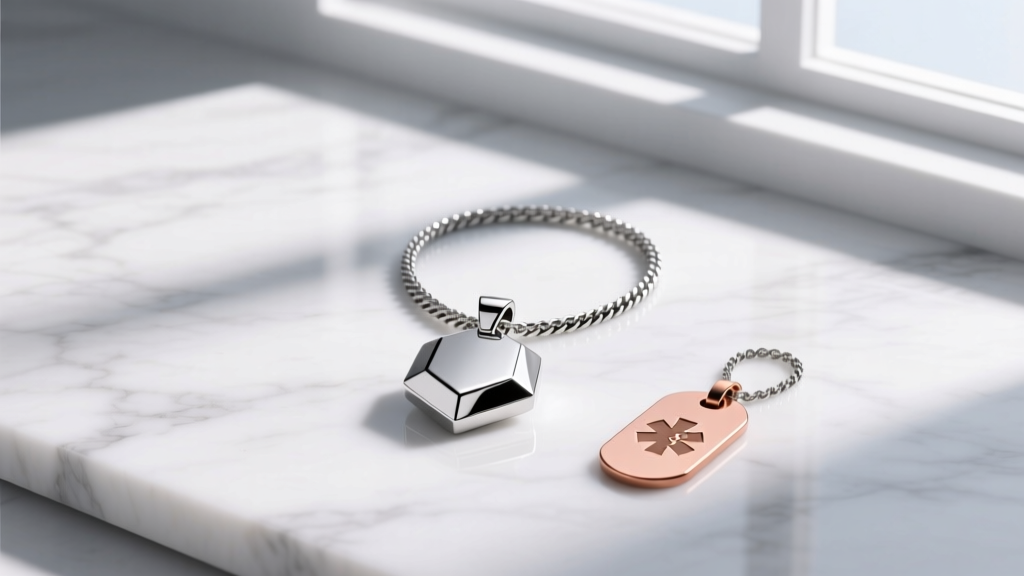
Even if your necklace is made of perfectly safe, non-magnetic diamagnetic gold, wearing it in a closed loop around your neck during an MRI can act as an antenna. The RF pulses can induce an electrical current in the loop, leading to severe thermal burns at the point where the metal touches the skin. If you must wear a medical ID necklace during a scan, technicians will often place a non-conductive pad beneath it or tuck it out of the way, but choosing a shorter, lighter chain that can be easily tucked under the armpit reduces the loop diameter and the associated burn risk.
Pre-Scan Protocols for Jewelry Wearers
If you are involved in an accident and are rushed into an MRI suite while unconscious, first responders may not have the time to carefully unthread a complex clasp. This is why breakaway features or easily snip-able materials (like pure copper or thin titanium wire) are sometimes integrated into high-risk medical alert jewelry. However, the golden rule of MRI safety remains absolute: all jewelry should be removed before entering Zone III of an MRI suite.
The incident of a man pulled into an MRI machine by a necklace is a stark reminder that metallurgy matters. By understanding the difference between ferromagnetic hazards and paramagnetic safe havens, and by demanding laser-welded, springless constructions, you can curate a jewelry collection that is as safe in a medical emergency as it is beautiful in everyday life.


