Men's Cross Necklace Gold: Troubleshooting Tarnish & Breaks
Is your men's cross necklace gold fading or breaking? Learn expert troubleshooting for tarnish, chain repair, karat selection, and clasp upgrades.
The Hidden Vulnerabilities of Men's Gold Cross Necklaces
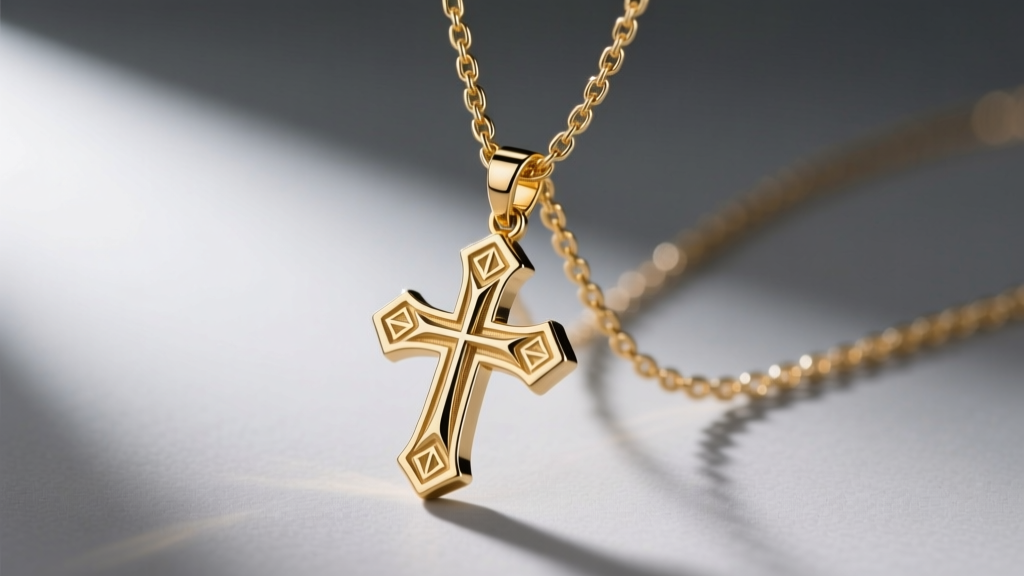
A solid gold cross necklace is a cornerstone of men's jewelry, blending personal significance with enduring style. However, the physical realities of wearing a heavy pendant on a flexible metal chain create unique mechanical and chemical stressors. Whether you are dealing with a fading finish, a snapping chain, or a worn-out bail, troubleshooting these issues requires an understanding of jewelry metallurgy and structural mechanics. As of 2026, advancements in laser welding and alloy formulations have changed how we approach repairs, but the fundamental physics of gold jewelry remain the same. This guide provides deep-dive troubleshooting for the most common failures associated with a men's cross necklace gold piece, offering actionable solutions to restore and protect your investment.
Troubleshooting Tarnish and Discoloration
Pure gold (24k) is highly resistant to tarnish, but it is far too soft for daily wear, especially for a heavy men's pendant. To create a durable men's cross necklace gold jewelers alloy pure gold with metals like copper, silver, zinc, and nickel. It is these secondary metals that react with sulfur, chlorine, and oxygen in the environment, leading to tarnish and discoloration.
Understanding Karat Weight and Oxidation
If your gold cross is developing a dark or reddish film, you are likely dealing with a lower-karat alloy. The Gemological Institute of America (GIA) notes that the higher the percentage of alloy metals, the more susceptible the piece is to environmental oxidation. Below is a breakdown of how different karats perform in daily wear scenarios.
| Karat Weight | Gold Purity | Tarnish Resistance | Durability & Best Use Case |
|---|---|---|---|
| 10k Gold | 41.7% | Low (Prone to darkening) | Highly durable, but requires frequent polishing. Best for budget-friendly, heavy chains. |
| 14k Gold | 58.5% | Moderate to High | The industry sweet spot. Excellent balance of tensile strength and tarnish resistance for daily wear. |
| 18k Gold | 75.0% | Very High | Softer metal, richer color. Prone to scratching but highly resistant to chemical tarnish. |
| 24k Gold | 99.9% | Absolute | Too soft for chains or heavy pendants. Will bend, stretch, and deform under its own weight. |
The Fix: For mild tarnish on 10k or 14k gold, use a specialized jewelry polishing cloth infused with micro-abrasives. Avoid liquid dip cleaners, as they can strip the natural patina and weaken the solder points on your chain links. If the discoloration is severe, a professional ultrasonic cleaning followed by a light rouge polish will restore the original luster without removing significant metal weight.

Chain Breakage, Stretching, and Clasp Failures
The chain is the structural lifeline of your necklace. Men's cross pendants carry significant weight, often between 5 to 15 grams, which places constant tension on the chain links and the clasp. Identifying the failure mode of your chain is critical to preventing the loss of your pendant.
Diagnosing Chain Link Failures
- Cuban and Curb Chains: These are highly popular for men but are notorious for stretching if the individual links are not soldered shut. Over time, the weight of the cross pulls the open links into ovals. Solution: Have a jeweler laser-weld or solder every fifth link to lock the chain's geometry without sacrificing flexibility.
- Box Chains: While they lay flat and look modern, box chains are structurally weak against lateral pressure. If a box chain kinks, the structural integrity of that specific link is permanently compromised, leading to sudden snaps. Solution: Never sleep in a box chain. If a kink occurs, do not pull it; use two pairs of smooth-jawed pliers to gently fold the link back into its geometric square.
- Rope Chains: These offer incredible tensile strength but are magnets for snags. If a single wire in a rope chain catches on a zipper or fabric, it can unravel the twisted pattern. Solution: Snagged rope chains require professional micro-soldering. Attempting to untwist them at home will result in localized work-hardening and eventual snapping.
Upgrading the Clasp
Most mass-produced men's cross necklace gold pieces come equipped with standard spring-ring clasps. These are fundamentally inadequate for heavy pendants. The internal spring mechanism degrades over time, and the small soldered ring at the base of the clasp is a primary failure point. Upgrade your clasp to a heavy-duty lobster clasp or, ideally, a box clasp with a figure-8 safety catch. According to manufacturing standards from The World Gold Council, a secure mechanical lock is essential for heavy gold jewelry to prevent accidental deployment.
Bail Friction and Pendant Detachment
The bail is the loop that connects the cross pendant to the chain. It is the highest-friction component on the entire necklace. As the chain moves back and forth through the bail during daily activity, it acts like a microscopic saw, slowly wearing away the gold.
Identifying Bail Wear
Inspect the inside curve of your bail monthly. If you notice a deep groove or a flattening of the metal, the bail is critically compromised. Many inexpensive pendants use cast bails, which are porous and brittle. When a cast bail wears thin, it doesn't just bend; it snaps cleanly, dropping the cross.
The Fix: Replace worn cast bails with a fabricated sheet-metal bail, which is denser and more resistant to friction. If you wear a thick Cuban or Figaro chain, the standard loop bail will restrict the chain's movement, causing excessive wear on both the chain and the bail. In this scenario, upgrade to a T-bar bail or a hidden channel bail specifically milled to accommodate the exact millimeter width of your chain.
Environmental Stressors and Chemical Damage
Gold itself is inert, but the environment you expose it to is not. The most common culprit for catastrophic damage to a men's cross necklace gold piece is chlorine. Whether from swimming pools, hot tubs, or household bleach, chlorine attacks the alloy metals (specifically copper and zinc) in 10k and 14k gold. This causes a phenomenon known as "stress corrosion cracking," where the metal becomes brittle and can shatter or snap under minimal pressure.
Troubleshooting Protocol:
- Never wear your gold cross in chlorinated water.
- If exposed to chlorine, immediately rinse the necklace in warm, distilled water and gently wash with a pH-neutral dish soap to halt the chemical reaction.
- Be mindful of colognes and body sprays. The alcohol and essential oils can build up in the crevices of a diamond-cut or textured cross, dulling the finish and trapping dead skin cells.
Skin Irritation and Allergic Reactions
If the skin beneath your gold cross necklace is turning green, black, or developing a red, itchy rash, you are experiencing an alloy reaction. The green/black smudge is typically caused by copper oxidation reacting with the acidity and salts in your sweat. A red, itchy rash, however, is a contact allergy, almost always triggered by nickel.
Nickel is frequently used in white gold alloys to provide a bright, silvery color, and it is sometimes present in lower-karat yellow golds to increase hardness. If you have a nickel allergy, a white gold men's cross necklace will cause persistent irritation unless it is properly maintained.
The Fix: For white gold, ensure the piece is plated with a thick layer of rhodium, a hypoallergenic platinum-group metal. Rhodium plating wears off over time (typically 12 to 18 months on a necklace), so plan for professional re-plating. If you prefer yellow gold but suffer from reactions, commission a custom cross pendant using a palladium-alloyed 18k gold, which is entirely nickel-free and naturally hypoallergenic.
Proportion, Sizing, and Length Adjustments
A common aesthetic and functional problem is an improperly sized chain. A chain that is too short will cause the cross to flip upside down constantly, while a chain that is too long will cause the pendant to swing wildly, increasing the risk of snags and chain stretching. For most men, the ideal length places the top of the cross pendant roughly two inches below the collarbone, typically requiring a 20-inch to 22-inch chain depending on torso size.
Adjustment Best Practices: Avoid using cheap extender chains or jumping links to adjust length, as these create weak points and ruin the visual flow of the necklace. Instead, have a professional jeweler permanently remove or add links to match your exact anatomical requirements. For a seamless look, ensure the added links match the exact gauge and karat weight of the original chain to prevent uneven tarnishing and wear patterns.
Professional Repair vs. DIY Maintenance
While daily cleaning and visual inspections can be done at home, structural repairs require professional intervention. As of 2026, laser welding has become the industry standard for repairing men's gold chains and bails. Unlike traditional torch soldering, which requires heating a large area of the chain and risking damage to nearby gemstones or diamond accents on the cross, laser welding uses a highly focused beam to fuse metal at a microscopic level. This results in a repair that is often stronger than the original factory link, with virtually no visible seam. Always seek out a jeweler equipped with a laser welder for any structural troubleshooting on your gold cross necklace to ensure the longevity and integrity of the piece.