Anatomy of a Men's Cross Pendant Necklace: Technical Guide
Explore the metallurgy, chain tensile strength, and proportion scaling required to engineer the perfect men's cross pendant necklace for daily wear.

The Metallurgy of Men's Cross Pendants: Alloys and Hardness Grades
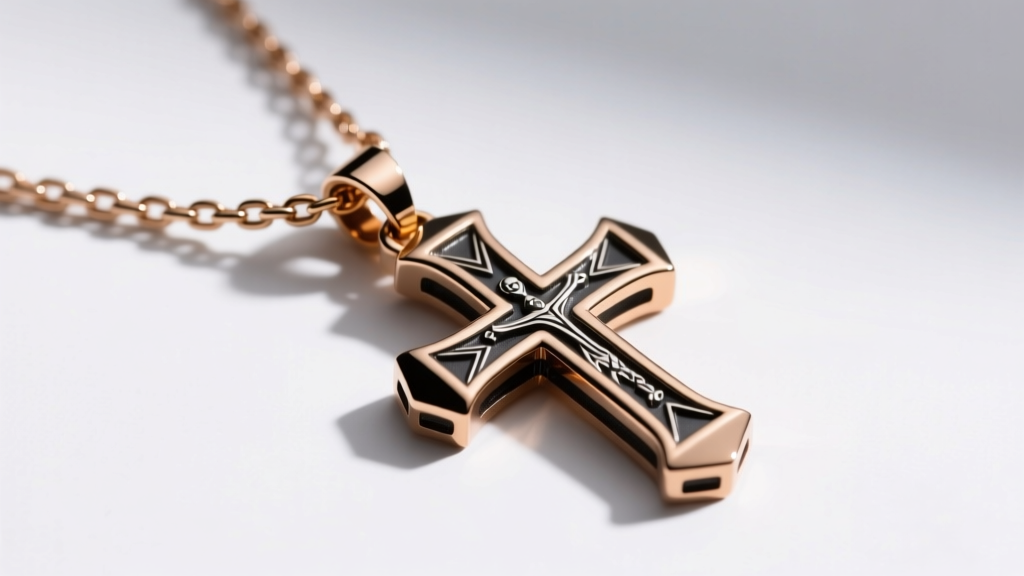
When evaluating a men's cross pendant necklace, most consumers focus solely on the aesthetic silhouette or the symbolic meaning. However, from a jewelry engineering perspective, a pendant is a dynamic mechanical system subjected to continuous kinetic stress, environmental corrosion, and friction. The substrate of the cross dictates its longevity, weight distribution, and skin compatibility. Understanding the specific metallurgical properties of common alloys is the first step in selecting a piece that will survive decades of daily wear.
316L Surgical Stainless Steel vs. Standard Alloys
For heavy, industrial-style crosses, 316L stainless steel remains the benchmark for hypoallergenic durability. According to the British Stainless Steel Association, the 'L' denotes low carbon, while the inclusion of 2-3% molybdenum drastically increases resistance to chloride pitting. This is critical for jewelry, as human sweat contains high levels of sodium chloride. With a Vickers hardness (HV) of roughly 150-190, 316L resists scratching far better than precious metals, though it requires advanced CNC milling or investment casting to achieve sharp, intricate gothic or Celtic detailing.
Precious Metals: Sterling Silver and Gold Karatages
Standard 925 sterling silver (92.5% silver, 7.5% copper) presents a structural challenge for heavy pendants. With a Vickers hardness of only 60-70 HV, it is highly susceptible to bending and impact deformation. To mitigate this, expert jewelers often utilize rhodium flashing or electrocoating (e-coating) to prevent silver sulfide tarnishing, while designing the cross with a thicker cross-sectional profile to add rigidity. For gold, the Gemological Institute of America (GIA) notes that 14k gold (58.5% pure gold alloyed with copper, silver, or zinc) offers an optimal hardness of 120-140 HV. This makes 14k vastly superior to 18k gold for a men's cross pendant necklace intended for rugged, everyday use, as the higher alloy content provides necessary structural memory and scratch resistance.

Chain Mechanics: Tensile Strength and Link Architecture
The chain is not merely a decorative string; it is a load-bearing suspension cable. A substantial men's cross pendant necklace requires a chain architecture capable of supporting the pendant's static weight while enduring the dynamic tensile forces generated by the wearer's movement. The wrong chain will stretch, kink, or snap at the clasp.
Manufacturers measure chain durability through wire gauge thickness and link interlocking geometry. A 3mm Cuban link chain, for instance, distributes weight across flat, interlocking surfaces, providing immense tensile yield. Conversely, a hollow-core Rope chain of the same visual width possesses a high surface area but is highly vulnerable to crushing and kinking if the pendant swings violently. For heavy pendants exceeding 15 grams, solid-core Box chains or tightly woven Figaro chains are mechanically superior due to their low friction coefficients and high shear strength.
| Chain Architecture | Recommended Gauge (mm) | Tensile Resilience | Bail Friction Coefficient |
|---|---|---|---|
| Cuban Link (Solid) | 3.0 - 5.0 | High | Moderate |
| Box Chain (Solid) | 2.5 - 4.0 | Very High | Low |
| Figaro (Solid) | 3.0 - 4.5 | Moderate | Moderate |
| Rope Chain (Hollow) | 3.5 - 6.0 | Low (Crush Risk) | High |
Bail Engineering: The Critical Pivot Point
The bail—the loop that connects the cross to the chain—is the most critical failure point on any necklace. It experiences cyclical fatigue and friction wear every time the wearer moves. Jewelry manufacturing experts at Ganoskin emphasize that the inner diameter of the bail must be at least 1.5 times the thickness of the chain to allow for a fluid pivot. If the fit is too tight, the chain acts as a file, slowly grinding through the bail metal over months of wear.
- Standard Loop Bails: These are soldered or laser-welded to the top of the cross. Modern laser welding provides deep metallurgical penetration without transferring heat to the rest of the pendant, which is vital if the cross features heat-sensitive enamel or gemstone inlays like onyx or turquoise.
- Hidden Bails (Drilled):strong> A hole is drilled horizontally through the top arm of the cross, allowing the chain to pass directly through. While this preserves the clean silhouette of the cross, it concentrates kinetic stress on a small cross-section of the metal. A hidden bail requires at least 2.5mm of solid metal above the drill channel to prevent shearing under the pendant's own weight.
- Tapered Bails: Often used in diamond-set crosses, these feature a wider base that narrows at the top, distributing the pendant's weight more evenly across the solder joint and reducing the lever-arm effect that causes standard bails to snap.
Proportion Scaling: Matching Dimensions to Anatomy
Aesthetics in men's jewelry are deeply rooted in mathematics and anatomical proportion. A men's cross pendant necklace that is too small will look lost against a broad chest, while one that is too large will appear costumey and unbalanced. Professional stylists utilize the rule of thirds and bi-acromial (shoulder) width to determine the correct pendant scale.

The Drop Length Matrix
The length of the chain dictates where the cross rests on the sternum, which fundamentally alters its visual impact and how it interacts with clothing necklines.
- 20 Inches (Clavicle Rest): Ideal for smaller, minimalist crosses (0.75 to 1 inch in height). Sits above the crew-neck collar line, making it visible without unbuttoning a shirt.
- 22 Inches (Upper Sternum): The most versatile length for men. Perfect for medium crosses (1.25 to 1.75 inches). Rests just below the collarbone, allowing it to be worn over a t-shirt or peek out from an open button-down.
- 24 to 26 Inches (Xiphoid Process): Reserved for large, statement crosses (2 to 3+ inches). Sits lower on the chest, often worn over streetwear, hoodies, or layered with shorter beaded necklaces.
Proportion Rule: The width of the cross pendant should generally not exceed one-sixth of the wearer's bi-acromial shoulder width to maintain visual harmony and prevent the piece from overwhelming the torso.
Maintenance and Oxidation Prevention
Even the most expertly engineered men's cross pendant necklace requires specific maintenance protocols based on its material composition and finishing techniques. For solid 316L stainless steel and plain gold alloys, a standard 40 kHz ultrasonic cleaner is highly effective at removing sebum and dead skin cells from intricate crevices and chain links. However, ultrasonic waves will strip intentional oxidation (blackening) from sterling silver crosses and can fracture porous gemstone inlays.
For oxidized or textured silver crosses, maintenance should be restricted to manual cleaning using a soft-bristled brush and a mild, phosphate-free dish soap. Polishing should only be applied to the raised, high-relief areas of the cross using a treated microfiber cloth, deliberately avoiding the recessed areas to preserve the contrasting dark patina that highlights the design's depth. By understanding the intersection of metallurgy, mechanical stress, and anatomical scaling, you can select a cross pendant that is not just a symbol, but a masterclass in functional jewelry engineering.