How to Find the Perfect Necklace Length for Men: A Step Guide
Learn how to measure and choose the ideal necklace length for men. Our step-by-step guide covers neck sizes, chain styles, and pendant pairings.


Why Proportions Dictate the Perfect Necklace Length for Men
Finding the right necklace length for men is less about guesswork and more about understanding physical proportions, anatomy, and metallurgy. In 2026, men's jewelry has moved far beyond the one-size-fits-all approach of the past decade. A chain that sits perfectly on a man with a 15-inch neck will look like a choker on someone with a 17-inch neck, while a 24-inch chain might disappear into the chest hair of a taller individual or look comically long on a shorter frame. According to style authorities at The Art of Manliness, the visual anchor point of a necklace fundamentally alters how broad your shoulders appear and how your torso is proportioned. This step-by-step guide will walk you through the exact measurements, material grades, and structural considerations required to select the perfect chain.
Step 1: Accurately Measuring Your Neck Size
Before you even look at a jewelry counter, you need your exact neck circumference. Do not rely on your shirt collar size, as dress shirts account for breathing room and tie knots, often adding 1 to 1.5 inches to your actual flesh measurement.
The String and Ruler Method
- Take a non-stretchable piece of string or a flexible tailor's measuring tape.
- Wrap it around your neck at the exact height where you want the top of the chain to rest. For a standard collar-length chain, wrap it just below the Adam's apple.
- Mark the intersection point and measure the string against a rigid steel ruler.
- The Golden Rule: Add exactly 2 inches to this measurement for a snug fit, or 4 inches for a relaxed, comfortable drape. If your neck measures 16 inches, an 18-inch chain will sit tightly on the collarbone, while a 20-inch chain will rest just below it.
Expert Troubleshooting: If you have a prominent trapezius muscle or a thicker build, always round up to the next even inch. Chains that sit too tight against the trapezius will cause friction burns and accelerate the wear on the chain's solder points.

Step 2: Matching Chain Length to Height and Build
Your overall height and torso length dictate how a standard chain length will visually translate. A 22-inch chain is the industry standard for an 'average' male, but average is a statistical myth. Here is how to map length to your specific build:
- Under 5'7" (Shorter Build): Stick to 18 to 20 inches. A 24-inch chain will drop too low, visually shortening your torso and making your legs look disproportionately short. A 20-inch 3mm Figaro chain is your most versatile option.
- 5'8" to 6'0" (Average Build): The 20 to 22-inch range is your sweet spot. A 22-inch chain will rest comfortably on the upper sternum, making it the ideal canvas for medium-sized pendants.
- Over 6'0" (Taller Build): You need 22 to 24 inches. A 20-inch chain on a man who is 6'3" will look like a choked collarbone accessory. A 24-inch chain provides the necessary visual weight to balance a longer torso.
Step 3: Selecting Chain Width, Gauge, and Metallurgy
Length is only half the equation; width and material determine the chain's drape, weight, and longevity. As noted in Blue Nile's chain education guide, the link structure fundamentally changes how a chain behaves at specific lengths.
Width Guidelines by Length
- 2mm - 4mm (The Subtle Anchor): Best for 18" to 20" lengths. Ideal for holding lightweight pendants (under 10 grams) or wearing tucked under an unbuttoned collar.
- 5mm - 8mm (The Standalone Statement): Best for 20" to 24" lengths. Cuban and Curb links in this width range lay flat against the chest and catch the light aggressively. They are heavy enough to be worn alone without a pendant.
- 10mm+ (The Heavyweight): Strictly for 22" to 26" lengths. Chains of this width are rigid. If worn at 18 inches, they will not articulate around the neck properly and will cause severe discomfort.
Metallurgy and Sweat Resistance
Longer chains (24 inches) rest directly against the sternum, an area prone to heavy sweating. If you live in a humid climate or wear your jewelry daily, avoid 925 Sterling Silver for long chains, as the copper alloy will oxidize rapidly against acidic sweat. Opt for 316L Surgical Stainless Steel or 14k Gold (which uses zinc and silver alloys for hardness and tarnish resistance, unlike the softer, more reactive 18k gold).
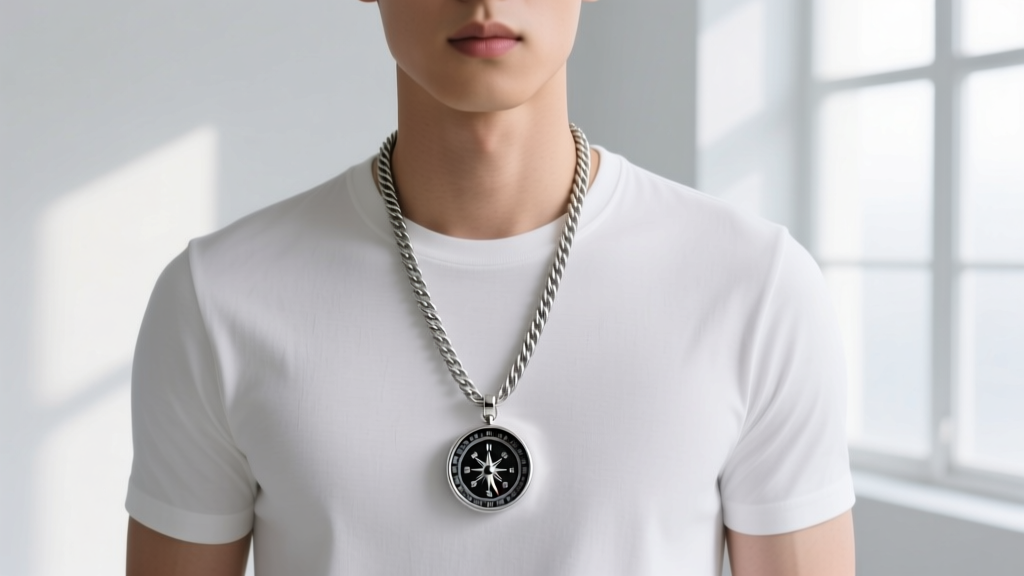
Step 4: Factoring in Pendant Weight and Clasp Mechanics
A massive failure point in men's jewelry is pairing a heavy pendant with a long, thin chain. A standard 18-inch 3mm 14k gold rope chain weighs roughly 12 grams. If you attach a 20-gram solid silver pendant, the dynamic tension on the clasp when walking down stairs can exceed 40 grams of sheer force.
The Clasp-to-Weight Ratio
If your pendant weighs more than the chain itself, you must upgrade your clasp. Standard lobster clasps are rated for static loads, not dynamic swinging. For any 22-inch or 24-inch chain holding a pendant over 15 grams, you must insist on a Box Clasp with a Figure-8 Safety Latch. The box clasp distributes the sheer force across a wide metal tongue, while the figure-8 wire acts as a secondary fail-safe if the primary tongue bends.
Furthermore, ensure the pendant's bail (the loop that slides onto the chain) is at least 1.5 times wider than the chain's millimeter width. A 6mm Cuban link requires a bail with an inner diameter of at least 9mm to prevent the links from grinding against the bail's interior, which will eventually saw through the metal.
Step 5: Adjusting for Necklines and Occasions
The final step is contextualizing your necklace length against your wardrobe. The interplay between fabric and metal dictates the visual success of the piece.
| Neckline Type | Ideal Chain Length | Recommended Width & Style | Visual Effect |
|---|---|---|---|
| Crew Neck T-Shirt | 20 - 22 inches | 3mm - 5mm Rope or Box | Breaks up the solid fabric block; sits just below the cotton collar. |
| V-Neck / Henley | 22 - 24 inches | 4mm - 6mm Figaro with Pendant | Follows the geometric lines of the V-neck, drawing the eye downward. |
| Button-Down (Unbuttoned) | 18 - 20 inches | 2mm - 4mm Subtle Chain | Peeks out from the collarbone without tangling in the fabric placket. |
| Hoodies / Streetwear | 24 - 26 inches | 8mm+ Cuban or Tennis Chain | Sits over the heavy kangaroo pocket and thick cotton hood. |
Pro Styling Tip: If you are layering chains, maintain a strict 2-inch differential between them. A 18-inch 2mm box chain layered with a 20-inch 5mm Cuban link creates a cascading effect that prevents the clasps from tangling and the links from scratching one another.
Common Mistakes to Avoid
Finally, avoid the 'trimming' trap. Never buy a chain that is too long with the intention of taking it to a local jeweler to remove links. Removing links from a continuous pattern chain (like a Miami Cuban or a Franco) alters the symmetry of the weave and often leaves a visible, stiff solder mark near the clasp. Always measure twice, buy the exact length, and rely on the manufacturer's original factory soldering for maximum tensile strength.
By following these precise measurement techniques and understanding the physical mechanics of chain links, you will secure a necklace that complements your anatomy, withstands daily wear, and elevates your personal style effortlessly.


