Men's Necklace Size Chart: Expert Fitting & Drape Guide
Master the men's necklace size chart with our expert guide. Learn chain width ratios, clasp tensile limits, and material drape for a flawless fit.

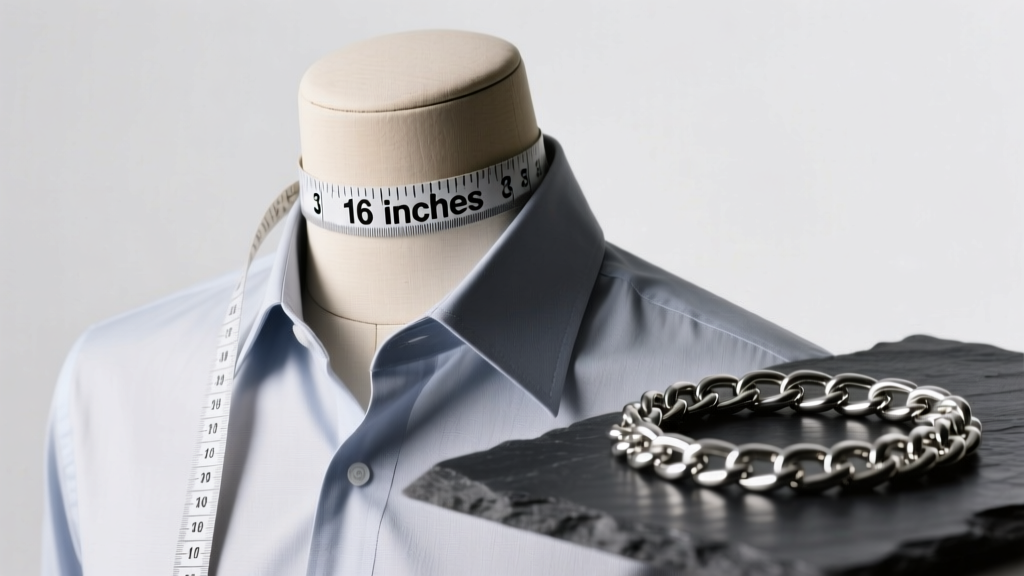
The Biomechanics of Men's Neckwear: Why Standard Charts Fail
Most generic jewelry guides treat a men's necklace size chart as a simple one-dimensional metric, focusing exclusively on chain length. However, as any master jeweler or bespoke tailor will confirm, achieving the perfect drape on a male physique requires a three-dimensional understanding of anatomy, material density, and kinetic movement. The average adult male neck circumference ranges from 15 to 18 inches, but the slope of the trapezius muscles, the prominence of the Adam's apple, and the breadth of the shoulders drastically alter how a chain sits.
When selecting a chain, you are not just picking a length; you are engineering a wearable suspension system. A chain that is too thin for its length will behave like a lanyard, twisting and tangling. A chain that is too thick for a shorter length will restrict movement and cause epidermal friction. This expert deep dive dissects the technical specifications required to master men's necklace fitting.
The Definitive Men's Necklace Size Chart
Below is a technical matrix correlating chain length with anatomical landmarks and proportional width requirements. This data assumes a standard male neck base circumference of 16.5 inches.
| Length (Inches) | Length (CM) | Anatomical Drape Point | Ideal Width Range | Best Chain Styles |
|---|---|---|---|---|
| 18" | 45 cm | Base of Neck / Collar | 2mm - 4mm | Box Chain, Wheat, Snake |
| 20" | 50 cm | Collarbone (Standard) | 3mm - 6mm | Curb, Figaro, Rope |
| 22" | 55 cm | Upper Sternum / Crewneck | 4mm - 8mm | Miami Cuban, Franco |
| 24" | 60 cm | Mid-Sternum | 5mm - 10mm | Cuban, Rope, Mariner |
| 30"+ | 75+ cm | Solar Plexus / Opera | 6mm - 12mm+ | Heavy Cuban, Pendant Ropes |
Chain Width-to-Length Ratios: The Engineering of Drape
The most common mistake men make when buying jewelry is ignoring the width-to-length ratio. The structural integrity and visual weight of a necklace depend heavily on this proportion. According to manufacturing standards referenced by Rio Grande, a chain's flexibility is dictated by the interlocking surface area of its links.
- The Lanyard Effect (High Length, Low Width): A 24-inch chain that is only 2mm wide lacks the mass to lay flat against the pectoral muscles. It will constantly flip, tangle, and catch on body hair. Minimum width for a 24-inch chain should be 4mm.
- The Choke Effect (Low Length, High Width): An 8mm Miami Cuban link cut to 18 inches will sit rigidly around the neck. Because the links are large, the chain cannot articulate tightly enough to follow the curve of the cervical spine, leading to severe discomfort and premature clasp failure due to lateral torque.
- The Golden Ratio: For standard everyday wear (20 to 22 inches), a width between 4mm and 6mm provides the optimal center of gravity, allowing the chain to articulate smoothly while maintaining enough mass to resist twisting.

Hardware Failure Points: Clasp Tensile Limits
A men's necklace is only as strong as its weakest mechanical joint. The clasp is a critical failure point, especially on heavier chains. Standard spring-ring clasps are entirely unsuitable for men's jewelry due to their low tensile threshold and fragile internal springs.
"When a solid gold chain exceeds 100 grams, the kinetic force generated by a simple head turn or a snag on a shirt collar can easily exceed 15 pounds of lateral tension. Standard lobster clasps will deform or snap under this dynamic load."
Clasp Selection Matrix by Chain Weight
- Under 50g (Lobster Clasp): A 12mm or 15mm lobster clasp is sufficient for chains under 5mm width and 50 grams total weight. Ensure the jump ring is soldered closed.
- 50g to 150g (Box Clasp): Mandatory for medium-to-heavy chains (6mm - 8mm). A box clasp distributes tension across a wider surface area and features a friction-fit tongue.
- Over 150g (Box Clasp + Figure-8 Safety): For chains exceeding 10mm or 150 grams, a box clasp must be paired with a secondary figure-8 safety wire. If the primary tongue fails or is accidentally depressed, the safety wire prevents the chain from dropping and suffering impact damage.
Material Density and Kinetic Movement
The GIA Gem Encyclopedia outlines the specific gravity of precious metals, which directly dictates how a necklace feels and moves on the body. Material density affects both the drape of the chain and the long-term fatigue on the wearer's cervical spine.
Calculating Chain Weight by Volume
Consider a standard 22-inch, 6mm solid Cuban link chain. The volume of the metal remains constant, but the weight shifts dramatically based on the alloy:
- 14k Yellow Gold (Density ~13.0 g/cm³): Weighs approximately 135 grams. The high mass provides a luxurious, heavy drape that lays perfectly flat against the sternum. However, it requires a robust box clasp.
- Sterling Silver (Density ~10.4 g/cm³): Weighs approximately 105 grams. Offers a substantial feel but is prone to tarnishing and requires more frequent polishing due to the larger surface area of wide links.
- Grade 5 Titanium (Density ~4.4 g/cm³): Weighs approximately 45 grams. Extremely lightweight and hypoallergenic. The low mass means the chain may not drape as fluidly as gold, often requiring a slightly longer length (24 inches) to achieve the same visual hang.
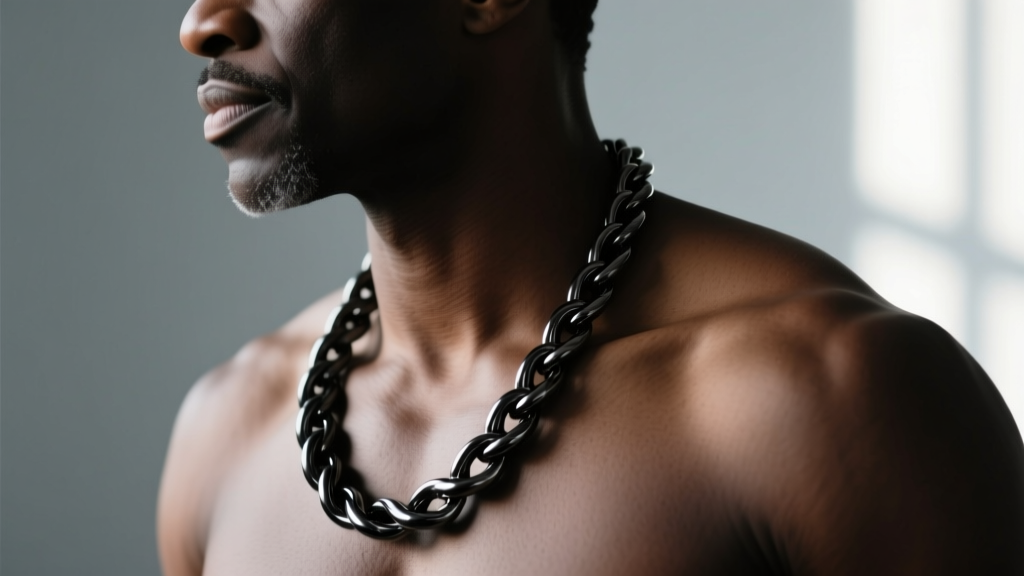
Troubleshooting Common Fit Issues
Even with a precise men's necklace size chart, real-world variables can cause fit issues. Here is how to troubleshoot the most common technical problems:
The Chain Keeps Flipping Upside Down
The Cause: A center-of-gravity imbalance. The clasp or the jump rings are heavier than the chain links, or the pendant bail is too tight, causing the chain to rotate around the neck. The Fix: Upgrade to a lighter-weight clasp (e.g., switching from a heavy brass-core lobster to a solid lightweight gold or titanium alternative). If wearing a pendant, ensure the bail is a 'V-bail' or 'snap-on bail' that allows the chain to glide freely without catching.
The Chain Pulls on Neck Hair
The Cause: Microscopic burrs on the interior edges of the links, or a chain style with high friction (like a tightly woven Snake or Herringbone chain). The Fix: Switch to a style with rounded, polished exterior edges, such as a Miami Cuban or a rounded Rope chain. Avoid Herringbone chains entirely for men with chest or neck hair, as their flat, overlapping scales act like a comb that traps hair.
The Necklace Sits Asymmetrically
The Cause: Uneven trapezius muscle development or a sloping shoulder posture, which causes the chain to slide toward the lower side. The Fix: Add a small, dense counterweight bead or a custom soldered jump ring directly opposite the clasp at the nape of the neck. This shifts the center of gravity and forces the chain to self-center on the collarbone.


