Mesh Necklace Gold Alloys: Technical Guide to Weaves
Explore the technical anatomy of the gold mesh necklace. Compare Milanese vs. Cobra weaves, karat durability, and clasp mechanics for lasting wear.

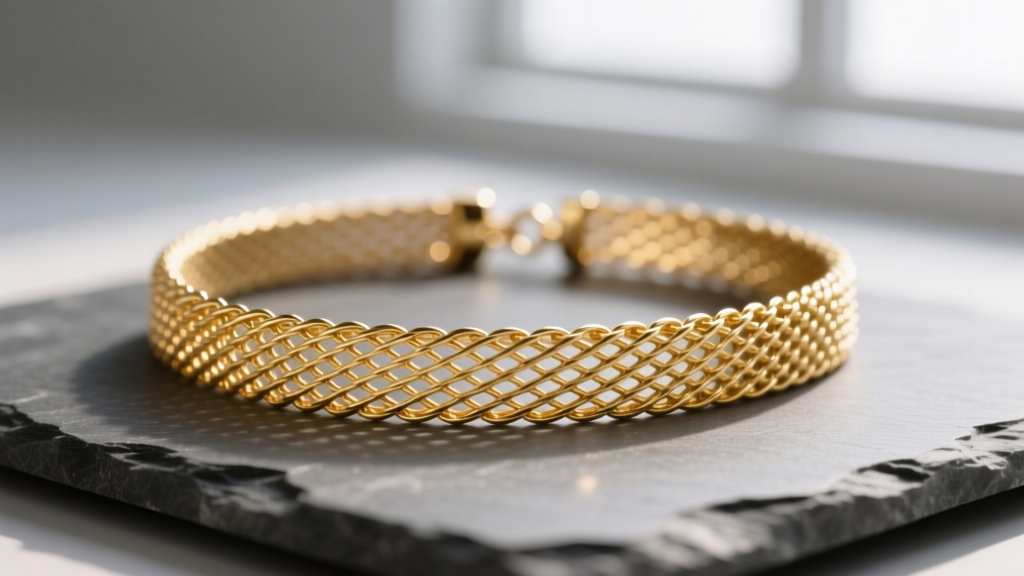
The Metallurgy of Gold Mesh: Karat Weight vs. Structural Integrity
When evaluating a mesh necklace, gold purity is the first technical variable to consider. Unlike standard cable or curb chains, mesh is constructed from dozens of micro-wires woven together to create a flexible, textile-like metal fabric. This unique architecture places immense tensile and shear stress on the individual wires, making the metallurgical composition of the gold alloy critical to the piece's longevity.
Pure 24k gold is entirely unsuitable for mesh manufacturing due to its low yield strength; the micro-wires would stretch and deform under the weight of the clasp alone. According to the Gemological Institute of America (GIA), alloying gold with copper, silver, and zinc is necessary to achieve the required work-hardening properties.
- 14k Gold (58.5% Gold): The higher concentration of copper and zinc provides superior tensile strength. 14k mesh wires can be drawn down to extremely fine gauges (0.15mm - 0.20mm) without becoming brittle, resulting in a highly fluid drape and excellent resistance to kinking.
- 18k Gold (75% Gold): The luxury standard for high-end mesh. Because it is softer, manufacturers must use slightly thicker wires (0.25mm+) or employ specialized annealing processes during the drawing phase to prevent the metal from becoming work-hardened and snapping on the loom. It offers a richer, warmer color but requires more careful handling to avoid plastic deformation.
Weave Architecture: Milanese, Cobra, and Ombre Structures
The term 'mesh' encompasses several distinct weaving techniques, each with unique structural properties and failure modes. Understanding these weaves is essential for predicting how the necklace will behave during daily wear.
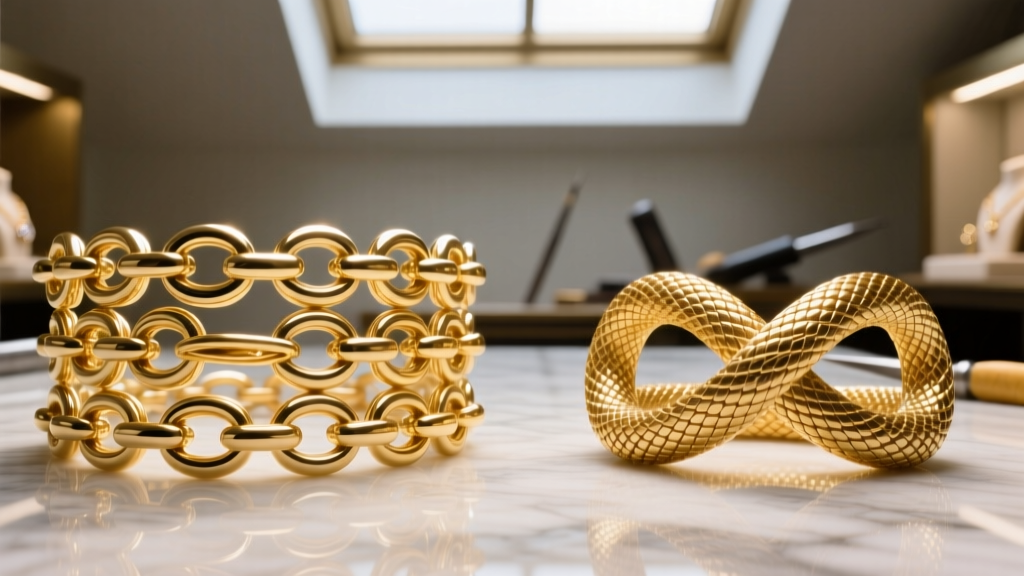
Milanese Mesh
Originating from specialized metal-weaving looms adapted from the textile industry, Milanese mesh consists of continuous micro-wires that are interlocked in a spiral or flat weave without the use of solder. This creates a remarkably smooth, flat surface that reflects light uniformly. However, because the wires are merely looped through one another, Milanese mesh has a distinct 'grain.' It is highly flexible along its longitudinal axis but rigid laterally. Bending it against this lateral grain forces the wires past their elastic limit, resulting in permanent kinks.
Cobra Mesh
Often confused with true woven mesh, Cobra is technically a micro-link chain where flat, interlocking rings are compressed tightly together. It lacks the continuous wire structure of Milanese mesh, making it slightly heavier and less fluid, but significantly more resistant to lateral kinking. The interlocking links distribute stress more evenly across the chain's width.
| Weave Type | Wire Gauge (Typical) | Lateral Flexibility | Kink Resistance | Primary Failure Mode |
|---|---|---|---|---|
| Milanese (Flat) | 0.15mm - 0.25mm | Low (Rigid) | Moderate | Lateral wire buckling |
| Milanese (Tubular) | 0.20mm - 0.30mm | High (Omnidirectional) | Low | Hollow core crushing |
| Cobra | N/A (Link-based) | Moderate | High | Link separation at clasp |
Clasp Mechanics and Failure Points in Mesh Chains
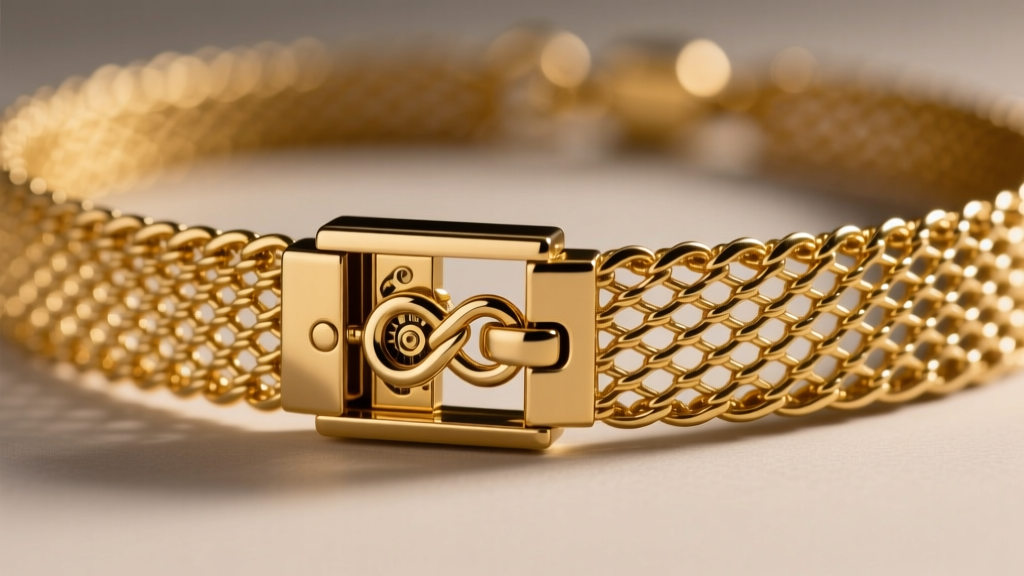
The most critical vulnerability of any mesh necklace is the transition point where the flexible metal fabric meets the rigid clasp assembly. This junction acts as a severe stress concentrator. When a heavy gold mesh chain swings, the kinetic energy is transferred directly to the end-caps (often called 'cigar bands'), which can fatigue the solder joints over time.
The End-Cap Transition and Laser Welding
Historically, end-caps were attached using traditional torch soldering. This method is highly problematic for mesh because the woven gold wires act as a heat sink, rapidly wicking thermal energy away from the joint and risking the melting of the delicate outer wires. Today, precision manufacturers utilize laser welding to fuse the end-caps to the mesh. Laser welding provides localized, high-intensity heat that secures the joint without compromising the structural integrity of the surrounding weave.
For heavy gold mesh (over 40 grams), a standard lobster clasp is insufficient. A concealed tongue-and-groove box clasp, reinforced with a dual figure-8 safety catch, is mandatory to prevent catastrophic loss if the primary locking mechanism fails.
Historical Manufacturing: From Textile Looms to CNC
The evolution of the mesh necklace is a fascinating intersection of horology, textiles, and metallurgy. As documented by Lang Antiques University, early Victorian mesh was painstakingly hand-knitted or woven using fine wire, a process that limited production to small, rigid purse frames and watch fobs. The breakthrough occurred in the early 20th century when manufacturers adapted automated ribbon and textile looms to handle annealed gold and silver wires.
Modern manufacturing has introduced CNC-guided weaving and automated tension-control systems. These machines can maintain exact micro-tension on dozens of spools simultaneously, ensuring that the resulting mesh fabric has zero slack. This precision is what gives high-quality gold mesh its signature 'liquid metal' drape, allowing it to pool and flow over the collarbone without bunching.
Maintenance: Preventing Kinks and Wire Fractures
Proper maintenance of a gold mesh necklace requires an understanding of metal fatigue and capillary action. The most common cause of irreversible damage is improper storage, which leads to kinking. Once a micro-wire undergoes plastic deformation (kinking), it cannot be perfectly straightened without annealing and re-weaving—a process that is economically unfeasible.
Furthermore, cleaning mesh requires specific protocols to avoid chemical and structural damage. Jewelers Mutual advises caution when dealing with intricate jewelry structures. Follow these strict technical guidelines for maintenance:
- Storage Geometry: Never store a mesh necklace in a tangled pile. It must be laid perfectly flat in a lined drawer or hung from a wide, padded hook that supports the entire length of the chain to prevent gravity-induced stress on the upper links.
- The Ultrasonic Hazard: Avoid ultrasonic cleaners, especially for tubular or hollow-core mesh. The high-frequency vibrations can cause micro-fractures in work-hardened wires. Additionally, capillary action can trap cleaning solutions inside the hollow mesh core, leading to galvanic corrosion and subsequent skin discoloration from copper alloys.
- Chemical Cleaning: Use only a mild, non-ionic surfactant and a soft-bristled brush, stroking strictly in the longitudinal direction of the weave. Never scrub laterally, as this can lift and snag the interlocking micro-wires.
Conclusion: Investing in Precision Craftsmanship
A gold mesh necklace is not merely a decorative accessory; it is a feat of micro-engineering and metallurgical precision. By understanding the interplay between karat weight, weave architecture, and clasp mechanics, collectors and consumers can make informed decisions that prioritize both aesthetic beauty and structural longevity. Whether opting for the fluid drape of 18k Milanese or the rugged resilience of 14k Cobra, respecting the technical limits of the metal ensures the piece remains a flawless, liquid-gold statement for decades.


