2026 Visual Merchandising: The Evolution of Necklace Displays
Discover how 2026 necklace displays are evolving. Explore kinetic fixtures, 95+ CRI lighting, and architectural merchandising for high-end jewelry.

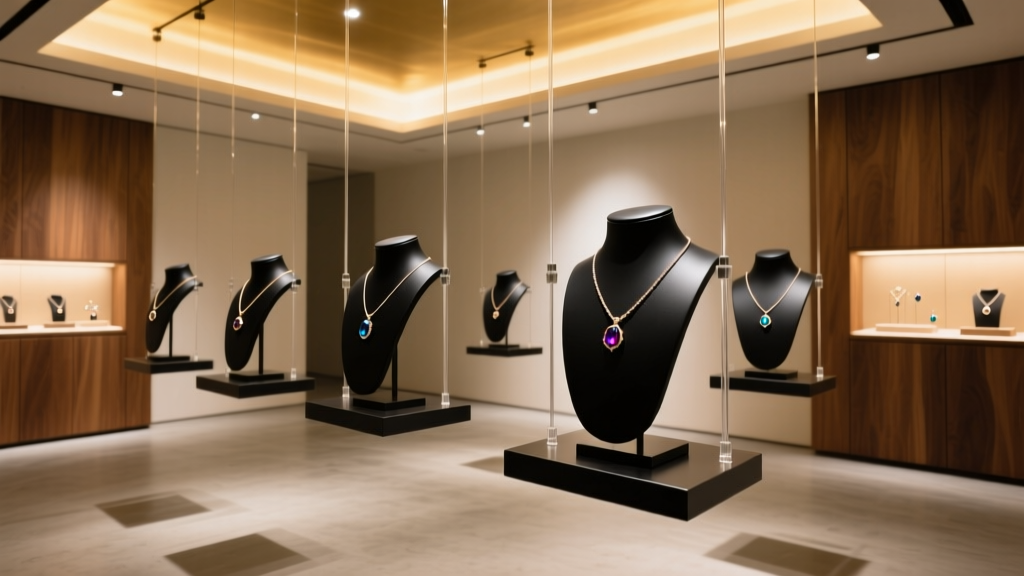
The Shift from Static to Architectural Merchandising
The era of the flat, lifeless velvet bust is officially over. As we navigate the retail landscape of 2026, visual merchandising for necklaces and pendants has undergone a radical transformation, shifting toward architectural, interactive, and technologically integrated displays. High-end jewelry boutiques and direct-to-consumer brands are no longer treating necklace displays as mere storage solutions; they are engineering them as dynamic stages designed to manipulate light, emphasize chain layering, and justify premium price points.
According to recent retail design analyses published by JCK, the modern consumer's perception of a jewelry piece's value is heavily influenced by the spatial geometry of its presentation. The standard flat bust, which forces chains to lie flush against a 2D plane, obscures the three-dimensional craftsmanship of pendant bails and chain links. In 2026, the industry standard has shifted to the "15-degree backward tilt" rule. By angling the neck form backward at precisely 15 degrees, merchandisers ensure that pendants naturally rest at the lowest point of the chain without sliding off the form, while simultaneously angling the gemstone's table directly toward the overhead case lighting to maximize scintillation.
Material Science in Modern Fixture Design
The tactile and visual properties of the display material play a critical role in color contrast and perceived luxury. Traditional polyurethane foam wrapped in standard velvet is being rapidly replaced by advanced composites and metals that resist tarnish transfer and fingerprint smudging.
| Material Grade | Reflectivity & Contrast | Avg. Unit Cost (2026) | Best Use Case |
|---|---|---|---|
| Cast Acrylic (Lucite) | High gloss; invisible profile | $85 - $140 | Layered diamond tennis necklaces |
| Anodized Aluminum | Matte/Satin; zero glare | $120 - $250 | Chunky gold chains, industrial aesthetics |
| Treated Walnut & Brass | Warm, organic texture | $180 - $350 | Heritage brands, vintage-inspired lockets |
| Pacific Cloth-Wrapped MDF | Ultra-matte; light absorbing | $45 - $90 | High-volume silver and oxidized metals |
Anti-tarnish technology is now embedded directly into the display surfaces. For fabric-wrapped displays, Pacific cloth—which contains microscopic silver particles that neutralize sulfur gases in the air—is the mandatory baseline to prevent sterling silver chains from yellowing while on the showroom floor. For hard surfaces like acrylic, anti-static coatings are applied to prevent dust accumulation, a persistent issue that degrades the brilliance of displayed diamonds.
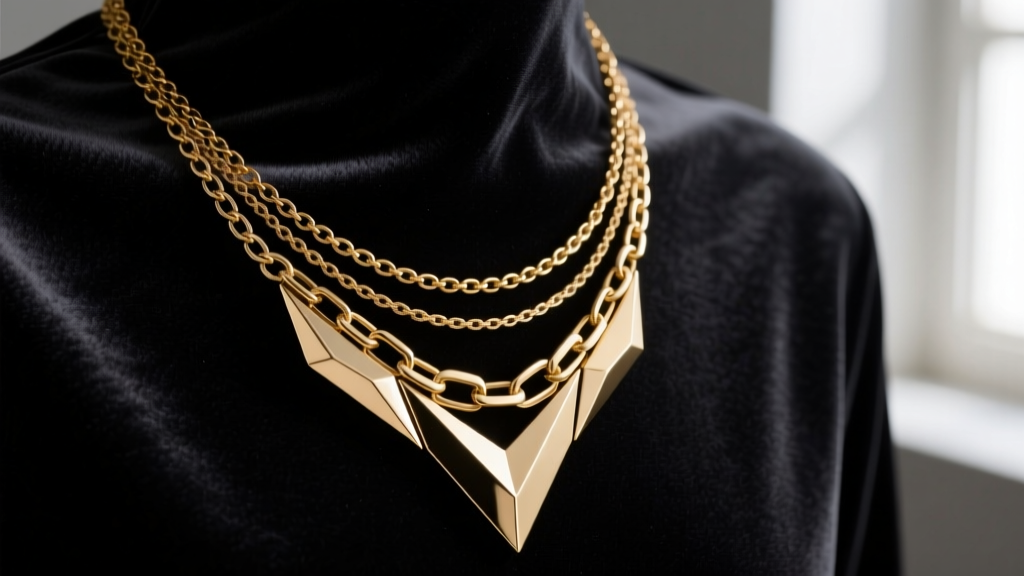
Kinetic and Levitating Technologies for High-Carat Pendants
For high-ticket items, particularly solitaire pendants exceeding 2 carats or complex multi-gemstone lockets, static displays fail to capture the full optical performance of the stones. The 2026 trend in luxury visual merchandising heavily favors kinetic movement to showcase diamond fire and scintillation from every angle.
Motorized Turntables vs. Magnetic Levitation
Micro-motorized turntables, operating at a nearly imperceptible 1 RPM (revolution per minute), are now integrated into the base of premium necklace busts. This slow rotation ensures that as a customer walks past the case, the diamond catches the light continuously, creating a "sparkle trail" that draws the eye from across the store. These units typically retail between $400 and $800 per fixture and require concealed, low-voltage wiring routed through the display case shelving.
At the absolute pinnacle of luxury merchandising, magnetic levitation bases are being deployed for flagship pieces. By suspending a minimalist, clear acrylic pendant holder in mid-air using electromagnetic fields, brands eliminate all visual clutter, forcing the customer's focus entirely onto the floating gemstone. While the ROI on a $2,500 levitation fixture requires housing a piece valued at $50,000 or more, the psychological impact of a "floating" diamond significantly elevates the brand's prestige and justifies the premium pricing.
Lighting Integration: The 95+ CRI Standard
A necklace display is only as effective as the lighting that strikes it. In 2026, embedding micro-LED strips directly into the "neck" or collarbone area of the display form has become a hallmark of elite boutique design. However, the critical metric is no longer just brightness; it is the Color Rendering Index (CRI).
Standard retail lighting often hovers around an 80 CRI, which washes out the subtle secondary hues of fancy colored diamonds and makes rose gold look artificially yellow. Modern architectural displays now feature integrated 95+ CRI LED micro-strips. Furthermore, merchandisers are utilizing dual-temperature displays: embedding 3000K (warm white) LEDs on the left side of the case to optimize the rich tones of 18k yellow gold, and 4500K (cool white) LEDs on the right side to maximize the icy brilliance of platinum and white gold settings.
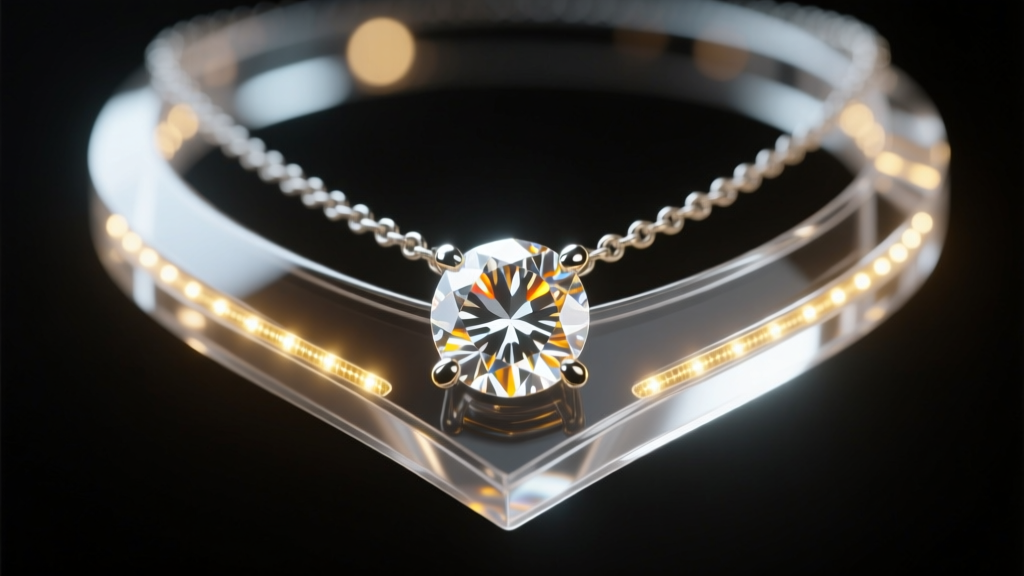
Brands like WAC Lighting and Luminii have pioneered these micro-flex LED tapes, allowing fixture designers to route lighting through the impossibly thin profiles of modern acrylic necklace forms. The result is a display that appears to glow from within, providing fill-light that eliminates the harsh shadows traditionally cast by overhead case lighting onto the lower half of a pendant.
The Layering Bar Concept: Spatial Metrics
With chain layering remaining a dominant styling trend in 2026, boutiques are replacing traditional busts with "Layering Bars"—modular, architectural peg systems that allow customers and sales associates to visually mix and match chain lengths and pendant weights. Designing an effective layering bar requires strict adherence to spatial metrics to prevent tangling and visual clutter.
- Peg Spacing: Horizontal pegs must be spaced exactly 45mm apart. Anything closer risks chain tangling; anything wider breaks the visual cohesion of the layered set.
- Upward Pitch: Pegs are angled upward at a 5-degree pitch. This prevents delicate chains (like 14k gold cable or serpentine chains under 1.5mm thick) from sliding off the fixture when the case is opened or bumped.
- Depth Staggering: To simulate how chains will lay on a human collarbone, the pegs are staggered in depth. The 16-inch choker peg sits 10mm forward of the 18-inch princess peg, ensuring the pendants do not collide or overlap unnaturally.
- Weight Testing: Fixtures must be rated to hold up to 150 grams per peg without bowing, accommodating heavy figaro or Cuban link chains without warping the acrylic or brass over time.
Conclusion: ROI of the Display Upgrade
Upgrading to modern, architecturally sound necklace displays is no longer a superficial aesthetic choice; it is a measurable conversion driver. By implementing the 15-degree tilt, utilizing 95+ CRI integrated lighting, and adopting modular layering bars, retailers report a significant increase in dwell time at the necklace case. When a customer can clearly see the intricate bail work of a pendant, observe the untangled flow of a layered chain setup, and experience the true color of the metal under optimized lighting, the perceived value of the jewelry aligns seamlessly with its price tag. As visual merchandising continues to evolve, the fixture itself has become the silent, yet most persuasive, sales associate on the floor.


