Mookaite Necklace Buying Guide: Stone Quality & Settings
Discover how to choose the perfect mookaite necklace. Learn to identify authentic Australian jasper, compare settings, and find the right price point.

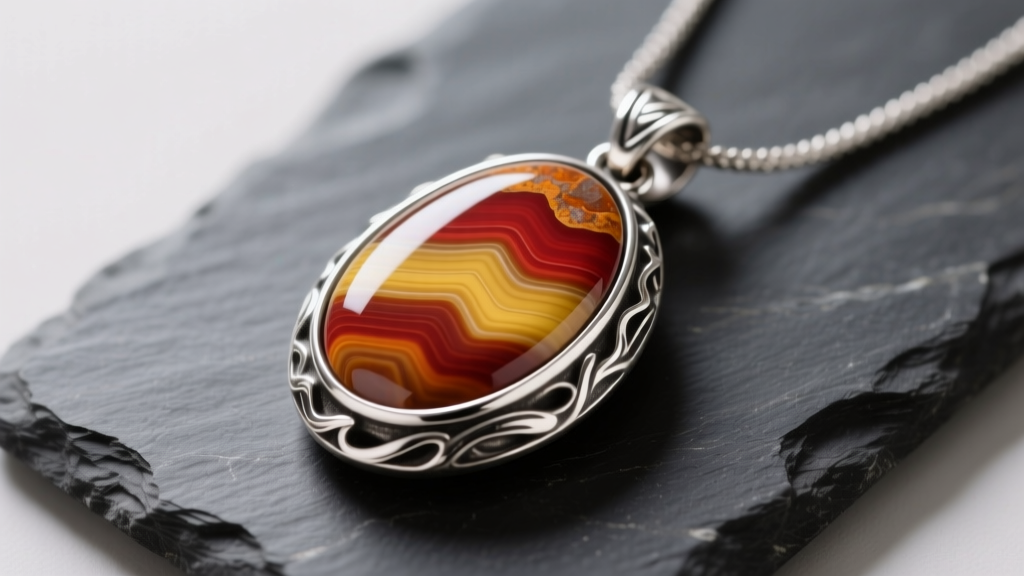
Mookaite, frequently marketed as "Australian Jasper," is one of the most visually striking and energetically sought-after gemstones in the contemporary jewelry market. Sourced exclusively from the Kennedy Ranges of Western Australia, this vibrant stone features a breathtaking palette of brick red, mustard yellow, cream, and deep mauve. However, navigating the market for a mookaite necklace requires a discerning eye. Because of its unique mineralogical composition and rising popularity in the 2026 artisan jewelry space, buyers must understand how to evaluate stone quality, authenticate genuine material, and select hardware that ensures the piece lasts a lifetime.
The Mineralogy of Mookaite: What You Are Actually Buying
To buy intelligently, you must first understand the geology. While universally sold as "jasper," Mookaite is technically a silicified porcellanite and radiolarite. According to Mindat's mineralogical database, true jasper is a microcrystalline quartz, whereas Mookaite is an ancient sedimentary rock formed from the silica-rich remains of radiolarians (microscopic marine organisms) mixed with clay and iron oxides.
This distinction is critical for jewelry buyers for two reasons:
- Variable Hardness: While the highly silicified red and yellow bands approach a Mohs hardness of 6.5 to 7, the darker, clay-rich matrix bands can be significantly softer (around 5.5). This makes the stone susceptible to pitting and scratching if not set correctly.
- Porosity: Unlike agate or pure quartz jasper, the clay inclusions in Mookaite make it slightly porous. It will absorb harsh chemicals, lotions, and even the natural oils from your skin over time, which can dull its polish.
Cabochon Pendants vs. Beaded Strands
When shopping for a mookaite necklace, you will primarily encounter two styles. Each requires a different approach to quality assessment.
The Cabochon Cut: Showcasing the Landscape
Cabochons are polished, non-faceted domes that act as a window into the stone's internal "landscape." Because Mookaite's value lies in its bold, contrasting banding, a high-quality cabochon should feature sharp, distinct transitions between the mustard yellow and deep red zones. Avoid stones with excessive "muddy" brown blending, as this indicates a high concentration of low-grade clay matrix.
Setting Requirement: Always opt for a bezel setting (where a metal rim completely encircles the stone's edge). Prong settings leave the softer clay edges exposed, making them highly vulnerable to chipping from everyday impacts against desks or doorframes.
Beaded Mookaite Necklaces
Beaded strands range from uniform 4mm rondelles to heavy 12mm spheres. When evaluating a beaded necklace, the drill holes are your best indicator of manufacturing quality. Look closely at the holes: they should be clean, smooth, and free of jagged "blowouts" where the drill bit exited the stone.
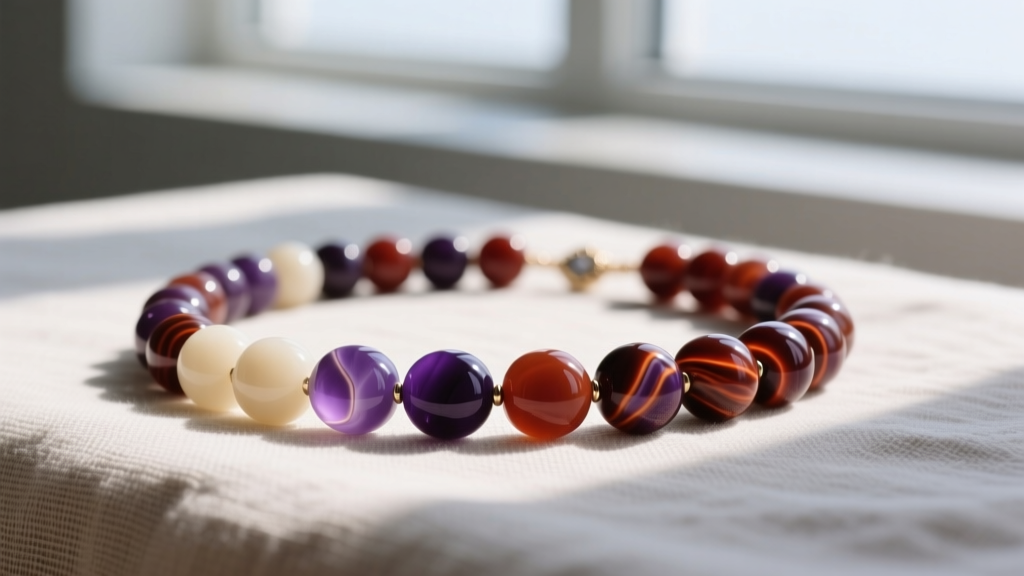
The Knotting Imperative: High-end beaded Mookaite must be knotted on silk or high-tensile nylon between every bead. Because silica dust is highly abrasive, unknotted beads will grind against each other over time, slowly enlarging the drill holes and eventually compromising the structural integrity of the strand.
How to Authenticate Genuine Mookaite
As demand has surged, the market has seen an influx of dyed howlite, generic banded agate, and low-grade mudstone passed off as premium Mookaite. Use this framework to verify authenticity:
- The Luster Test: Genuine Mookaite has a distinct waxy-to-matte luster in its unpolished or semi-polished matrix areas, whereas dyed agate will appear glassy or vitreous.
- The Opacity Check: Hold the stone up to a strong LED flashlight. True Mookaite is entirely opaque. If you see translucent veining or light passing through the edges, you are likely looking at dyed chalcedony or agate.
- Color Realism: Mookaite's yellow is a specific, earthy mustard tone. If the yellow appears neon, overly bright, or uniform without natural gradient fading into the red bands, it has likely been chemically enhanced.
Hardware, Metals, and Findings
A heavy Mookaite cabochon (a 20x30mm stone can easily weigh 15 to 20 carats) requires robust hardware. Flimsy, glue-on bails will inevitably fail, dropping the stone onto hard surfaces and causing catastrophic fractures.
- Sterling Silver (925): The cool, oxidized tones of antiqued sterling silver provide a stunning contrast to Mookaite's warm earth tones. Ensure the silver is rhodium-plated if you want to prevent tarnish, though many collectors prefer the dark patina of oxidized silver.
- Gold Vermeil & Solid 14k: Yellow gold naturally harmonizes with the mustard bands in the stone. For everyday wear, solid 14k gold is recommended over vermeil, as the friction from the heavy stone can eventually wear through the thin gold plating on a vermeil bail.
- The Bail: Insist on a mechanical bail (secured with pegs and jeweler's epoxy) or a cast bezel cup with an integrated bail. Avoid simple pinch bails for stones heavier than 10 carats.
Mookaite Necklace Pricing & Quality Matrix (2026 Market Rates)
| Necklace Style | Material & Setting | Expected Price Range | What to Look For |
|---|---|---|---|
| Simple Beaded Strand (18") | 8mm beads, unknotted nylon | $35 - $75 | Uniform bead sizing, secure barrel clasp. |
| Premium Beaded Strand (18") | 10mm beads, hand-knotted silk | $120 - $250 | Flawless drill holes, high color contrast, sterling clasp. |
| Cabochon Pendant | Sterling Silver Bezel Setting | $85 - $180 | Tight bezel wrap, integrated cast bail, distinct banding. |
| Artisan Designer Piece | 14k Solid Gold, Custom Cut | $350 - $800+ | Freeform or precision fantasy cuts, heavy gold weight, signed maker's mark. |
Length, Proportion, and Neckline Pairing
Because Mookaite features bold, high-contrast patterns, it acts as a statement piece. The length of the necklace dictates how it interacts with your wardrobe.
- Choker (16 inches): Best reserved for smaller, 4mm to 6mm beaded strands. A heavy cabochon on a 16-inch chain will sit too high on the collarbone and feel restrictive.
- Princess (18 inches): The universal standard. An 18-inch chain places a cabochon pendant perfectly in the hollow of the throat, making it ideal for crew necks and scoop necks.
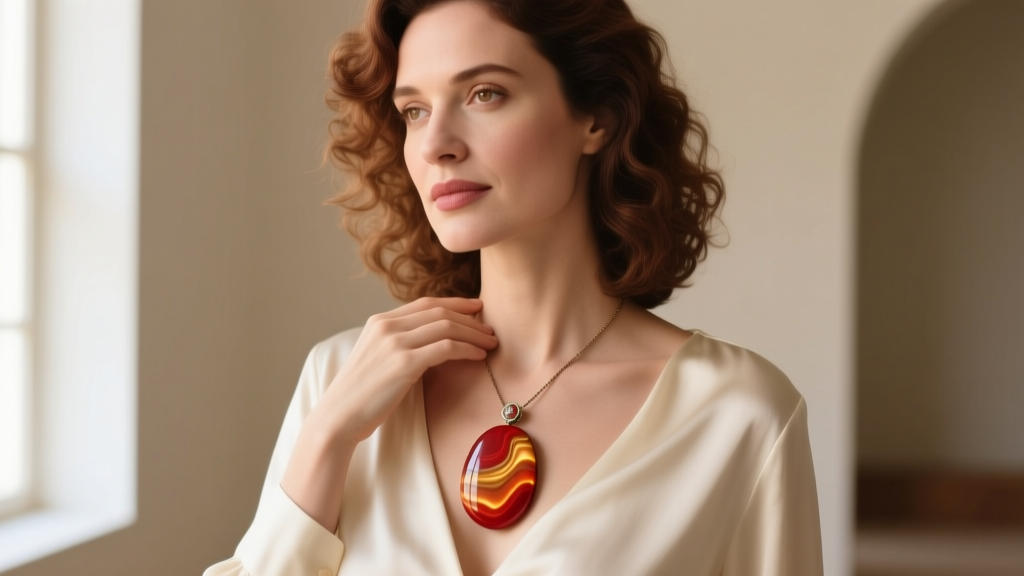
- Matinee (20 to 24 inches): Highly recommended for large, heavy Mookaite pendants. The extra length allows the stone to rest against the sternum, providing a striking visual anchor over V-neck blouses, tunics, and winter sweaters.
Critical Care Instructions for Porous Jasper
Proper maintenance is non-negotiable for preserving the polish and structural integrity of your Mookaite jewelry. According to gemological care guidelines outlined by Jewelers of America, porous and matrix-heavy stones require specialized handling.
Expert Warning: Never place a Mookaite necklace in an ultrasonic cleaner. The high-frequency vibrations will exploit the microscopic fault lines between the hard silica bands and the soft clay matrix, leading to internal fracturing and eventual stone failure.
Routine Cleaning: Use a soft, lint-free microfiber cloth dampened with warm water and a drop of pH-neutral dish soap. Gently wipe the stone, avoiding vigorous scrubbing on the darker matrix bands. Dry immediately with a separate soft cloth.
Storage: Store your Mookaite necklace in a soft cotton pouch, separate from diamonds, sapphires, or even quartz jewelry. While the silica bands are relatively hard, the clay inclusions can easily be scratched by harder gems tumbling against them in a shared jewelry box.
Final Verdict: Investing in Earth's Canvas
A mookaite necklace is more than just an accessory; it is a wearable piece of ancient Australian geological history. By prioritizing bezel settings for cabochons, demanding hand-knotting for beaded strands, and strictly avoiding ultrasonic cleaners, you ensure that the vibrant reds and mustard yellows of your stone remain as striking as the day it was unearthed from the Kennedy Ranges. When you know exactly what to look for, you can confidently invest in a piece that balances natural beauty with enduring craftsmanship.


