Expert Care Guide: Cleaning Your Moravian Star Necklace
Learn expert techniques to clean, polish, and store your moravian star necklace. Discover how to remove tarnish from intricate geometric crevices.


The Unique Cleaning Challenges of Moravian Star Pendants
The Moravian star is a masterpiece of geometric jewelry design. Mathematically known as a rhombicuboctahedron, this intricate shape features 26 distinct points, 18 square faces, and 8 triangular faces. While this complex architecture creates a stunning, light-catching pendant, it also creates a nightmare for jewelry maintenance. The deep 90-degree and 45-degree inner angles act as microscopic traps for sebum, dead skin cells, cosmetic lotions, and environmental pollutants.
Unlike a simple dome or flat disc pendant, you cannot simply wipe a moravian star necklace with a standard polishing cloth. The cloth cannot reach the inner vertices, and if you attempt to use traditional paste polishes, the abrasive compounds will dry into a stubborn, chalky white residue deep within the crevices. According to the Gemological Institute of America (GIA), improper cleaning of textured or geometric silver jewelry is one of the leading causes of long-term surface degradation and trapped corrosive agents.
Step-by-Step Cleaning Guide for Sterling Silver and Gold Stars
To properly restore the brilliance of your pendant without damaging the sharp points or trapping polish in the seams, you must rely on liquid-based degreasing and chemical ion exchange rather than mechanical friction.
Phase 1: Deep Degreasing
Before tackling silver sulfide (tarnish), you must strip away the invisible layer of body oils that acts as a barrier to your cleaning agents.
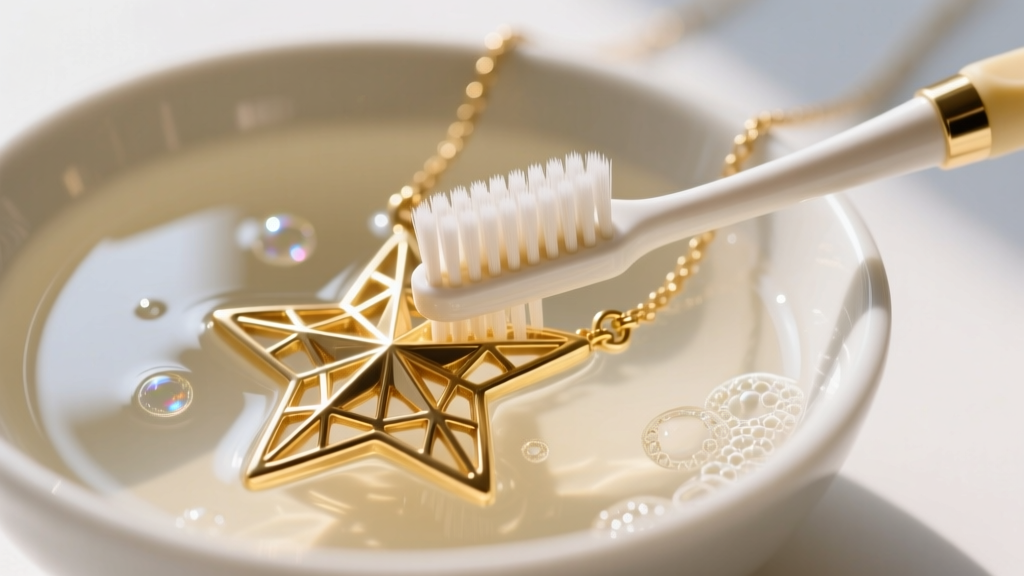
- The Solution: Mix 1 cup of warm (not hot) distilled water with three drops of a mild, phosphate-free dish soap like Dawn.
- The Tool: Use an extra-soft baby toothbrush. Standard adult toothbrushes have bristles that are too stiff and can micro-scratch high-polish gold or silver faces.
- The Technique: Submerge the pendant for 5 minutes. Then, holding the pendant by the bail, gently agitate the brush into the inner vertices using small circular motions. Rinse thoroughly under a gentle stream of lukewarm distilled water to prevent hard water spot mineral deposits.
Phase 2: Tarnish Removal via Ion Exchange
If your sterling silver moravian star has developed a yellow or black tarnish in the recessed angles, mechanical polishing will fail. Instead, use a galvanic ion exchange bath. This method reverses the chemical reaction that causes tarnish (silver sulfide) without removing any of the underlying precious metal.
- Line a glass or ceramic bowl with aluminum foil, shiny side facing up.
- Place your moravian star necklace on the foil, ensuring the silver touches the aluminum.
- Sprinkle 1 tablespoon of baking soda and 1 tablespoon of kosher salt over the pendant.
- Pour boiling water into the bowl to submerge the piece. You will immediately see bubbling and smell a faint sulfur (rotten egg) odor. This is the sulfur leaving the silver and bonding with the aluminum.
- Leave for 3 to 5 minutes, then remove with wooden tongs, rinse in distilled water, and pat dry with a microfiber cloth.
Critical Warning: Never use the aluminum foil bath if your moravian star features an intentionally oxidized (blackened) finish designed to highlight the geometric edges. This process will strip the antiquing, leaving the piece flat and washed out. For oxidized pieces, use only the Phase 1 degreasing method and a targeted Sunshine polishing cloth on the raised points only.
Cleaning Solutions Comparison Chart
Choosing the wrong chemical agent can permanently pit your jewelry or strip rhodium plating. Use this matrix to determine the safest approach for your specific piece.
| Cleaning Method | Best Used For | Risk Level | Effect on Crevices |
|---|---|---|---|
| Mild Dish Soap Bath | Daily grime, lotions, all metals | Very Low | Excellent (flushes debris) |
| Aluminum Foil Ion Bath | Heavy black tarnish on solid silver | Medium (strips oxidation) | Superior (chemical reach) |
| Commercial Silver Foam | Moderate tarnish, gold-plated silver | Low | Good (requires rinsing) |
| Chemical Liquid Dips | Avoid entirely | Extremely High | Poor (causes micro-pitting) |
As noted by Jewelers of America, chemical liquid dips (often containing thiourea and harsh acids) should never be used on geometric jewelry. They strip the metal's natural luster, leaving a dull, matte finish that requires professional re-polishing to fix.
Chain Maintenance and Detangling the Points
The 26 sharp vertices of a moravian star act like tiny grappling hooks. If paired with the wrong chain, the pendant will constantly snag, leading to severe tangling and potential kinking of the chain links. Snake chains, box chains, and omega chains are highly susceptible to catching on the star's points.
The Ideal Chain Pairing: Opt for a 1.2mm to 1.5mm rope chain or a standard cable chain. The rounded, continuous links allow the sharp points of the star to glide off rather than wedge into tight seams. Furthermore, ensure the jump ring connecting the pendant to the chain is soldered closed; an open jump ring will eventually be pulled apart by the pendulum weight of the heavy geometric star.
Detangling Protocol: If the star points become hopelessly knotted in a fine chain, do not pull. Lay the necklace on a flat, well-lit surface. Apply a single drop of mineral oil or baby oil directly to the knot to eliminate friction. Using two fine sewing needles, gently pick the center of the knot outward, allowing the chain links to slide off the star's points one by one.
Proper Storage to Prevent Tarnish and Bending
A moravian star necklace requires specialized storage. Tossing it into a communal jewelry box guarantees two things: rapid tarnishing from exposure to ambient humidity and sulfur in the air, and bent points from being crushed under heavier items.
A bent point on a Moravian star ruins the optical symmetry of the rhombicuboctahedron. Fixing a bent vertex is not a simple pliers job; it requires a master jeweler to use a laser welder and a custom mandrel to reshape the metal without leaving fire-scale marks or melting the adjacent solder joints.
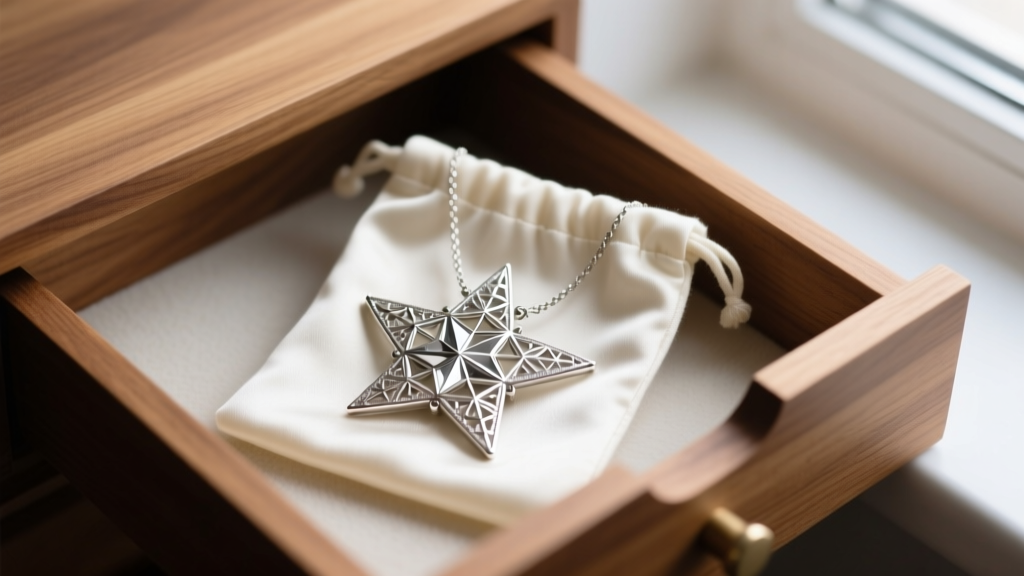
To prevent this, store your necklace in a dedicated Pacific Silvercloth pouch. These specialized flannel bags are embedded with microscopic silver particles that intercept and absorb tarnish-causing gases before they reach your pendant. Include a small packet of silica gel in your storage drawer to control ambient moisture, ensuring your geometric masterpiece remains pristine and mathematically perfect for decades to come.


