Necklace Crystal Meanings: Gemological & Wearability Guide
Explore necklace crystal meanings through a gemological lens. Learn how Mohs hardness, cleavage, and mineral structure affect pendant wearability.

The Intersection of Metaphysics and Mineralogy
When consumers research necklace crystal meanings, they are typically seeking a spiritual, emotional, or psychological resonance from their jewelry. The market is saturated with claims that specific stones attract love, ward off negativity, or promote mental clarity. However, as gemologists and jewelry engineers, we must bridge the gap between metaphysical intent and mineralogical reality. A crystal's 'meaning' is only as enduring as its physical ability to survive the harsh environment of the human décolletage.
The chest area is a high-impact, high-exposure zone. Pendants are subjected to swinging impacts, thermal shock from body heat to winter air, and constant exposure to sebum, lactic acid, and cosmetic chemicals. Understanding the crystal structure, Mohs hardness, and cleavage planes of popular 'meaning' stones is critical for selecting a necklace that will last a lifetime rather than degrading in a matter of months. This guide deconstructs the most sought-after necklace crystal meanings through a strict technical and gemological lens.
Technical Breakdown: Popular Crystals and Their Wearability
Amethyst (Quartz): The 'Calm and Clarity' Stone
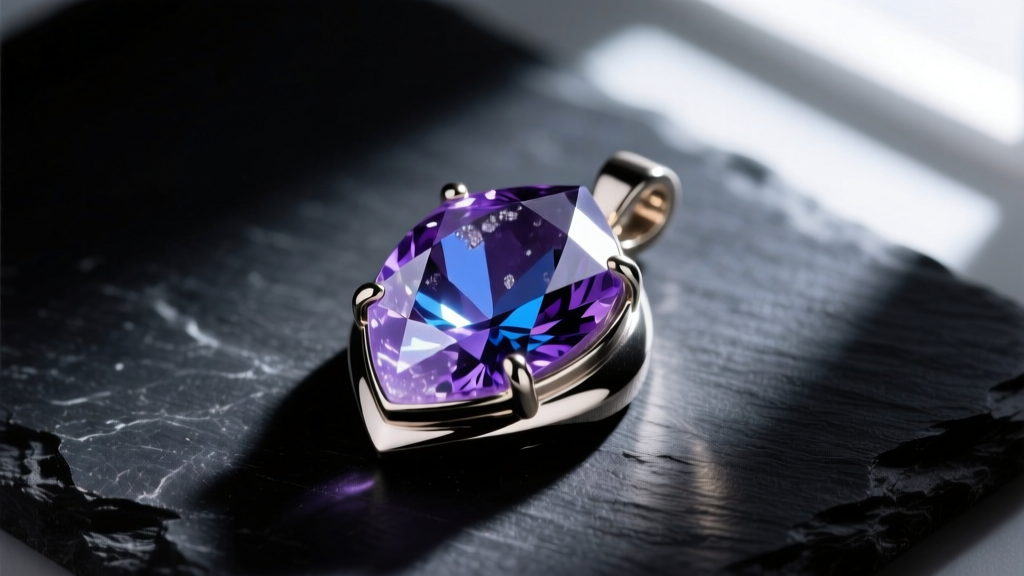
Amethyst is universally associated with mental clarity, stress relief, and spiritual grounding. Gemologically, it is a purple variety of macrocrystalline quartz (SiO2), colored by iron impurities and natural irradiation within the crystal lattice. It operates in the trigonal crystal system and lacks true cleavage, meaning it does not split along defined planar weaknesses. Instead, it exhibits a conchoidal (shell-like) fracture.
With a Mohs hardness of 7, amethyst is highly suitable for daily-wear pendants. However, its primary vulnerability is photochemical degradation. Prolonged exposure to direct ultraviolet (UV) radiation can cause the iron-based color centers to fade, turning a vibrant purple pendant into a washed-out gray or yellowish stone over several years. Furthermore, consumers should be aware that much of the commercial 'citrine' on the market is actually heat-treated amethyst, a process that permanently alters the stone's oxidation state at temperatures around 470°C. For authentic amethyst pendants, opt for deep Siberian or Uruguayan hues, and store the necklace away from direct sunlight when not in use. For more on quartz varieties, consult the Gemological Institute of America (GIA).
Rainbow Moonstone (Feldspar): The 'Intuition and New Beginnings' Stone
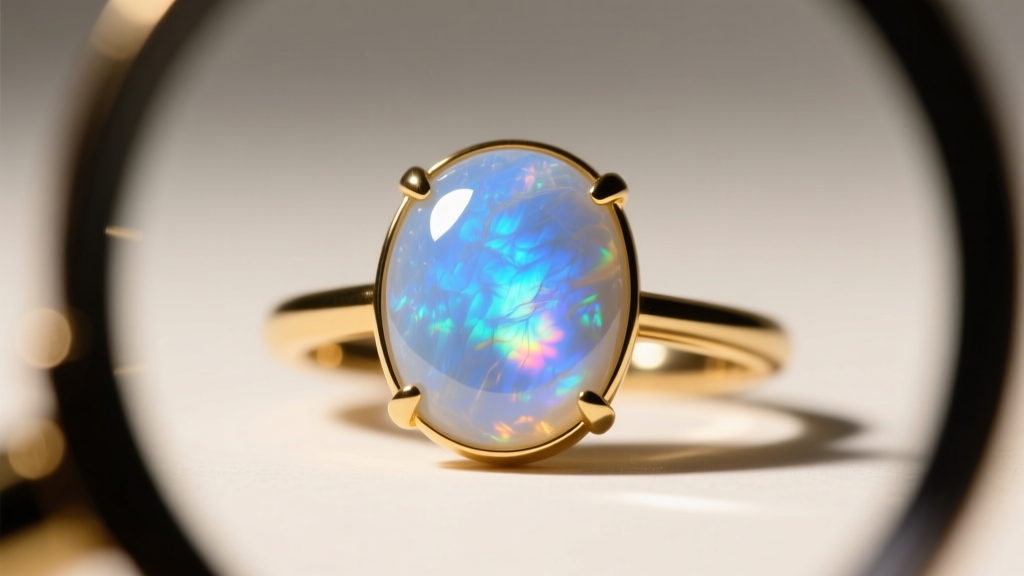
Prized for its ethereal blue sheen, rainbow moonstone is linked to intuition, feminine energy, and emotional balance. Technically, rainbow moonstone is not a true moonstone (orthoclase) but rather a transparent variety of labradorite (plagioclase feldspar). Its signature optical phenomenon, adularescence, is caused by light scattering between microscopic, alternating exsolution lamellae of orthoclase and albite within the stone.
From a wearability standpoint, moonstone presents significant challenges. It ranks between 6 and 6.5 on the Mohs scale, making it susceptible to scratching from common dust (which contains quartz particles at Mohs 7). More critically, feldspar possesses two directions of perfect cleavage. This means a sharp, accidental impact against a marble countertop or a heavy doorframe can cause the cabochon to split cleanly in half. Prong settings are highly discouraged for moonstone pendants; a fully enclosed bezel setting with a shock-absorbing epoxy backing is the only responsible way to secure this stone for daily wear. Read more about its structural properties in GIA's moonstone profile.
Malachite: The 'Transformation and Protection' Stone
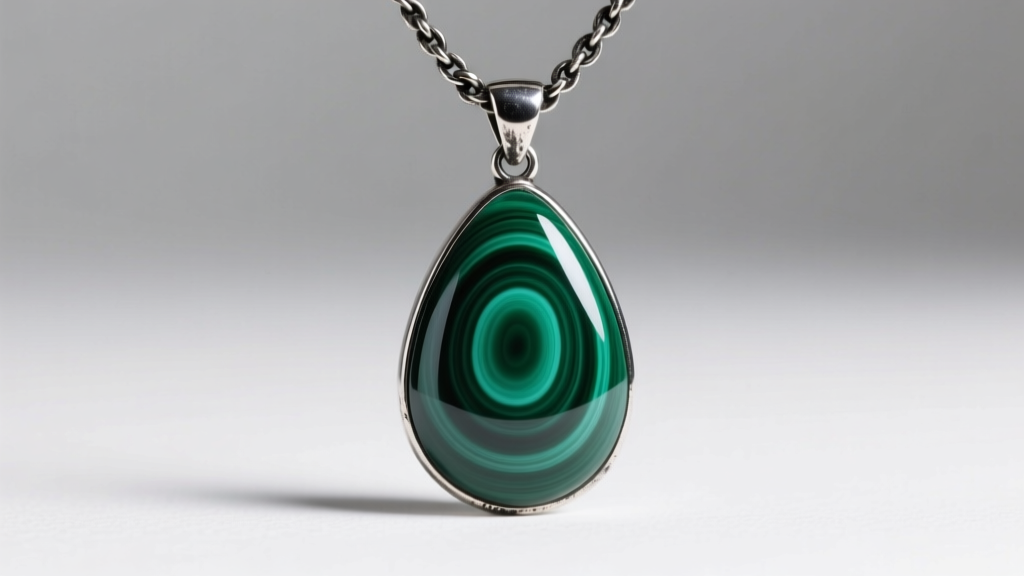
Malachite is heavily favored in metaphysical circles for absorbing negative energies and catalyzing deep personal transformation. Mineralogically, it is a copper carbonate hydroxide (Cu2CO3(OH)2), forming in the oxidized zones of copper ore deposits. Its striking concentric banding is a result of fluctuating oxidation states and impurities during its botryoidal (grape-like) growth process.
Malachite is an exceptionally fragile choice for a necklace pendant. It registers a mere 3.5 to 4 on the Mohs scale, meaning it can be easily scratched by a copper coin or a steel setting tool. Furthermore, it is highly porous and chemically reactive. Human sweat, which contains lactic acid and salts (pH 4.5 to 5.5), will actively dissolve the polished surface of a malachite cabochon, leaving it pitted, dull, and structurally compromised. According to the Mindat.org mineral database, malachite also effervesces in mild hydrochloric acid. If you wear a malachite pendant, it must be sealed with a jewelry-grade cyanoacrylate or epoxy resin, and it should never be worn during exercise or in high-humidity environments.
Labradorite: The 'Magic and Shielding' Stone
Labradorite is sought after for its supposed ability to shield the aura and enhance mystical awareness. Its technical claim to fame is 'labradorescence'—a schiller effect displaying flashes of peacock blue, gold, and green. This is caused by light interference within microscopic twinning planes (Bøggild twinning) in the anorthite-rich plagioclase structure.
Like moonstone, labradorite sits at Mohs 6-6.5 and has perfect cleavage. The primary failure mode for labradorite pendants is 'edge chipping' along the girdle or the flat back of the cabochon. When sourcing a labradorite pendant for its 'shielding' meaning, ensure the stone has a high dome and a thick, reinforced bezel edge to protect the vulnerable cleavage planes from lateral impacts.
The Pendant Setting Matrix: Protecting Your Meaning
Choosing the correct metallurgy and setting architecture is just as important as the crystal itself. The table below outlines the optimal engineering approaches for securing these metaphysical stones.
| Crystal Type | Mohs Hardness | Cleavage / Fracture | Ideal Pendant Setting | Primary Vulnerability |
|---|---|---|---|---|
| Amethyst | 7.0 | No cleavage; Conchoidal fracture | Prong, Bezel, or Tension | UV fading, thermal shock |
| Moonstone | 6.0 - 6.5 | Perfect in 2 directions | Full Bezel with epoxy backing | Impact splitting, scratching |
| Malachite | 3.5 - 4.0 | Perfect in 1 direction | Closed-back Bezel (sealed) | Acid corrosion, scratching |
| Labradorite | 6.0 - 6.5 | Perfect in 2 directions | Thick-walled Bezel | Edge chipping, cleavage splits |
Expert Insight: Never use ultrasonic cleaners on any crystal pendant with perfect cleavage or high porosity. The high-frequency cavitation bubbles will force moisture into micro-fissures, rapidly expanding existing cracks and shattering stones like moonstone and malachite from the inside out.
Environmental Degradation: What Damages Crystal Pendants?
To preserve the physical integrity—and by extension, the symbolic meaning—of your crystal necklace, you must understand the specific environmental failure modes that plague pendant wear:
- Thermal Shock: Moving from a heated indoor environment to freezing outdoor temperatures can cause differential expansion and contraction within the crystal lattice, particularly in stones with high inclusion counts (like rutile-included quartz), leading to internal fracturing.
- Chemical Exposure: Perfumes, hairsprays, and lotions contain alcohols and volatile organic compounds (VOCs) that can strip the polish from softer organic and porous stones. Always apply cosmetics at least 15 minutes before putting on your crystal pendant.
- Galvanic Corrosion: If a porous stone like malachite is set in an unsealed copper or brass bezel, the moisture from the skin can create a galvanic cell, accelerating the oxidation of the metal and staining the stone with irreversible verdigris.
Sourcing and Authenticity: Avoiding Treated 'Meaning' Stones
The high demand for specific necklace crystal meanings has birthed a massive secondary market of treated, dyed, and synthetic imitations. From a technical standpoint, these treatments fundamentally alter the stone's interaction with light and its structural stability.
For example, 'agate' pendants sold in vibrant pinks, blues, and purples are almost universally gray chalcedony that has been boiled in sugar solutions and treated with sulfuric acid or synthetic dyes. These dyes can leach out when exposed to the slight acidity of human sweat, causing the stone to lose its color and potentially irritating the skin. Similarly, 'turquoise' pendants are frequently howlite (a soft borate mineral) dyed with copper-based salts to mimic the matrix of genuine turquoise. Genuine, unstabilized turquoise is highly porous and requires careful maintenance, whereas dyed howlite will eventually reveal its white core as the dye abrades away at the high points of the cabochon.
Final Verdict on Choosing Your Pendant
The true power of a crystal necklace lies not just in its historical or metaphysical associations, but in the geological miracle of its formation. When you wear a pendant, you are wearing a specific arrangement of atoms forged under immense pressure and heat. By respecting the gemological realities of Mohs hardness, cleavage planes, and chemical reactivity, you ensure that the stone you chose for its meaning remains a beautiful, intact heirloom rather than a degraded, chipped disappointment. Always prioritize structural setting integrity and environmental awareness to keep your crystal pendants pristine for decades to come.


