Necklace Hook Engineering: Gauge, Metallurgy, and Failure Analysis
An expert technical deep dive into necklace hook mechanics, covering wire gauge sizes, metallurgical temper, and common clasp failure modes.

The Physics of Tension and Springback
While spring rings and lobster clasps dominate mass-market production, the traditional necklace hook remains a staple in bespoke and high-end jewelry fabrication. From S-hooks to fishhook safety clasps, the mechanics of a hook rely entirely on the principles of elastic deformation and springback. When a bench jeweler forms a wire into a hook, they are engineering a localized spring. The clasp must flex open just enough to clear a jump ring or eyelet, then immediately return to its original geometry to secure the piece. If the metal undergoes plastic deformation—meaning it bends and stays bent—the clasp has failed its primary mechanical purpose. Understanding this boundary between elastic and plastic deformation is the cornerstone of necklace hook engineering.
In 2026, despite advanced CAD/CAM casting techniques, cast hooks are generally avoided by master jewelers. Cast alloys possess a crystalline grain structure that is inherently brittle and lacks the directional tensile strength of drawn wire. A properly engineered necklace hook must be fabricated from wire that has been drawn through a draw plate, aligning the metal's grain structure longitudinally to maximize tensile strength and fatigue resistance.
Wire Gauge Specifications and Load Tolerances
The structural integrity of any hook clasp is dictated by its American Wire Gauge (AWG) thickness and the diameter of the jump ring it engages. A mismatch in gauge and load will result in catastrophic prying. For lightweight chains (under 10 grams), a 20-gauge or 18-gauge wire is sufficient. However, as pendant weight increases, the static load on the clasp requires a thicker cross-section to prevent the hook from pulling open under its own weight.
| AWG Size | Diameter (mm) | Recommended Max Static Load | Ideal Hook Type & Application |
|---|---|---|---|
| 20 Gauge | 0.81 mm | Up to 15 grams | Delicate S-hooks for fine cable chains |
| 18 Gauge | 1.02 mm | 15 - 35 grams | Standard S-hooks, lightweight fishhooks |
| 16 Gauge | 1.29 mm | 35 - 60 grams | Heavy fishhooks, medium shepherd hooks |
| 14 Gauge | 1.63 mm | 60 - 100+ grams | Heavy-duty shepherd hooks, tube clasps |
According to fabrication guidelines from Rio Grande, selecting the correct gauge is only half the battle; the wire must also be paired with an appropriately sized eyelet. A 16-gauge hook engaging a 22-gauge jump ring will cause severe abrasion on the softer, thinner jump ring, eventually slicing through it via friction wear.

Metallurgical Temper: The Hidden Variable
The most common reason a custom necklace hook fails is incorrect metallurgical temper. Wire is sold in various tempers: dead soft, half-hard, hard, and spring-hard. A hook fabricated from dead-soft wire will be malleable and easy to bend, but it will lack the yield strength to snap back into place. It will permanently deform the first time the wearer pulls it.
For optimal springback, a necklace hook should be formed from half-hard or spring-hard wire. In metallurgical terms, this is achieved through work hardening (cold working) or specific heat-treatment quenching protocols. For example, dead-soft 14k yellow gold has a Vickers Hardness (HV) of approximately 70-80. When drawn to a spring-hard temper, that same alloy reaches an HV of 150-160. This doubling in hardness provides the necessary elastic limit. As detailed in GIA's jewelry fabrication resources, attempting to solder a hook after forming it can accidentally anneal the metal, returning it to a dead-soft state and ruining the tension. Master jewelers mitigate this by using laser welders, which localize the heat input and preserve the surrounding wire's spring temper.
Diagnostic Guide to Necklace Hook Failure Modes
When a client returns a broken or compromised necklace, a bench jeweler must diagnose the failure mode to engineer a lasting repair. The three primary failure modes include:
- Lateral Prying (Plastic Deformation): Occurs when the wearer pulls the chain at a 90-degree angle to the clasp, or when a heavy pendant swings and catches on clothing. The lateral force exceeds the metal's yield point, bending the hook outward. Solution: Increase the wire gauge by one step and switch to a half-hard temper.
- Metal Fatigue (Fracture): Common in S-hooks that are repeatedly squeezed closed by the wearer using fingernails or pliers. The constant compression and tension cycle causes microscopic fissures at the apex of the curve, eventually leading to a clean snap. Solution: Anneal and re-forge the curve, or replace with a heavier gauge wire with a wider, more gradual bend radius.
- Textile Snagging and Distortion: Intricate or overly decorative hooks often catch on knitwear. The sudden jerking force distorts the hook's geometry. Solution: Redesign the hook with a flush, tapered entry point, or transition to a shepherd's hook enclosed within a tube receiver.
Engineering Solutions for Heavy Pendants
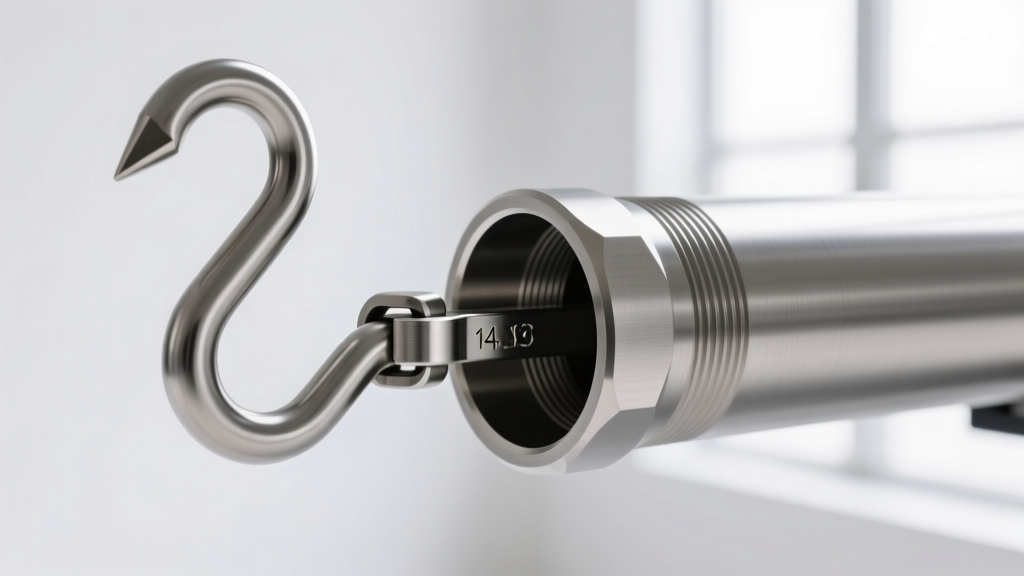
When designing necklaces for heavy pendants (exceeding 50 grams) or multi-strand pearl necklaces, the standard S-hook is mechanically inadequate. The industry standard shifts to the shepherd's hook (often integrated into a bayonet or tube clasp) or the traditional fishhook clasp. The fishhook clasp, characterized by a long, curved wire that threads through a matching eyelet and locks into a secondary safety catch, distributes the static load across a much longer surface area of the wire. This prevents localized stress points.
For heavy pendant applications, a 14-gauge stainless steel or platinum (Pt950/Ru) shepherd hook is ideal. Platinum-ruthenium alloys offer exceptional yield strength and do not suffer from the same work-hardening brittleness as high-karat golds. Furthermore, any heavy-duty hook clasp must be paired with a figure-8 safety chain. The safety chain does not bear the primary static load, but it prevents total loss of the garment in the event of a catastrophic hook failure or accidental unthreading.
Final Bench Notes
The necklace hook is a masterclass in minimalist engineering. It requires no internal springs, no tiny hinges, and no complex moving parts. Its reliability is entirely dependent on the jeweler's understanding of wire gauge, alloy composition, and crystalline temper. By respecting the physics of springback and avoiding the pitfalls of cast components and dead-soft metals, jewelers can fabricate hook clasps that are not only visually elegant but mechanically indefatigable.


