Necklace July Birthstone Guide: Ruby Material & Metal Properties
Discover the material properties of a necklace July birthstone. Compare natural vs. lab-grown rubies and find the best metal chains for your pendant.

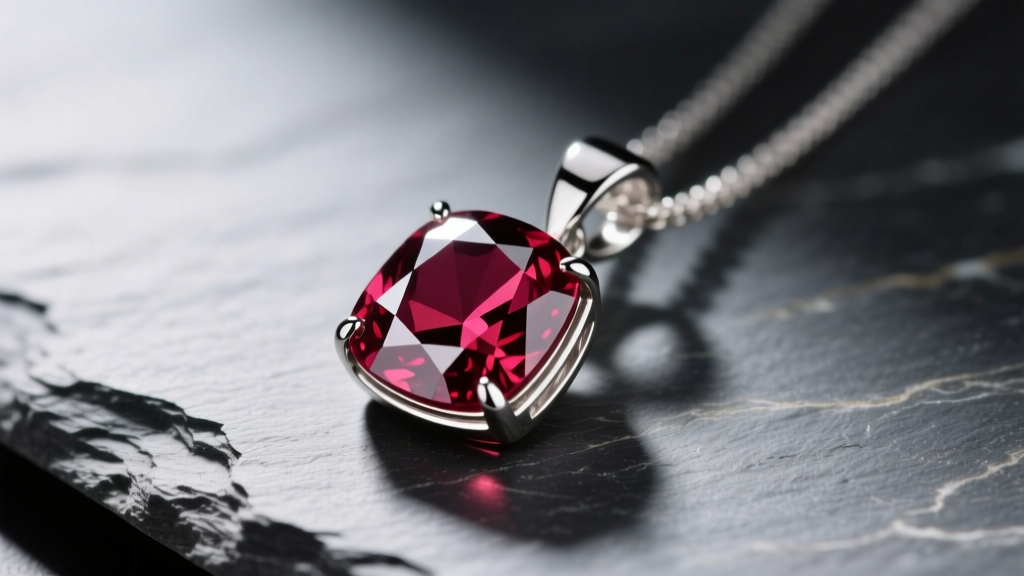
The Core of the Necklace July Birthstone: Understanding Corundum
When selecting a necklace July birthstone, you are fundamentally investing in corundum—specifically, the red variety known as ruby. Chemically, ruby is aluminum oxide (Al2O3). Its signature crimson hue is not inherent to the base mineral but is the result of trace amounts of chromium (Cr3+) replacing aluminum atoms within the crystal lattice. This specific elemental substitution is what separates a true ruby from a pink sapphire, a distinction that remains one of the most debated boundaries in modern gemology.
From a structural standpoint, corundum is remarkably resilient. It ranks at a 9.0 on the Mohs scale of mineral hardness, making it the second hardest natural gemstone after diamond. However, hardness (resistance to scratching) should not be confused with toughness (resistance to breaking). Ruby lacks true cleavage, meaning it does not split along predictable crystallographic planes like diamond or topaz. Instead, it exhibits 'parting' along twin planes, which means a sharp, direct impact to a prong-set ruby pendant can still cause internal fracturing or chipping if the stone has heavy inclusion networks.
Natural vs. Lab-Grown vs. Simulant: A Material Breakdown
The market for a necklace July birthstone is saturated with options ranging from earth-mined gems to advanced laboratory creations and deceptive simulants. Understanding the material genesis is critical for assessing both value and long-term wearability. According to the Gemological Institute of America (GIA), lab-grown rubies share the exact same chemical and optical properties as their natural counterparts, but their inclusion landscapes and growth structures differ vastly.
| Material Type | Growth Method | Specific Gravity | Refractive Index | Key Identifying Features |
|---|---|---|---|---|
| Natural Ruby (Mozambique/Mogok) | Geological (Metamorphic) | 4.00 | 1.762 - 1.770 | Rutile silk, calcite inclusions, angular zoning, twin lamellae. |
| Lab-Grown (Flux) | Flux-Melt Growth | 4.00 | 1.762 - 1.770 | Platinum/crucible metal inclusions, veil-like healing fractures, curved striae. |
| Lab-Grown (Verneuil) | Flame Fusion | 4.00 | 1.762 - 1.770 | Curved growth striae, gas bubbles, extremely high clarity, lower market value. |
| Lead-Glass Filled Ruby | Heavily Treated Natural | ~3.00 - 3.50 | Variable | Blue/orange flash effect in fractures, gas bubbles in glass, highly unstable. |
Buyers must be exceptionally wary of lead-glass filled rubies. These are low-grade, heavily fractured natural rubies infused with high-lead-content glass to improve transparency. While they may look like a vibrant necklace July birthstone, the glass filler has a completely different hardness and chemical resistance. Exposure to mild acids (even lemon juice or common household cleaners) will etch the glass, permanently ruining the stone's surface.
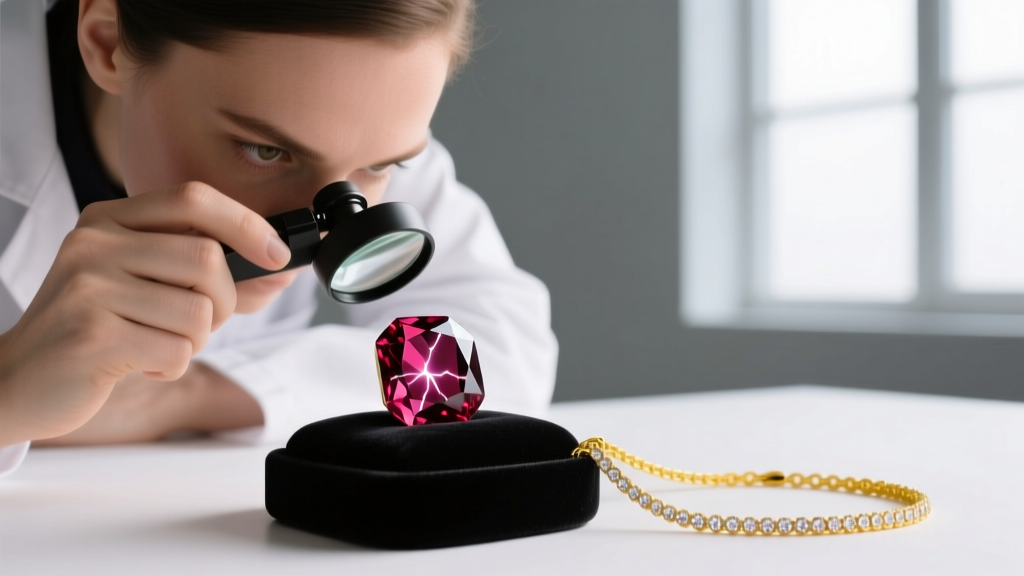
Chain Metallurgy: Pairing Metals with Ruby Pendants
The longevity of your ruby pendant necklace depends as much on the chain and setting metallurgy as it does on the gemstone itself. The Federal Trade Commission (FTC) mandates strict guidelines on metal purity disclosures, but understanding how these alloys interact with the human body and the gemstone is a matter of materials science.
Platinum (950 Grade)
Platinum is the premier choice for securing high-value natural rubies. Unlike gold alloys, which lose microscopic layers of metal through abrasion over decades of wear, platinum 'displaces' when scratched. This means a platinum bezel or prong setting will maintain its structural mass over a lifetime, providing superior security for a dense 4.00 SG gemstone. Furthermore, platinum's naturally white luster does not reflect unwanted yellow or rose hues into the ruby, allowing the stone's natural pigeon-blood or purplish-red body color to dominate.
18k Yellow Gold vs. 14k Rose Gold
For a more traditional aesthetic, 18k yellow gold (75% pure gold, alloyed with silver and copper) provides a warm contrast that historically complements the slight purplish secondary hues found in Burmese rubies. However, 18k gold is relatively soft. If you are designing a necklace meant for daily wear, 14k rose gold (58.5% pure gold, alloyed heavily with copper) offers significantly higher tensile strength and scratch resistance due to the copper content. The copper alloy also imparts a pinkish warmth that harmonizes beautifully with the chromium-induced red of the July birthstone.
Inclusion Mapping and Structural Integrity
Not all inclusions are created equal. When evaluating a natural ruby for a pendant, the type and location of internal characteristics dictate the stone's vulnerability to setting pressures and daily impacts.
- Rutile Silk: Microscopic needles of rutile (titanium dioxide) that intersect at 60-degree angles. While heavy silk can lower transparency, it is often responsible for the highly prized 'soft' glow in unheated rubies and does not severely compromise structural integrity.
- Crystal Inclusions: Trapped zircon or calcite crystals. If these inclusions reach the surface of the gemstone, they create a natural fault line. A jeweler applying too much pressure with a prong pusher near a surface-reaching crystal can easily cleave the stone.
- Healing Fractures: 'Fingerprint' inclusions that indicate the stone healed a crack during its geological formation. These are generally stable but should be mapped to ensure they do not align with the setting's stress points.
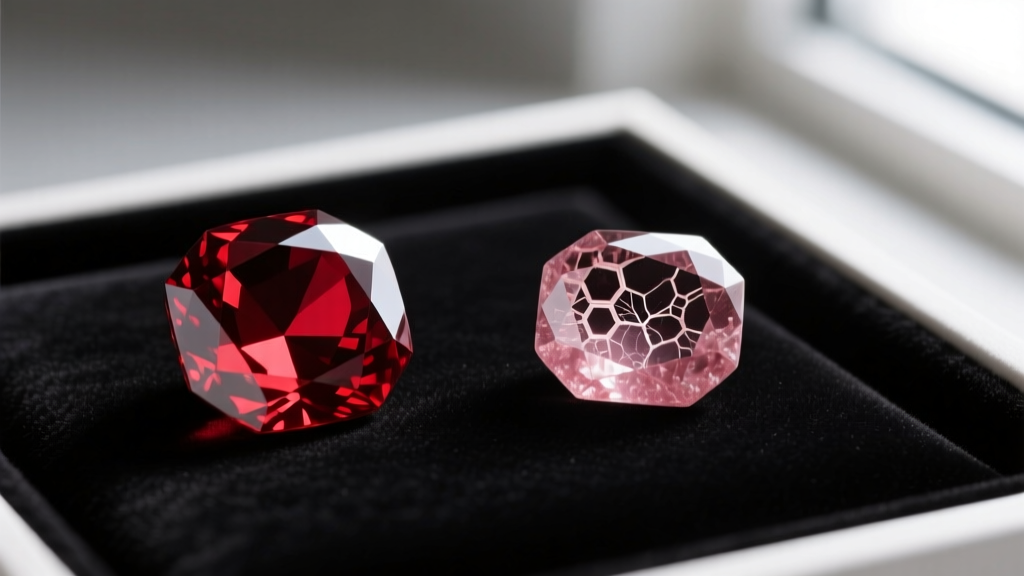
Prong Engineering and Setting Styles
Because ruby pendants swing and strike surfaces more frequently than rings or earrings, the setting engineering is paramount. A standard four-prong setting leaves the gemstone's girdle exposed to lateral impacts. For a necklace July birthstone, a half-bezel or V-prong configuration is highly recommended. V-prongs cap the vulnerable corners of a cushion or princess-cut ruby, distributing mechanical stress away from the stone's edges. If you opt for a full bezel setting, ensure the jeweler uses a laser welder to close the metal rim; traditional torch soldering can subject the ruby to thermal shock, especially if the stone contains liquid-filled healing fractures that could expand and shatter the corundum under rapid heat.
Care Protocols and Failure Modes
Maintaining the optical brilliance and structural integrity of your ruby necklace requires adherence to strict cleaning protocols. While untreated and heat-treated natural rubies are incredibly durable, the methods used to clean them can introduce catastrophic failure modes if the stone's treatment history is unknown.
- Avoid Ultrasonic Cleaners for Treated Stones: If your ruby is fracture-filled or heavily included, the high-frequency vibrations of an ultrasonic cleaner can shake the stone apart or dislodge glass fillers.
- Thermal Shock Risks: Never clean a ruby pendant with boiling water or steam. Sudden temperature changes can cause existing microscopic fissures to propagate rapidly through the crystal lattice.
- Chemical Exposure: Remove the necklace before swimming in chlorinated pools or using household bleach. While the corundum itself is highly resistant to chemicals, the chlorine will aggressively attack the copper and silver alloys in 14k or 18k gold chains, leading to stress corrosion cracking and eventual chain failure.
By understanding the deep material properties of corundum and the metallurgy of your chain, you ensure that your necklace July birthstone remains a secure, brilliant heirloom capable of withstanding the rigors of daily wear.


