Crafting the Necklace of Swords: Metallurgy & Design
Explore the technical craftsmanship behind the necklace of swords, from lost-wax casting and metallurgy to interlocking chain articulation.

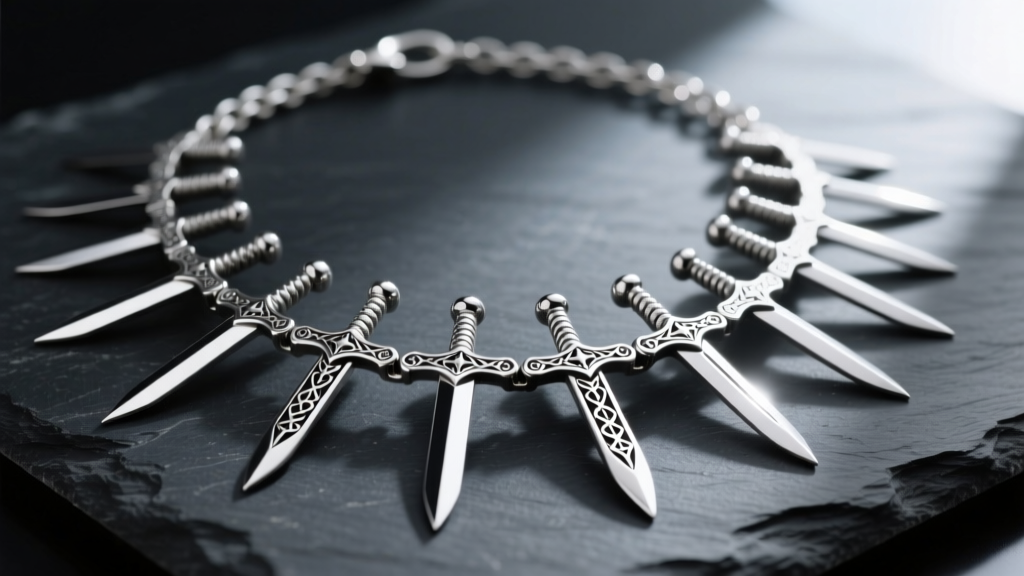
The Anatomy of a Necklace of Swords
In the realm of high-end artisan and historical reproduction jewelry, the necklace of swords represents a pinnacle of metallurgical engineering and micro-sculpting. Unlike standard pendant necklaces, a true necklace of swords features an articulated chain where each link is a fully realized, three-dimensional miniature sword. This design requires the pommel of one blade to seamlessly connect to the crossguard of the next, creating a flexible yet structurally rigid mesh. Crafting this piece demands a mastery of both macro-structure chainmaille weaving and micro-structure investment casting. According to historical archives at The Wallace Collection, the miniaturization of functional sword hilts dates back to 16th-century guild mastery pieces, but adapting these motifs for modern wearable jewelry introduces complex tensile and galvanic challenges.
Metallurgical Specifications & Alloy Selection
The aesthetic contrast between the blade and the hilt is paramount in a necklace of swords. To achieve this, master jewelers utilize a bimetallic approach, pairing high-hardness steels with noble metals. The blades require a material that can hold a crisp, polished edge and resist micro-scratches, while the hilts demand high malleability for intricate lost-wax casting.
| Component | Alloy | Vickers Hardness (HV) | Primary Advantage |
|---|---|---|---|
| Miniature Blades | 1095 High Carbon Steel | ~600 HV (Hardened) | Exceptional edge retention and mirror polish capability |
| Crossguards & Pommels | 925 Sterling Silver | ~65 HV (Annealed) | High fluidity for intricate lost-wax casting detail |
| Articulation Pins | Grade 5 Titanium (Ti-6Al-4V) | ~350 HV | High shear strength and biocompatibility |
| Decorative Inlays | Phosphor Bronze (C51000) | ~180 HV | Warm gold-like hue and excellent spring properties |
While 316L stainless steel is often used in mass-produced fantasy jewelry, it lacks the deep, blue-black patina potential of 1095 carbon steel when treated with liver of sulfur or forced oxidation. Research presented at the Santa Fe Symposium on Jewelry Manufacturing Technology highlights that high-carbon steels, when properly quenched and tempered, provide a superior substrate for diamond-paste polishing, yielding a mirror finish that rivals white gold.
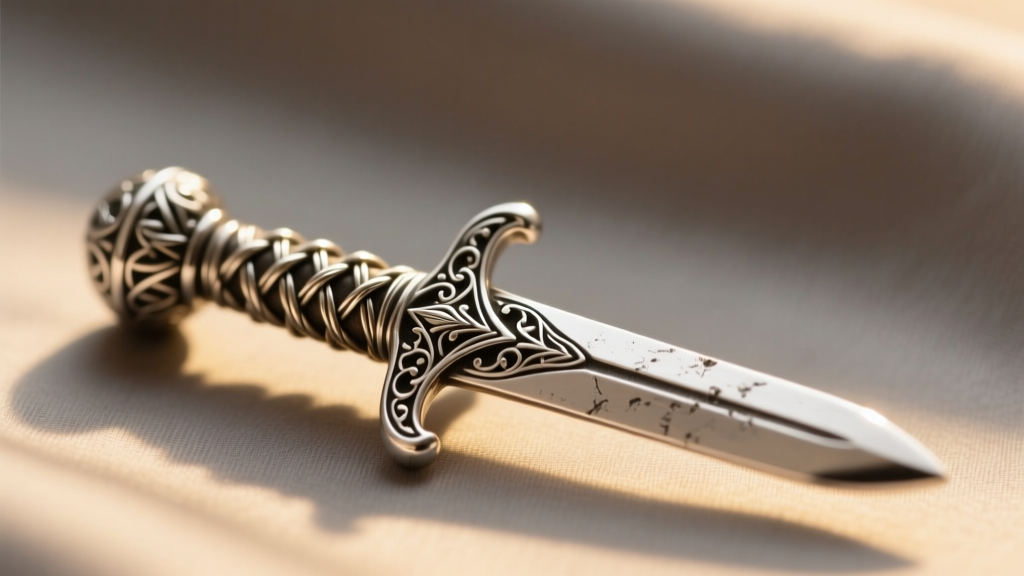
Articulation & Chain Engineering
The most critical failure point in any necklace of swords is the articulation joint. Connecting a steel pommel to a silver crossguard using standard jump rings results in excessive lateral play and rapid wear. Instead, expert fabricators employ a micro-riveted pin system.
The Pommel-to-Guard Rivet Mechanism
Each miniature sword is cast with a hollow, reinforced channel running horizontally through the pommel and the crossguard. A 14-gauge (1.63mm) Grade 5 titanium wire is threaded through the pommel of the upper sword and the crossguard of the lower sword. The ends of the titanium wire are then peened using a micro-hammer and anvil, creating a permanent, low-friction pivot point. This allows the necklace to drape fluidly around the clavicle without the links binding or snapping under the 40-60 gram weight of the assembled piece.
- Tensile Load Bearing: A properly peened titanium rivet can withstand up to 15 kg of shear force before deformation.
- Friction Coefficient: Titanium against polished steel yields a low kinetic friction coefficient, preventing the grinding that plagues brass-on-brass chain links.
- Aspect Ratio (AR): The internal diameter of the pommel channel must maintain an AR of at least 3.2 relative to the pin diameter to ensure a 45-degree drape angle.
Lost-Wax Casting vs. CNC Milling
Producing the hilts for a necklace of swords requires capturing sub-millimeter details, such as braided wire grips and faceted pommel nuts. While 5-axis CNC milling can produce these parts, it struggles with the deep undercuts required for authentic medieval quillon designs. Therefore, investment casting (lost-wax) remains the industry standard.
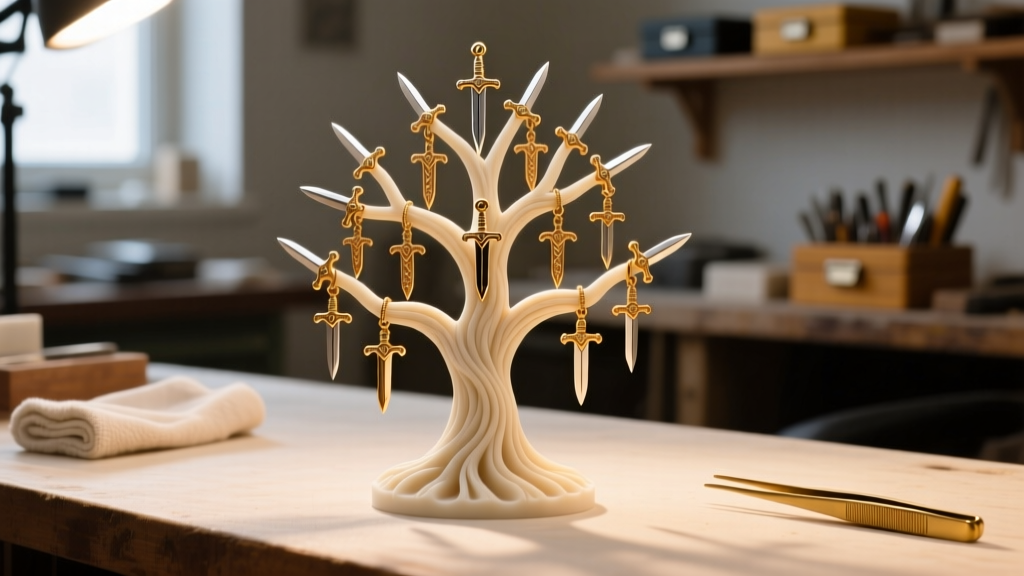
The process begins by injecting high-pressure jeweler's wax into a vulcanized rubber mold. For a 24-inch necklace of swords, a single wax tree may hold up to 80 individual micro-hilts. The tree is invested in a phosphate-bonded plaster, which captures details down to 10 microns. During burnout, the mold is heated to 730°C (1350°F) to ensure complete wax elimination. The 925 sterling silver is then centrifugally cast at 950°C. Post-casting, the sprues are cut, and the hilts are tumbled in a magnetic pin finisher to reach a semi-polished state before hand-assembly.
Galvanic Corrosion & Dielectric Barriers
One of the most severe technical challenges in designing a bimetallic necklace of swords is galvanic corrosion. When 1095 carbon steel (the anode) comes into direct physical contact with sterling silver (the cathode) in the presence of an electrolyte—such as human perspiration—a galvanic cell is formed. This causes the steel to oxidize and pit rapidly, while the silver remains untouched.
To mitigate this electrochemical failure mode, advanced jewelers introduce dielectric barriers at every steel-to-silver junction. This is achieved by applying a 2-micron layer of PVD (Physical Vapor Deposition) titanium nitride to the interior of the silver crossguard channels. Alternatively, microscopic PTFE (Teflon) washers can be threaded onto the titanium rivet pins, physically separating the dissimilar metals and breaking the electrical circuit. Without these barriers, a necklace of swords worn daily against the skin will exhibit severe pitting on the steel blades within six months.
Maintenance & Patina Preservation
Owning a high-carbon steel and silver necklace of swords requires a strict maintenance regimen to preserve the intentional contrast between the darkened steel and the bright silver.
"The beauty of a mixed-metal historical piece lies in the tension between the metals. You must protect the steel from moisture while allowing the silver to develop a soft, natural luster through wear." — Master Artisan Jeweler
Actionable Care Protocol
- Post-Wear Neutralization: After wearing, wipe the steel blades with a microfiber cloth lightly dampened with a 5% solution of sodium bicarbonate (baking soda) and distilled water. This neutralizes the acidic salts from sweat.
- Micro-Oiling: Apply a sub-drop of Renaissance Wax or synthetic camellia oil to the steel blades. This displaces ambient moisture and creates a hydrophobic barrier.
- Ultrasonic Warning: Never place a fully assembled necklace of swords in an ultrasonic cleaner. The high-frequency cavitation can work the micro-rivets loose and force water into the articulation joints, leading to hidden internal rust.
By adhering to these metallurgical and mechanical principles, the necklace of swords transcends mere costume jewelry, becoming a masterwork of wearable engineering that honors both historical weaponry and modern materials science.


