The Necklace Peace Sign Trend: A 2026 Styling Guide
Discover how to style the necklace peace sign trend in 2026. Explore material grades, chain pairings, and layering techniques for this iconic pendant.

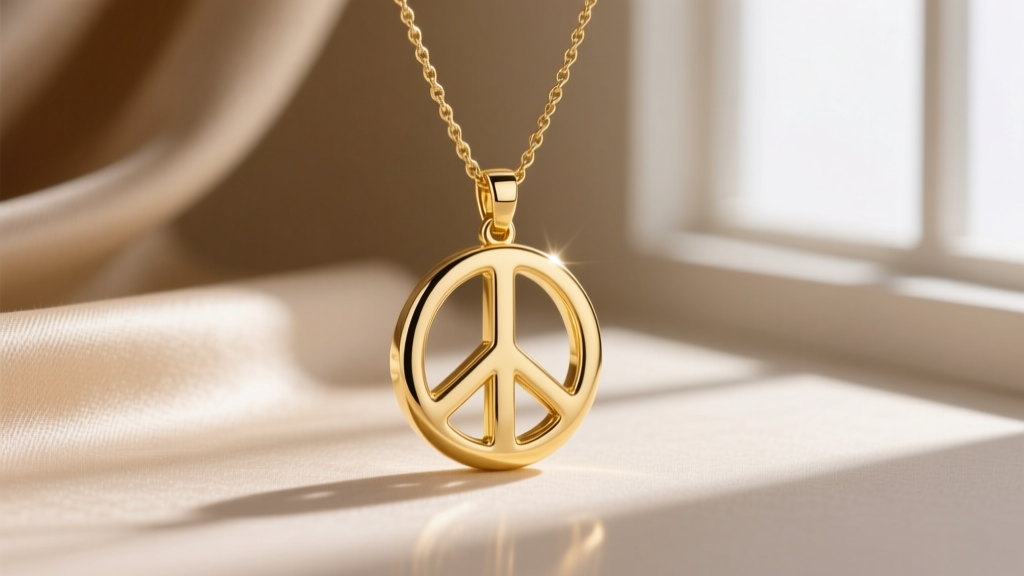
The Evolution of the Peace Sign Pendant
The peace sign has transcended its 1960s counterculture origins and its 1990s mall-kiosk cliché. In 2026, the necklace peace sign is a study in architectural minimalism, mixed-metal layering, and precise geometric proportions. No longer confined to chunky brass or tie-dye aesthetics, today's iterations are engineered with fine jewelry tolerances, offering a sophisticated nod to nostalgia without sacrificing modern elegance. This comprehensive guide breaks down the metallurgical realities, chain architectures, and advanced layering frameworks required to master this enduring symbol.
Metallurgical Realities: Choosing the Right Alloy
When evaluating a fine jewelry peace sign pendant, the structural integrity of the intersecting lines—the inverted 'Y' within the circle—is paramount. According to the Gemological Institute of America (GIA), the Vickers hardness (HV) of gold alloys varies significantly based on karatage. 14k yellow gold (58.5% pure gold) typically registers around 140 HV, providing superior tensile strength. This makes 14k the optimal choice for peace sign pendants where the internal lines are milled to a delicate 1.5mm width. Conversely, 18k gold (75% pure gold, approx. 125 HV) offers a richer, warmer hue but is more susceptible to bending and warping if subjected to daily tension. For collectors prioritizing color depth over structural rigidity, 18k is acceptable provided the pendant features a reinforced bezel or a minimum line thickness of 2.0mm. Sterling silver (925) remains a viable entry-point, though buyers should seek out rhodium-plated variants or Argentium silver to mitigate the rapid sulfide tarnishing that disproportionately accumulates in the tight angles of the peace sign geometry.
The Hidden Bail and Geometric Proportions
A critical design evolution in 2026 is the departure from the standard loop bail. Traditional bails interrupt the continuous circular geometry of the pendant, creating a visual 'speed bump' at the top of the necklace. Modern fine jewelers are increasingly utilizing hidden bails—where the chain threads directly through a hollowed-out top segment of the circle itself. This preserves the unbroken silhouette of the peace sign, allowing it to sit flush against the clavicle. Furthermore, while the traditional peace sign relies on a perfect 1:1 circular ratio, contemporary trend forecasting highlights a shift toward the 'stretched' peace sign. This elongated oval variant features a 1.3:1 height-to-width ratio, which naturally mirrors the anatomical lines of the human neck and chest, creating a more flattering, elongating effect when worn with V-neck or scoop-neck garments.
Chain Gauge and Link Architecture
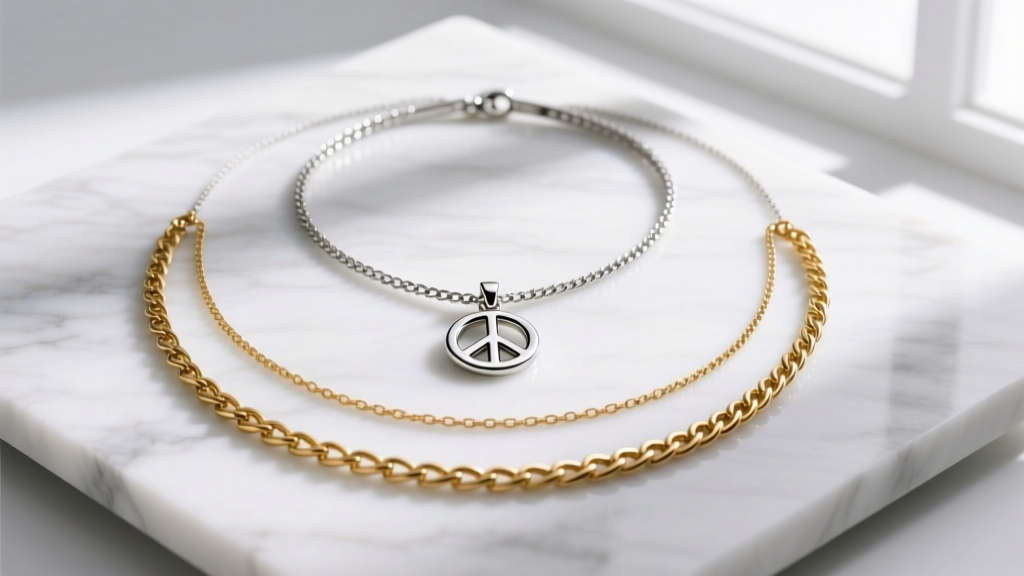
The visual weight of a peace sign pendant must be perfectly calibrated to its supporting chain. A standard 15mm to 18mm peace sign pendant typically weighs between 2.5 and 4.5 grams. Pairing this with a chain that is too delicate results in a top-heavy silhouette that constantly flips upside down, while a chain that is too thick overpowers the pendant's minimalist intent. Below is a structural pairing matrix for optimal drape and durability.
| Chain Style | Optimal Gauge | Max Pendant Weight | Aesthetic Profile |
|---|---|---|---|
| Cable Chain | 1.0mm - 1.2mm | 3.5 grams | Classic, minimalist, disappears on skin |
| Rolo Chain | 1.5mm - 1.8mm | 6.0 grams | Textured, vintage-inspired, durable |
| Figaro Chain | 2.0mm - 2.5mm | 10.0 grams | Streetwear edge, high-contrast layering |
| Box Chain | 1.2mm - 1.5mm | 5.0 grams | Geometric synergy, high light reflection |
For the ultimate contemporary aesthetic, a 1.2mm 14k yellow gold box chain provides a geometric synergy that mirrors the hard lines of the peace sign, while offering sufficient structural support to prevent the pendant from sliding excessively.
Enamel and Inlay Techniques: Beyond Bare Metal
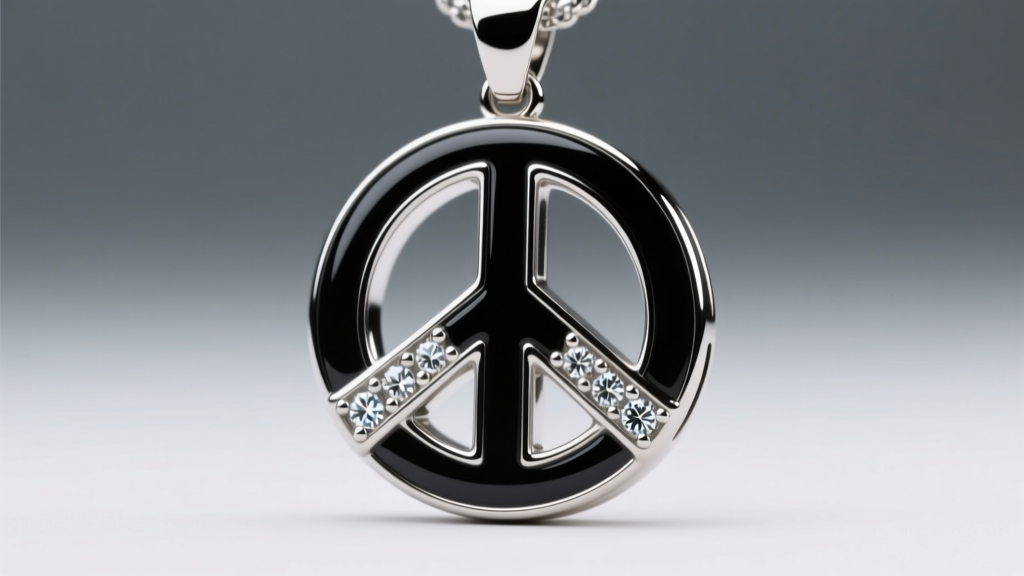
For those seeking contrast, inlaid peace sign pendants offer a striking visual pop. However, not all inlays are created equal. The market is currently divided between vitreous enamel and cold (epoxy) enamel. Vitreous enamel is essentially powdered glass fused to metal at temperatures exceeding 1400°F. It is highly resistant to UV degradation, meaning a deep onyx or cobalt blue vitreous enamel peace sign will not yellow or fade over decades of wear. Its primary vulnerability is impact; dropping a vitreous enamel pendant on a hard tile floor can cause micro-fractures or shattering. Cold enamel, a two-part epoxy resin, is highly impact-resistant and significantly cheaper to produce. However, as noted by jewelry conservationists, cold enamel is prone to UV yellowing and chemical degradation from perfumes and lotions, typically requiring replacement or refinishing within three to five years. When investing in a high-contrast piece, always verify that the manufacturer utilizes kiln-fired vitreous enamel or ethically sourced hardstones like black onyx and lapis lazuli.
The 2026 Layering Matrix
Layering a necklace peace sign requires strict adherence to the 'two-inch drop rule' to prevent clasp tangling and visual clutter. The peace sign, acting as the focal mid-layer, should sit precisely at the hollow of the throat or the upper sternum.
- The Anchor (14-15 inches): A 1.0mm snake chain or a delicate micro-pave diamond solitaire. This sits tight against the base of the neck, providing a high-contrast foundation.
- The Focal Point (17-18 inches): The peace sign pendant on a 1.2mm cable or box chain. This is the centerpiece, resting perfectly on the clavicle.
- The Terminator (20-22 inches): A heavier, textural piece such as a 3.0mm paperclip chain or a vertical bar lariat. This draws the eye downward, elongating the torso and framing the central peace sign.
Mixing metals within this matrix is highly encouraged in 2026. Pairing a 14k yellow gold peace sign with a white gold anchor chain and a rose gold terminator chain creates a curated, collected-over-time aesthetic that Vogue has frequently highlighted as a hallmark of modern, personalized luxury.
Market Segmentation and Pricing Tiers
Navigating the market requires understanding what drives the cost of a peace sign pendant beyond mere brand markup.
Entry-Level ($60 - $150)
At this tier, expect 925 sterling silver or 10k/14k gold vermeil. The pendants are often cast using the lost-wax method with minimal hand-finishing. Internal lines may be slightly rounded or lack crisp edges. Vermeil pieces will eventually wear through to the brass or silver base metal at high-friction points, requiring re-plating.
Mid-Tier Fine ($300 - $800)
This is the sweet spot for solid 14k gold and high-quality vitreous enamel. Pendants in this category feature laser-cut precision, hidden bails, and ethically sourced recycled gold. The finishing includes hand-polishing and microscopic inspection to ensure the intersecting lines are perfectly flush with the outer circle.
Haute & Luxury ($1,500+)
Luxury iterations incorporate micro-pave diamond accents along the internal lines or the outer bezel, utilizing 18k or platinum settings. These pieces often feature custom-cut gemstone inlays (like malachite or turquoise) rather than enamel, and are finished with invisible clasps and proprietary chain weaves.
Final Styling Directives
The necklace peace sign in 2026 is not a costume piece; it is a deliberate exercise in geometric styling. By prioritizing structural alloys like 14k gold, demanding hidden bails for uninterrupted silhouettes, and applying strict mathematical spacing to your layering matrix, you elevate a historical symbol into a cornerstone of modern fine jewelry. Treat the pendant not just as a message, but as a masterclass in proportion, weight distribution, and metallurgical endurance.


