Master Necklace Pronunciation: Luxury Terms & Styling Guide
Master luxury necklace pronunciation with our guide to French and Italian jewelry terms. Learn to style sautoirs, rivières, and colliers like an expert.


The Intersection of Linguistics and Luxury
In the upper echelons of the 2026 fine jewelry market, the distinction between a casual shopper and a true connoisseur often comes down to vocabulary. As heritage houses in Paris and Milan continue to dictate global trends, understanding proper necklace pronunciation is no longer just an exercise in linguistics—it is an essential tool for navigating high-end boutiques, estate auctions, and sophisticated styling circles. When you can confidently request to view a sautoir or discuss the articulation of a rivière, you unlock a deeper level of service and respect from jewelers.
This guide breaks down the most critical, frequently mispronounced necklace terminology, providing exact phonetic spellings, technical specifications, and actionable styling advice for the modern collector.
The French Dominance: Essential Necklace Pronunciation
French remains the lingua franca of high jewelry (haute joaillerie). The following terms represent foundational silhouettes that dominate luxury trend forecasts.
1. Sautoir (soh-TWAHR)
A sautoir is an exceptionally long necklace, typically measuring 30 to 36 inches or more, that often terminates in a tassel, fringe, or detachable pendant. Originally popularized in the Art Deco era, the sautoir has seen a massive resurgence in 2026 as a staple for evening layering.
- Technical Specs: True luxury sautoirs are crafted from 18k gold chains ranging from 1.5mm to 3.0mm in gauge to support the weight of the terminal pendant without stretching. High-end versions feature a hidden latch system allowing the pendant to be removed and worn as a brooch.
- Styling Advice: Wear a sautoir unclasped and knotted loosely at the navel over a silk slip dress, or double-wrap it to create a layered matinée effect over structured blazers.
2. Rivière (ree-VYAIR)
Translating to "river," a rivière is a necklace featuring gemstones of the same species that graduate in size, flowing seamlessly around the neck without interruption from a central focal pendant.
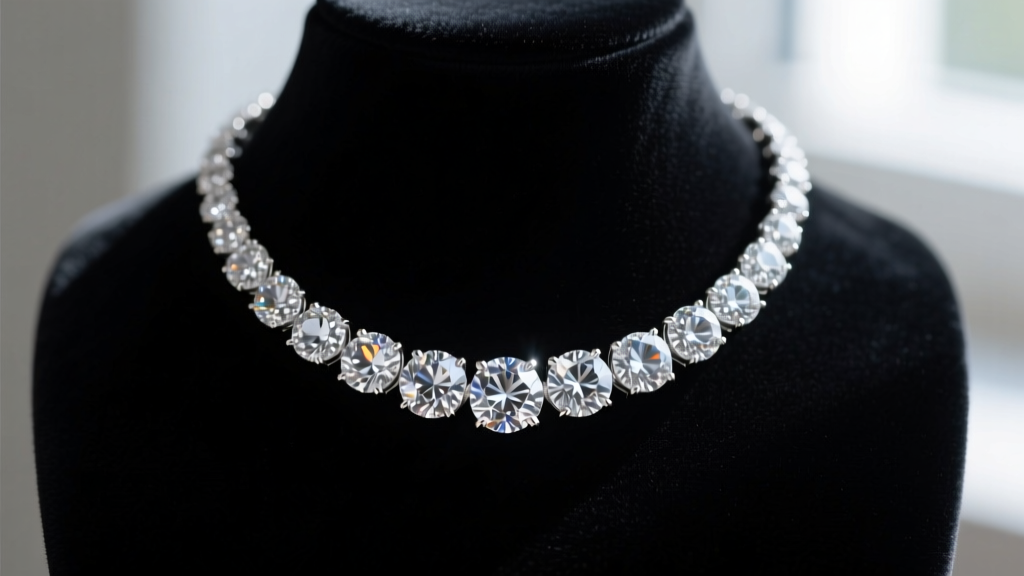
- Technical Specs: A genuine diamond rivière requires meticulously calibrated stones. For example, a 15-carat total weight piece might feature a center stone of 6.5mm (approx. 1.00 ct) graduating down to 3.5mm (approx. 0.15 ct) at the nape. The stones are typically set in four-prong platinum baskets with a flexible, articulated link system to ensure the "river" lays flat against the collarbone. Always look for a box clasp with double figure-eight safety catches.
- Styling Advice: The rivière is the ultimate "quiet luxury" piece. Pair it with a deep V-neckline to elongate the decolletage, allowing the graduation of the stones to draw the eye downward.
3. Collier de Chien (koh-LYAY duh SHYEN)
Literally translating to "dog collar," this is a highly specific type of choker. Unlike a standard chain choker, a traditional collier de chien is wide, often crafted from black velvet or multi-strand seed pearls, and features a central ornamental plaque or cameo.
- Technical Specs: These sit tightly at 13 to 14 inches. The central plaque is usually crafted in 18k yellow gold with guilloché enamel work. Because of the tight fit, the clasp must be a custom-fitted barrel or slide mechanism rather than a standard lobster claw.
- Styling Advice: Best worn with off-the-shoulder gowns or wide boat-neck tops. The stark contrast of dark velvet against the skin makes it a dramatic choice for winter galas.
Length Classifications: Matinée vs. Opéra
Beyond specific styles, the French lexicon also dictates standard necklace lengths. Misidentifying these can lead to purchasing a piece that completely disrupts your intended silhouette. According to the Lang Antiques University, precise length categorization is vital for estate valuation.
| Term | Pronunciation | Exact Length | Best Neckline Pairing | 2026 Trend Status |
|---|---|---|---|---|
| Matinée | mat-in-AY | 20 - 24 inches | V-Neck, Scoop, Sweetheart | Surging (Ideal for Layering) |
| Opéra | OP-er-uh | 28 - 36 inches | Turtleneck, Strapless, Halter | Stable (High Jewelry Staple) |
| Collier | koh-LYAY | 15 - 16 inches | Off-shoulder, Boat, Plunging | Classic Everyday Essential |
Note: The term "collier" is the general French word for necklace, but in English jewelry parlance, it is often used to describe a standard 16-inch princess-length piece that rests perfectly on the collarbone.
Historical & Structural Terms: Torque and Lariat
When moving away from chain-based necklaces, structural integrity becomes the primary focus. Here is how to discuss rigid and semi-rigid silhouettes.
The Torque (or Torc)
A torque is a rigid metal ring that opens at the front or back, relying on the tension of the metal to stay in place. Originating from ancient Celtic and Roman cultures, the torque is a favorite among avant-garde designers in 2026.

- Material Realities: Because a torque must be bent slightly to put on and take off, 18k gold is often too soft and will lose its shape over time. Expert jewelers recommend 14k gold or platinum for torques, utilizing a thick gauge (minimum 4mm to 6mm) to provide the necessary "spring-back" memory. If purchasing an 18k torque, ensure it features a hinged back with a secure box clasp rather than relying on tension.
The Lariat (and Y-Necklace Variants)
Pronounced lar-ee-AT, this style features a vertical drop that forms a "Y" shape. Unlike a sautoir, the lariat typically lacks a fixed clasp at the terminal end, instead threading through a loop or sliding ring.
- The Friction Problem: The most common failure point in a lariat necklace is the slide mechanism. If the ring is too large, the vertical tail slips through, causing the necklace to fall off. High-quality lariats utilize a silicone-lined friction bead or a precision-machined 14k gold slide with an internal spring tensioner to hold the drop securely at the desired sternum depth.
Material & Technique Vocabulary
To truly master necklace pronunciation, one must also understand the terminology used to describe the metalwork and stone settings. The Gemological Institute of America (GIA) emphasizes that knowing these terms protects consumers from misrepresentation.
"True connoisseurship in high jewelry begins with the vocabulary. When you ask to see a rivière rather than a 'graduated diamond necklace,' the boutique experience fundamentally shifts." — Archives of European Estate Jewelry
Pavé (pah-VAY)
Meaning "paved," this setting technique places small gemstones tightly together, creating a surface that looks like solid stone. In necklace pendants, true pavé requires stones to be set with microscopic beads of metal raised from the surrounding gold, rather than being glued or set in shared prongs. Expect to pay a premium for "micro-pavé," which uses stones under 1.5mm in diameter for a seamless, liquid-light effect.
Millegrain (MILL-eh-grain)
Translating to "a thousand grains," this is a decorative edge technique where tiny beads of metal are applied to the borders of a setting. It is a hallmark of Edwardian and Art Deco revival pieces. When examining a millegrain necklace, use a 10x loupe; hand-applied millegrain will show slight, organic irregularities, whereas cast or machine-stamped millegrain will look perfectly uniform and flat.
How to Speak the Language of High Jewelry Boutiques
When shopping at heritage boutiques in Place Vendôme or Via Monte Napoleone, or even high-end domestic estate jewelers, your vocabulary dictates the inventory you are shown. Sales associates are trained to reserve their most exquisite, museum-quality vault pieces for clients who demonstrate horological and gemological literacy.
Actionable Tips for the Boutique:
- Never say "choker" when referring to a multi-strand pearl piece with a diamond clasp; ask to see their colliers de chien or bib necklaces.
- Specify the articulation. When viewing rivières, ask the associate, "How many articulated links separate the graduated stones?" A higher number of links means better drape and less risk of the chain kinking.
- Inquire about the clasp mechanics. For long opéra-length pearl necklaces, ask if the piece features a "trombone clasp" (a vintage push-pull mechanism) or a modern concealed box clasp with dual safety catches.
Mastering necklace pronunciation bridges the gap between simply wearing jewelry and truly understanding its history, engineering, and artistry. By integrating these terms into your lexicon, you ensure that your 2026 jewelry acquisitions are not just visually stunning, but technically impeccable.


