The Necklace with Gems: 2026 Trend Analysis & Styling Guide
Discover 2026's top trends for the necklace with gems. Learn expert styling tips, gemstone hardness guides, and how to pair cuts with necklines.

The 2026 Shift: From Minimalist Chains to Bold Gemstone Statements
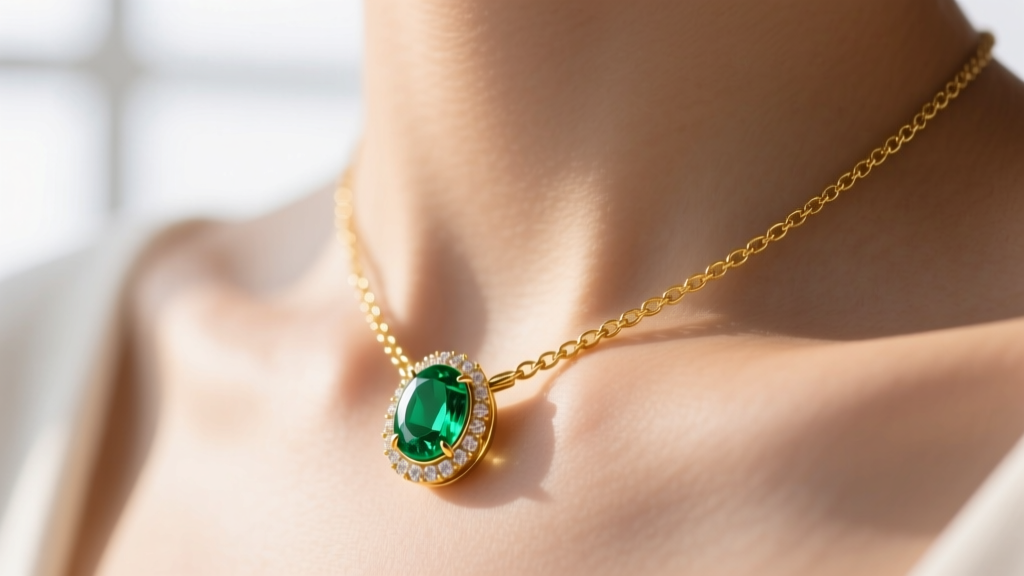
As we navigate the jewelry landscape of 2026, the prevailing aesthetic has decisively shifted away from the ultra-delicate, micro-layered chains that dominated the early 2020s. Today, the modern collector and style enthusiast are gravitating toward a singular, impactful anchor piece: the statement necklace with gems. This transition, often dubbed 'expressive permanence' by industry analysts, reflects a broader consumer desire for investment-grade versatility over fast-fashion accessorizing.
According to market insights from the American Gem Society, buyers are increasingly prioritizing larger carat weights and unique, non-traditional gemstone cuts. Lab-grown sapphires, ethically sourced emeralds, and vibrant spinels are taking center stage, allowing wearers to achieve bold visual weight without the prohibitive costs associated with mined diamonds. A well-chosen necklace with gems is no longer just an accessory; it is a focal point that dictates the entire architecture of an outfit.
Gemstone Hardness & Setting Durability: What You Must Know
When investing in a prominent pendant or collar necklace, understanding the Mohs scale of mineral hardness is non-negotiable. A necklace rests on the chest, an area prone to accidental impacts against desks, steering wheels, and doorways. Choosing a gemstone requires balancing visual appeal with structural integrity.
For instance, while Tanzanite offers a mesmerizing violet-blue hue, its Mohs rating of 6.5 to 7 and perfect cleavage make it highly susceptible to chipping if set in a standard four-prong setting. Conversely, a sapphire (Mohs 9) lacks cleavage planes, making it exceptionally durable for daily wear in exposed prong or tension settings. The Gemological Institute of America (GIA) emphasizes that the setting must always be tailored to the specific fracture risks of the stone.
| Gemstone | Mohs Hardness | Cleavage / Fracture Risk | Recommended 2026 Setting |
|---|---|---|---|
| Sapphire / Ruby | 9.0 | None (High Durability) | Claw Prong or Tension |
| Emerald | 7.5 - 8.0 | Moderate (Brittle, often included) | Bezel or Halo |
| Tanzanite | 6.5 - 7.0 | Perfect Cleavage (High Chip Risk) | Protective V-Prong or Bezel |
| Opal | 5.5 - 6.5 | Brittle, sensitive to dehydration | Closed-Back Bezel |
Cut & Neckline Matrix: Styling Your Necklace with Gems
The geometry of your gemstone must harmonize with the neckline of your garment. In 2026, stylists are moving away from arbitrary pairings and relying on a strict geometric matrix to ensure the necklace with gems elongates the neck rather than truncating it.
The V-Neck and Plunge Matrix
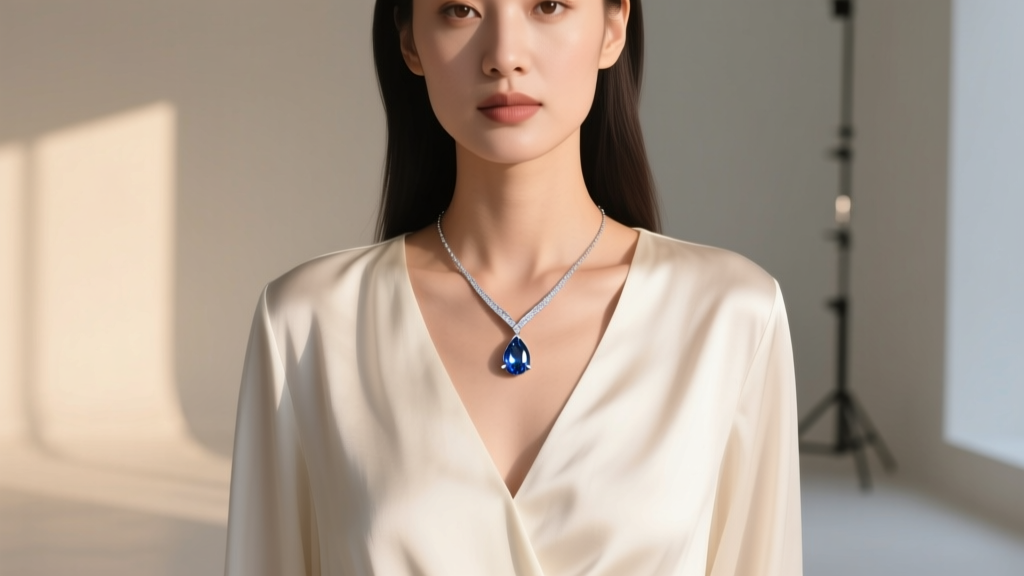
For V-necklines, deep scoops, and wrap dresses, the goal is to mirror the garment's angles. A pear-cut or marquise gemstone suspended on a Y-drop or lariat chain perfectly follows the natural plunge of the fabric. Avoid round brilliant cuts on deep V-necks, as the circular geometry clashes with the sharp angles of the collar, creating visual dissonance.
The Boatneck and Square Neckline Matrix
Boatnecks (Bateau) and square necklines create strong horizontal lines across the collarbone. To break this horizontal tension, opt for elongated vertical cuts. An emerald-cut or baguette gemstone set in a vertical bezel pendant draws the eye downward, restoring proportional balance to the upper body. Alternatively, a multi-gemstone 'riviere' style collar that sits flush above the neckline can frame a boatneck beautifully without interrupting its line.
Metal Pairings: Enhancing Gemstone Refractive Index
The metal you choose for your necklace with gems is not merely a structural necessity; it is an optical tool. The Refractive Index (RI) of a gemstone dictates how it bends light, and the color of the underlying metal can either amplify or mute this effect.
- High RI Stones (Diamond, Moissanite, White Sapphire): These stones rely on brilliance and dispersion (fire). Setting them in high-polish platinum or rhodium-plated 18k white gold acts as a mirror, bouncing light back through the crown of the stone and maximizing scintillation.
- Warm, Lower RI Stones (Citrine, Garnet, Yellow Beryl): These gems benefit from the warm reflectivity of 18k or 22k yellow gold. The gold's natural hue saturates the body color of the gemstone, making a pale citrine appear deeply golden and rich.
- Pastel & Dichroic Stones (Morganite, Kunzite, Tourmaline): Rose gold is the undisputed champion for pastel beryls. The copper alloys in rose gold harmonize with the pink and peach undertones of morganite, creating a cohesive, romantic gradient that white metals tend to wash out.
Chain Mechanics: Gauge, Weight, and Bail Engineering
A common failure point in luxury jewelry is the chain snapping under the pendulum weight of a heavy gemstone pendant. When styling a substantial necklace with gems, chain gauge and bail engineering are critical.
If your centerpiece gemstone exceeds 3 carats (approximately 0.6 grams plus the metal setting), a delicate 0.8mm cable chain is structurally insufficient. The constant friction of the bail rubbing against the inner links will eventually wear through the gold. For stones in the 3 to 8-carat range, opt for a 1.5mm to 2.0mm wheat, box, or rope chain. These weaves distribute the tensile stress across multiple interlocking links rather than a single weak point.
"A master jeweler will always reinforce the bail of a heavy emerald or sapphire pendant with a platinum or steel core. 14k or 18k gold is too soft to withstand years of friction against a chain, and an invisible internal sleeve prevents the bail from thinning and snapping." — Senior Bench Jeweler, Jewel Style Radar Advisory Board
Investment vs. Fashion: 2026 Pricing Tiers
Understanding the current market valuation helps buyers make informed decisions when purchasing a necklace with gems. The 2026 market is distinctly bifurcated between high-tech lab-grown alternatives and premium, traceable mined stones.
Tier 1: Accessible Luxury ($150 - $600)
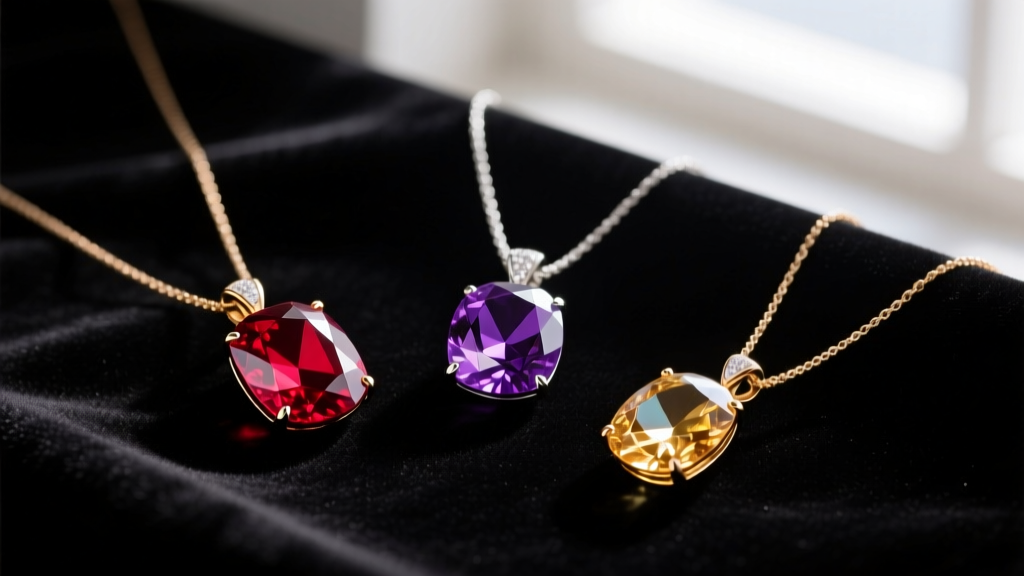
This tier is dominated by lab-grown sapphires, emeralds, and high-quality semi-precious stones like amethyst and blue topaz. Lab-grown stones offer identical chemical and optical properties to their mined counterparts but allow for larger, flawless centerpieces. A 2-carat lab-grown sapphire set in 14k solid gold typically retails between $350 and $550, offering exceptional visual impact for everyday wear.
Tier 2: The Collector's Bridge ($1,200 - $4,500)
Here, you find fine jewelry staples: mined tsavorite garnets, unheated sapphires, and premium tourmalines. This tier focuses on rarity and origin. A necklace featuring a 1.5-carat neon-green tsavorite from Kenya, prized for its high refractive index and lack of required heat treatment, will command prices starting around $2,800, reflecting its geological scarcity.
Tier 3: Heritage & Investment ($8,000+)
The apex tier features untreated Colombian emeralds, Burmese rubies, and natural fancy-colored diamonds. These pieces are bought not just as adornments, but as tangible assets. A necklace featuring a certified, minor-oil Colombian emerald over 3 carats will easily surpass the $15,000 mark, driven by the closing of historic mines and strict export regulations.
Conclusion: Curating Your Signature Piece
The modern necklace with gems is a triumph of geological beauty and precise metallurgical engineering. By respecting the Mohs hardness of your chosen stone, pairing the cut with your preferred necklines, and ensuring the chain gauge can support the pendant's weight, you secure a piece that is as durable as it is breathtaking. In 2026, let your gemstone necklace do the talking—bold, intentional, and brilliantly cut.


