Styling a Necklace with Halter Top Necklines: An Expert Guide
Master the geometry of pairing a necklace with halter top necklines. Expert insights on lengths, metal grades, and clasp mechanics for flawless styling.


Pairing a necklace with halter top garments is one of the most complex challenges in jewelry styling. The halter silhouette—characterized by straps that converge at the nape and frame the décolletage—creates a high-density visual zone. In 2026, as architectural and structured halters dominate resort and evening wear, the margin for styling error has narrowed. A poorly chosen necklace will not only clash visually but can cause physical friction, chain breakage, and skin irritation.
This expert deep dive bypasses generic fashion advice to examine the spatial geometry, material science, and mechanical requirements of successfully integrating necklaces with halter necklines.
The Geometry of Halter Necklines and Jewelry Clearance
To understand how to layer jewelry over a halter, we must first map the spatial geometry of the garment. A standard halter top creates a 45-to-60-degree angle from the acromion (shoulder joint) to the cervical spine (nape). This creates a distinct 'V' or 'U' negative space on the chest.
The primary failure mode when wearing a necklace with a halter top is spatial competition. If a necklace's drop length falls within the exact trajectory of the halter straps, the chain will compete with the fabric. This leads to:
- Visual Clutter: The eye cannot distinguish between the garment's structural lines and the jewelry.
- Tensile Snagging: When a delicate 1.2mm cable chain gets caught in the woven fibers of a crochet or knit halter, the tensile strength of the chain (often under 3 lbs for fine gold) will snap before the fabric yields.
- Pendant Displacement: The friction of the fabric straps will continuously push a lightweight pendant off-center, requiring constant manual adjustment.
The golden rule of halter geometry is binary: the jewelry must either sit entirely above the strap apex (collar length) or plunge entirely below the strap convergence (matinee or lariat length). The 16-to-18-inch 'princess' zone is the highest-risk area for tangling.
Optimal Necklace Lengths and Drop Metrics
Selecting the correct length requires understanding both the chain measurement and the 'drop' (the distance from the clavicle to the bottom of the pendant). Below is a technical compatibility matrix for halter necklines.
| Length Category | Measurement | Halter Compatibility | Recommended Chain Profile |
|---|---|---|---|
| Collar | 12 - 14 inches | High (for deep-V halters) | Rigid torque, velvet ribbon, or solid metal cuff |
| Choker | 14 - 16 inches | Low (High friction risk) | Avoid entirely unless wearing a strapless/banded halter |
| Princess | 17 - 19 inches | Medium (Requires precise drop) | Fine box chain with a fixed micro-pendant (under 5mm) |
| Matinee | 20 - 24 inches | High (Clears the bustline) | Lariat, Y-chain, or graduated bead strand |
Material Science: Friction, Sweat, and Metal Grades
Halter tops, particularly those worn in summer or in high-energy evening environments, trap heat and moisture at the nape and the décolletage. This localized microclimate drastically accelerates galvanic reactions and metal oxidation.
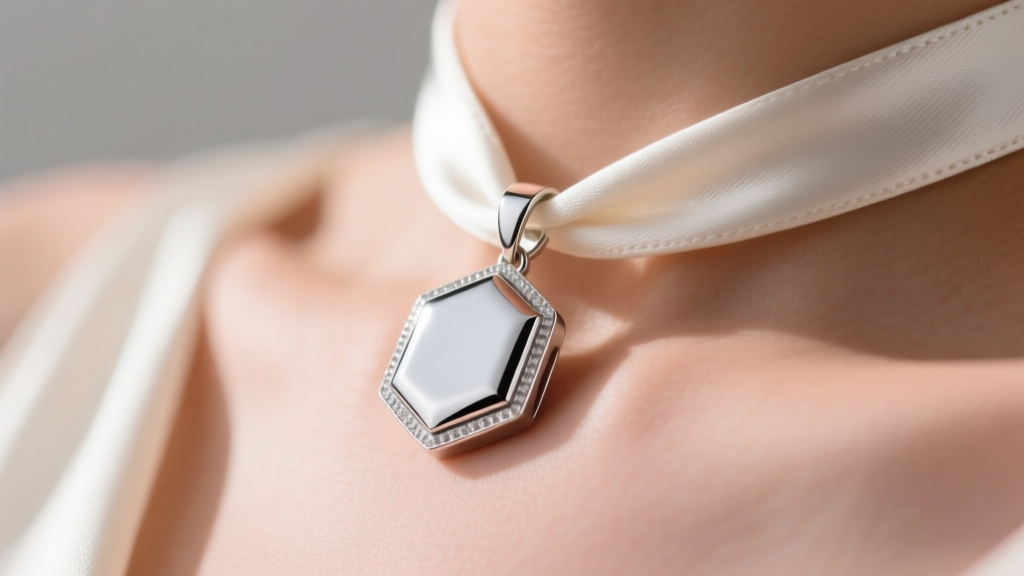
Sterling silver (925) is an alloy containing 92.5% silver and 7.5% copper. When copper is exposed to the salts, urea, and moisture in human sweat, it rapidly oxidizes to form copper chloride, leaving a green or black residue on the skin and tarnishing the chain. Because halter straps press jewelry directly into the skin, this reaction occurs much faster than with standard scoop-neck t-shirts.
For halter styling, we recommend the following hypoallergenic and oxidation-resistant materials:
- ASTM F136 Implant-Grade Titanium: Completely inert, highly resistant to saltwater and sweat, and exceptionally lightweight, preventing the chain from pulling on the halter fabric.
- Niobium: A reactive metal that can be anodized into vibrant colors without the use of nickel or copper alloys. It remains perfectly smooth against friction-prone zones.
- Solid 18k Yellow Gold: Unlike 14k gold, which often relies on higher copper content for durability, high-quality 18k gold alloys utilize silver and palladium, drastically reducing the risk of sweat-induced tarnishing. For more on gold alloy compositions, refer to the Gemological Institute of America (GIA).
Clasp Mechanics and Nape Clearance
The nape of the neck is a critical failure point when wearing a halter top. Halter garments typically tie, knot, or clasp at the cervical spine. Adding a standard jewelry clasp to this area creates a high-friction pressure point.
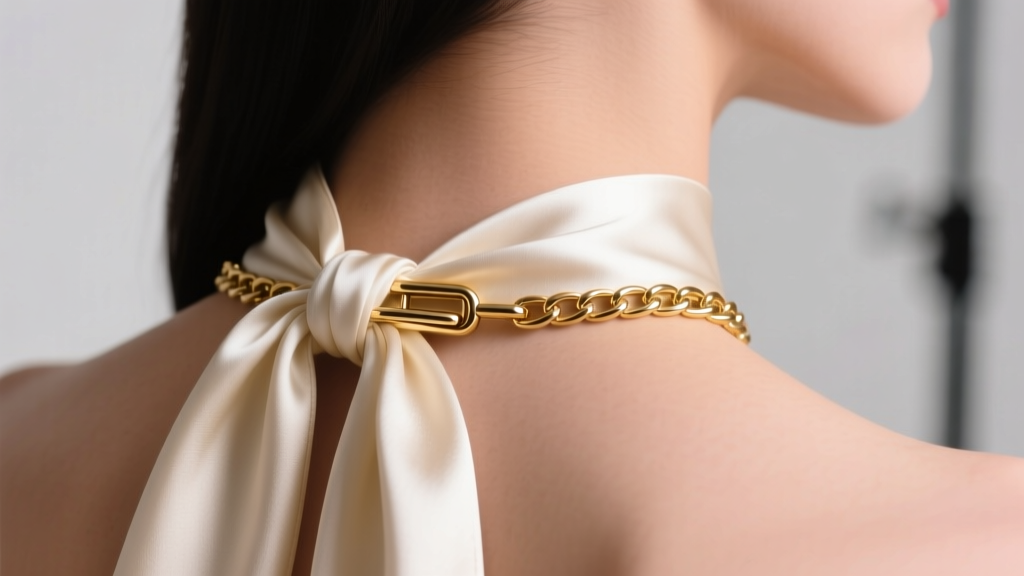
A standard 12mm lobster clasp features sharp machined edges and a protruding lever. When compressed between a halter knot and the wearer's spine, it will cause physical discomfort and can easily snag the garment's tie-straps, fraying the silk or cotton fibers.
Expert Clasp Solutions for Halters:
- 5mm Magnetic Tube Clasps: These feature a smooth, cylindrical profile with internal neodymium magnets. They slide under halter ties without creating pressure points or snagging fabric.
- Hinged Endless Chains: For chains under 1.5mm in thickness, a continuous loop with a hidden micro-hinge eliminates the need for a nape clasp entirely.
- Front-Closure Bayonets: If wearing a Y-necklace or lariat, utilize a front-facing bayonet clasp that integrates into the design, moving the mechanical bulk away from the nape entirely.
Three Expert-Approved Configurations for 2026
To translate these technical specifications into actionable styling, here are three structurally sound configurations for pairing a necklace with halter top designs.
1. The Plunging Lariat (For Deep V-Halters)
When wearing a halter with a deep plunging neckline, a 24-to-28-inch lariat necklace is optimal. The chain should trace the exact negative space of the 'V' without touching the fabric straps. Use a 1.0mm to 1.5mm rope chain; the twisted profile catches the light and mimics the drape of silk. The weighted drop at the end of the lariat acts as a plumb line, drawing the eye vertically and elongating the torso.
2. The Micro-Pendant Princess (For Banded Halters)
Banded halters (which feature a solid strip of fabric across the upper chest rather than separate straps) offer a safe zone for an 18-inch princess chain. To avoid visual weight, select a bezel-set diamond or sapphire pendant no larger than 4mm. According to dermatological guidelines on contact dermatitis from the American Academy of Dermatology, keeping the metal footprint small and elevated via a rigid bezel prevents the jewelry from trapping sweat against the sternum.
3. The Open-Back Body Drape (For Backless Halters)
Halter tops frequently feature entirely open backs. Instead of focusing solely on the décolletage, utilize a specialized 'backlace' or body chain. A 30-inch delicate chain that drapes from the front collarbone, over the shoulders, and down the spine turns the exposed back into a canvas. Ensure the chain features a silicone-lined adjustable slider to grip the skin slightly, preventing the chain from swinging and catching on the halter's lower back hem when sitting.
"The secret to halter styling is not about adding more jewelry; it is about respecting the architectural lines of the garment. Let the fabric frame the skin, and let the jewelry act as the precise, calculated punctuation."
By prioritizing spatial geometry, selecting sweat-resistant metal grades, and upgrading your clasp mechanics, you can seamlessly integrate fine jewelry into your halter wardrobe without sacrificing comfort or risking damage to your pieces.


