Olive Wood Crucifix Necklace: Sourcing, Care & Styling
Discover expert insights on the olive wood crucifix necklace. Learn about wood density, chain pairing, authenticity tests, and care.

The Material Science of Olea europaea
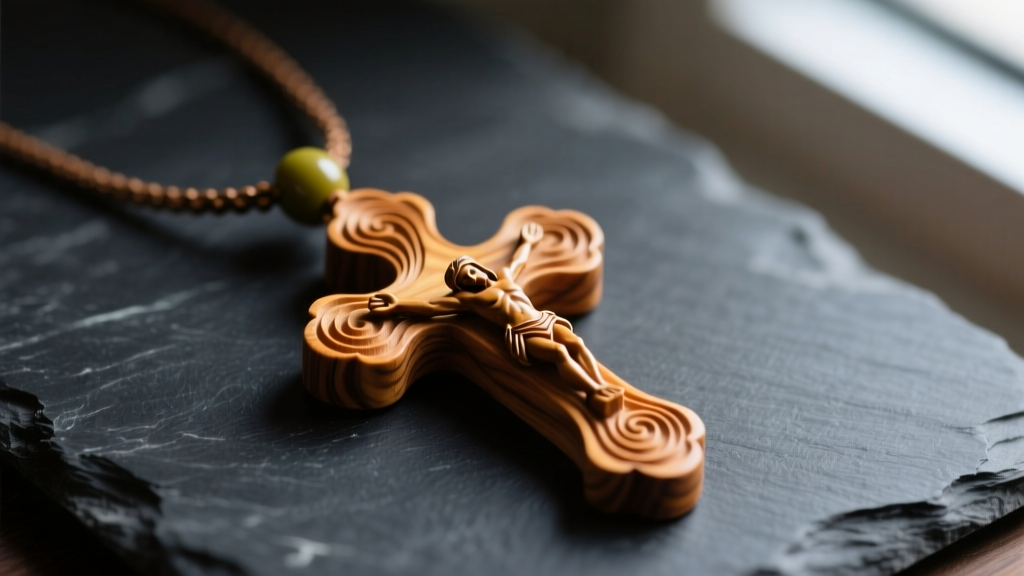
When evaluating an olive wood crucifix necklace, most buyers focus solely on the spiritual or aesthetic significance of the piece. However, from a materials science perspective, understanding the botany of Olea europaea is critical for assessing quality, longevity, and structural integrity. Olive wood is not a soft, porous timber; it is an exceptionally dense hardwood prized for its tight grain and natural oil content, making it one of the most durable organic materials used in religious jewelry.
Janka Hardness and Grain Density
According to The Wood Database, olive wood boasts a Janka hardness rating of approximately 2,700 lbf (pounds-force). To put this in perspective, this is nearly double the hardness of red oak (1,360 lbf) and significantly harder than black walnut. This extreme density is what allows master carvers to execute microscopic details on the corpus of the crucifix without experiencing 'tear-out' or splintering. When inspecting a high-end pendant, look for sharp, crisp lines in the facial features and extremities of the carving—this level of precision is only achievable in heartwood with a high Janka rating.
Heartwood vs. Sapwood Selection
A premium olive wood crucifix necklace should be carved exclusively from the heartwood of the tree. Heartwood is the darker, inner portion of the trunk, characterized by rich amber tones and striking, high-contrast dark brown streaks. It is also denser and more resistant to insect attack. Sapwood, the outer living portion of the tree, is pale yellow, softer, and highly susceptible to warping. Mass-produced pendants often blend sapwood and heartwood, resulting in a mottled, uneven appearance that lacks the structural stability required for a lifelong heirloom piece.
Artisanal Sourcing and Geographic Realities
The provenance of olive wood is a complex market. Many pendants are marketed as 'Bethlehem Olive Wood,' carrying deep historical and spiritual resonance. However, due to strict agricultural conservation laws protecting ancient olive groves in the Levant, the local supply of harvestable wood is incredibly limited. Today, a significant portion of olive wood used in global religious jewelry is actually sourced from pruned orchards in Spain, Italy, and Tunisia, then shipped to carving centers worldwide.
This is not inherently a negative; Mediterranean olive wood often features tighter growth rings due to arid climates, resulting in superior density. However, true vintage or locally sourced Levantine wood will command a premium price (typically $80 to $150+ for a medium-sized pendant) and should be accompanied by a certificate of origin from a verified cooperative. If a large, intricately carved pendant is selling for under $25, it is likely made from softer, imported woods like linden or balsa, stained to mimic olive wood.
Hardware Compatibility and Bail Mechanics
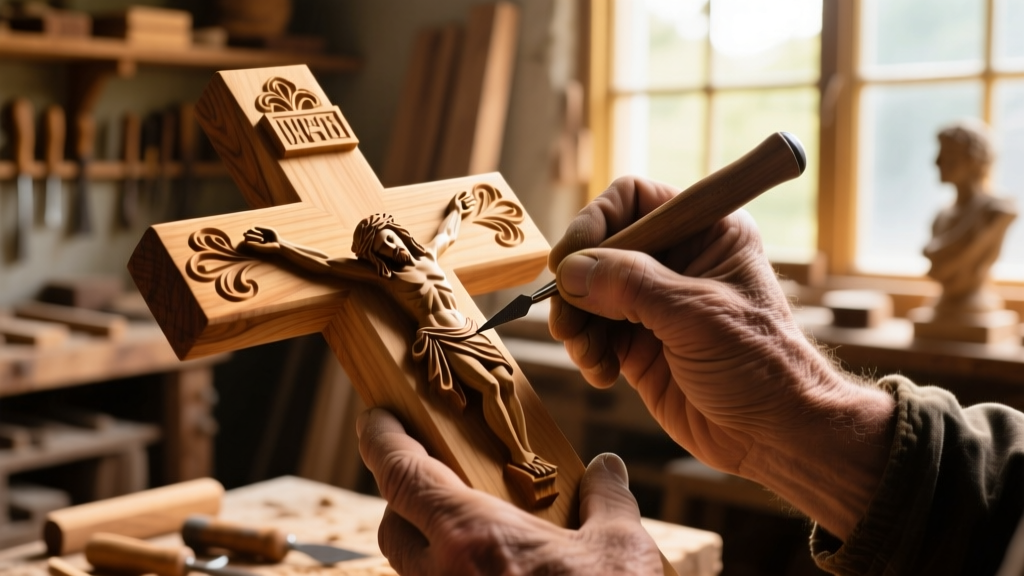
The most common point of failure in any wooden pendant is the bail—the hardware that connects the wood to the metal chain. Wood is hygroscopic, meaning it constantly absorbs and releases moisture from the air, expanding and contracting with seasonal humidity changes. Metal, conversely, is dimensionally stable. If a rigid metal collar is glued or crimped too tightly around a wooden bail, the wood will eventually split when it expands during high-humidity summer months.
When sourcing hardware for an olive wood crucifix necklace, jewelers must prioritize flexible connections. According to findings experts at Rio Grande, utilizing open jump rings or wire-wrapping techniques allows the wood the microscopic clearance it needs to breathe and move without fracturing.
| Bail Type | Material | Hygroscopic Risk | Expert Recommendation |
|---|---|---|---|
| Glued Metal Cap | Brass/Silver | High | Avoid. Cyanoacrylate glues restrict wood movement, leading to splitting. |
| Wire-Wrapped Loop | Sterling Silver | Low | Excellent. Allows natural expansion and contraction of the wood. |
| Carved Wood Loop | Olive Wood | None | Best. Unified material moves as a single entity; string with leather or cord. |
| Screw-In Pinch Bail | 14k Gold-Filled | Medium | Acceptable if pre-drilled with a slightly oversized pilot hole. |
Authenticity Verification: Spotting Fakes
Because of the premium placed on genuine olive wood, the market is saturated with counterfeits made from MDF (medium-density fiberboard), resin composites, or cheap softwoods heavily coated in tinted polyurethane. As a domain expert, you can verify authenticity using three non-destructive tests:
- The Olfactory Test: Rub the pendant vigorously with your thumb to generate friction heat. Genuine olive wood will emit a faint, sweet, fruity aroma. Resin or plastic fakes will smell like chemicals or emit no scent at all.
- The UV Fluorescence Test: Under a standard long-wave (365nm) UV blacklight, genuine olive wood exhibits a mild, cloudy yellow-green fluorescence. Varnished fakes or dyed woods will typically show a dull, uniform purple or blue glow from the synthetic topcoat.
- The End-Grain Inspection: Use a 10x jeweler's loupe to examine the top or bottom edge where the bail is attached. Real olive wood will show tightly packed, irregular pores and natural ray flecks. MDF or composite fakes will show a uniform, fibrous, or granular texture with no natural grain lines.
Long-Term Maintenance and Humidity Control
The natural oils in olive wood make it highly resistant to rot and water damage, but it is not immune to environmental stress. The ideal relative humidity (RH) for storing and wearing wooden jewelry is between 40% and 50%. In arid winter climates where indoor heating drops RH below 20%, the wood can experience 'checking'—small, superficial cracks along the grain.
The Oiling Protocol
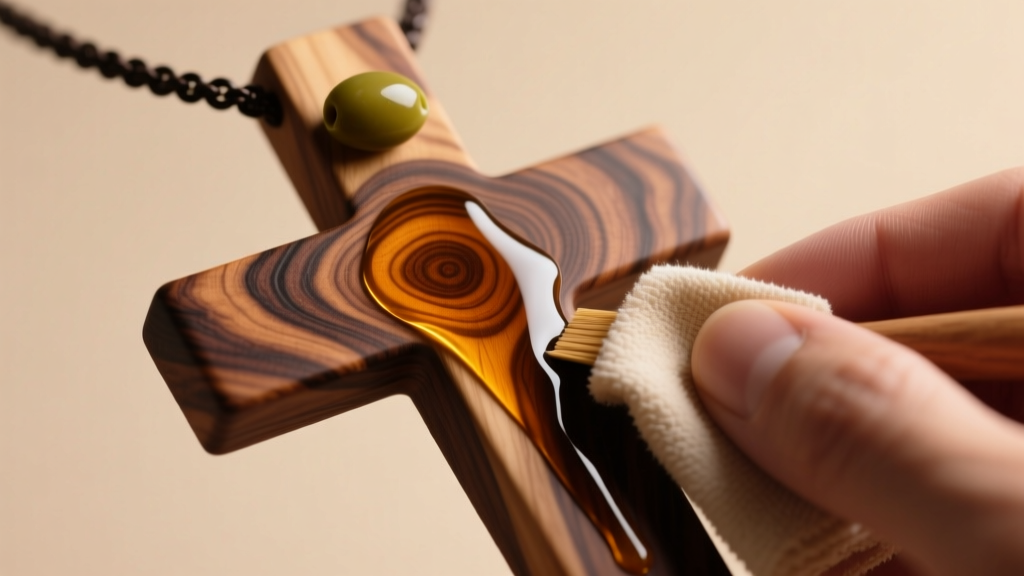
To maintain the pendant's luster and stabilize the moisture content, it must be oiled periodically. However, the choice of oil is paramount.
Expert Warning: Never use actual culinary olive oil to condition an olive wood crucifix necklace. Despite the name, plant-based culinary oils are non-drying and will eventually oxidize, turning rancid and emitting a sour odor against your skin. Always use food-grade mineral oil, fractionated coconut oil, or a specialized microcrystalline beeswax blend.
Application Steps:
- Ensure the pendant is clean and free of skin oils or dust.
- Apply 2-3 drops of food-grade mineral oil to a lint-free microfiber cloth.
- Rub the oil into the wood following the direction of the grain for 60 seconds.
- Allow the pendant to rest for 12 hours in a room-temperature environment.
- Buff off any unabsorbed excess oil with a dry cloth to prevent a sticky residue.
Repeat this process every six months, or whenever the wood begins to look dull or ashen.
Neckline Pairing and Styling Guidelines
An olive wood crucifix necklace carries a rustic, grounded aesthetic that pairs beautifully with specific textiles and necklines. Because the wood absorbs light rather than reflecting it like metal or gemstones, it requires contrast to stand out.
- The V-Neck and Deep Scoop: Pair a 24-inch to 30-inch olive wood pendant with a deep V-neck sweater or linen shirt. The elongated chain draws the eye downward, allowing the dark, intricate grain of the wood to rest against the skin or a contrasting light fabric, maximizing visual impact.
- The Crew Neck and Collared Shirt: For a more subtle, everyday look, opt for an 18-inch to 20-inch chain that rests just below the collarbone. This works exceptionally well with crisp white oxford shirts or dark navy crew necks, where the amber tones of the heartwood provide a striking color contrast.
- Chain Selection: Avoid overly thick, heavy Cuban links which can overpower the organic nature of the wood. Instead, choose delicate to medium-weight chains like a 2mm box chain, a rope chain, or a simple black leather cord. Sterling silver and oxidized black silver complement the cool undertones of the dark wood grain, while yellow gold enhances the warm amber highlights.
By understanding the material science, hardware mechanics, and proper maintenance protocols, you can ensure your olive wood crucifix necklace remains a structurally sound and visually stunning heirloom for decades to come.


