The Orion Necklace: Technical Guide to Constellation Jewelry
Explore the technical craftsmanship of the Orion necklace. Learn about metal grades, gemstone settings, and chain gauges for celestial jewelry.

The celestial jewelry trend has dominated the market for years, but few designs demand the technical precision and structural foresight of the Orion necklace. Translating one of the most recognizable star patterns in the night sky into a wearable, durable piece of fine jewelry requires a deep understanding of metallurgy, gemological scaling, and advanced fabrication techniques. Unlike simple pendant necklaces, a true constellation piece relies on a complex network of delicate chain links, micro-welded nodes, and precisely calibrated melee gemstones. In this expert deep dive, we deconstruct the engineering behind the Orion necklace, examining the material grades, chain gauges, and setting techniques that separate heirloom-quality craftsmanship from mass-produced costume jewelry.
Astronomical Mapping and CAD Translation
Creating an accurate Orion necklace begins long before metal is cast. Jewelers must first translate the celestial coordinates—right ascension and declination—of the constellation's primary stars into a two-dimensional Cartesian plane. According to astronomical data from Britannica, Orion is defined by distinct stellar magnitudes, with Betelgeuse and Rigel acting as the massive anchor points, and the three stars of Orion's Belt (Alnitak, Alnilam, and Mintaka) forming the central axis.
In modern Computer-Aided Design (CAD) software, these stellar relationships are mapped to a physical scale, typically spanning 35mm to 50mm in width for a standard pendant. The primary engineering challenge here is proportional integrity. If the CAD technician scales the distance between Betelgeuse and Rigel too aggressively to fit a smaller neckline profile, the iconic geometry of the hunter is lost. High-end manufacturers use parametric modeling to ensure that the ratios between the stars remain mathematically constant, regardless of the final millimeter dimensions of the pendant.
Metallurgy and Chain Gauge Specifications
The structural backbone of any Orion necklace is the chain and the connecting nodes. Because constellation necklaces feature multiple floating nodes suspended along a single continuous chain, the tensile strength and Vickers Hardness (HV) of the chosen alloy are critical.
Alloy Selection and Hardness
- 14k Yellow/White Gold: With a Vickers Hardness of approximately 135-150 HV, 14k gold offers the ideal balance of malleability for casting and rigidity for holding micro-settings. It is the industry standard for daily-wear constellation jewelry.
- 18k Gold: Softer (approx. 115-125 HV) and richer in color, 18k gold requires thicker chain gauges to prevent stretching under the weight of gemstone nodes.
- Platinum (950/50 Ru): With a density and tensile strength far exceeding gold, platinum allows for ultra-fine, intricate wirework and micro-prong settings without the risk of node deformation.
Chain Gauge and Tensile Strength Matrix
Selecting the correct chain gauge is paramount. A chain that is too thick will visually overpower the delicate star nodes, while a chain that is too thin will snap under dynamic stress.
| Chain Gauge (mm) | Chain Style | Approx. Tensile Strength | Best Application in Orion Necklaces |
|---|---|---|---|
| 0.6mm - 0.8mm | Cable / Rolo | 2.5 - 4.0 kg | Lightweight pieces featuring 1mm bezel-set melee diamonds; minimal visual footprint. |
| 0.9mm - 1.1mm | Cable / Box | 5.0 - 7.5 kg | Standard luxury pieces with 1.5mm - 2mm prong-set stones; optimal balance of strength and delicacy. |
| 1.2mm - 1.5mm | Wheat / Franco | 9.0 - 12.0 kg | Heavy-duty designs featuring large central nodes or solid metal star maps rather than suspended gems. |
Node Fabrication: Laser Welding vs. Traditional Soldering
One of the most defining technical aspects of a high-quality Orion necklace is how the star nodes are attached to the chain. In mass-market jewelry, nodes are often attached using traditional torch soldering. This method requires the application of solder paste and flux, followed by high heat. The thermal spread from a torch can easily damage adjacent gemstones, cause porosity in the casting, or leave visible oxidation marks that require aggressive polishing, thereby thinning the chain links.
Expert jewelers and premium manufacturers utilize laser welding for constellation nodes. Laser welding uses a concentrated pulse of light to fuse metal at a microscopic level without transferring ambient heat to the surrounding chain or gemstones. This allows a jeweler to weld a 1.5mm gold bezel directly onto a 0.8mm cable chain link with zero thermal damage to a pre-set diamond. The resulting joint is often stronger than the parent metal itself, drastically reducing the failure rate of floating star nodes.
"The shift toward pulse-arc and laser welding in the 2020s has revolutionized celestial jewelry. We can now suspend micro-set gemstones on ultra-fine chains without the risk of thermal shock fracturing the stones during assembly." — Master Bench Jeweler Technical Review
Gemstone Setting Techniques for Constellation Nodes
The stars of Orion are not uniform in brightness or color, and a technically superior Orion necklace reflects this through strategic gemstone selection and setting techniques. According to the Gemological Institute of America (GIA), the precision required for melee diamonds (stones weighing less than 0.15 carats) demands exacting calibration.
Stone Sizing and Stellar Magnitude
To mimic the visual weight of the actual constellation, jewelers map stellar magnitude to gemstone millimeter size:
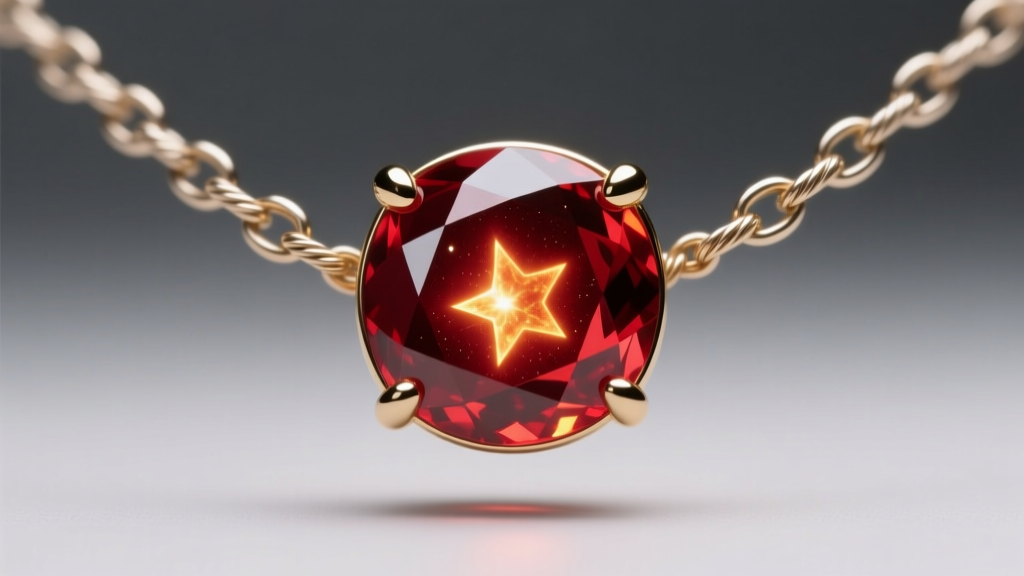
- Rigel & Betelgeuse (Magnitude ~0.1 to 0.5): Represented by 2.0mm to 2.5mm round brilliant or cushion-cut stones. Betelgeuse, a red supergiant, is frequently represented by a heat-treated ruby or a vibrant pink sapphire, while Rigel, a blue supergiant, is mapped to a Ceylon sapphire or a high-clarity diamond.
- Orion's Belt (Magnitude ~1.7): Typically represented by uniform 1.5mm to 1.7mm melee diamonds (approx. 0.015 to 0.02 carats each).
- Peripheral Stars (Bellatrix, Saiph): Mapped to 1.0mm to 1.2mm single-cut or full-cut diamonds (approx. 0.005 to 0.01 carats).
Bezel vs. Micro-Prong Settings
For stones 1.5mm and smaller, bezel settings are heavily favored in constellation necklaces. A bezel involves a continuous rim of metal pushed over the girdle of the stone. While it slightly reduces the light return compared to prongs, it offers superior protection against snagging on textiles—a common failure mode for delicate pendant necklaces. For the larger anchor stones (2.0mm+), micro-prong settings (usually 4-prong) are utilized to maximize brilliance and allow light to enter the pavilion of the diamond from multiple angles.
Clasp Mechanisms and Structural Termination
The termination points of an Orion necklace—where the chain meets the clasp and the jump rings—are frequent points of mechanical failure. Standard spring-ring clasps are generally inadequate for fine jewelry due to their weak internal tension springs and thin soldered seams.
Technical best practices dictate the use of a solid-cast lobster clasp (minimum 5mm in length) paired with a soldered, heavy-gauge jump ring. For platinum or 18k gold Orion necklaces featuring a high carat weight of melee diamonds, a custom box clasp with a safety figure-eight catch is recommended. This ensures that even if the primary tension mechanism fails, the secondary safety wire will prevent the total loss of the garment.
Common Failure Modes and Preventative Maintenance
Despite advanced CAD and laser welding, constellation necklaces are subject to specific mechanical stresses. Understanding these failure modes is essential for both the buyer and the bench jeweler.
- Chain Kinking and Link Distortion: Because Orion necklaces feature multiple rigid nodes, the chain segments between the stars are prone to twisting. If a 0.8mm cable chain twists and is pulled taut, the individual links can deform, leading to permanent kinking. Solution: Always store the necklace laid flat or suspended vertically by the clasp.
- Melee Diamond Loss: Micro-prong settings on 1mm stones have incredibly small metal tolerances. A minor impact against a hard surface can bend a micro-prong, releasing the stone. Solution: Annual ultrasonic cleaning and microscopic prong-tightening by a certified jeweler.
- Rhodium Plating Degradation: White gold Orion necklaces are plated with rhodium to achieve a bright white finish. The friction from the nodes rubbing against the collarbone and clothing will wear this plating away over 12 to 18 months, revealing the slightly yellowish underlying alloy. Solution: Opt for platinum or palladium-white gold alloys that do not require rhodium plating for long-term color stability.
The engineering behind a masterfully crafted Orion necklace is a testament to the intersection of astronomy and micro-metallurgy. By prioritizing precise CAD scaling, appropriate chain gauges, and advanced laser-welding techniques, jewelers can create celestial maps that are not only astronomically accurate but structurally resilient enough to be worn every day.