Our Father Necklace Troubleshooting: Fix Fading & Chain Breaks
Is your our father necklace fading, tangling, or breaking? Discover expert troubleshooting tips for micro-engravings, chain gauges, and metal allergies.

The Engineering Flaws of Micro-Engraved Prayer Jewelry
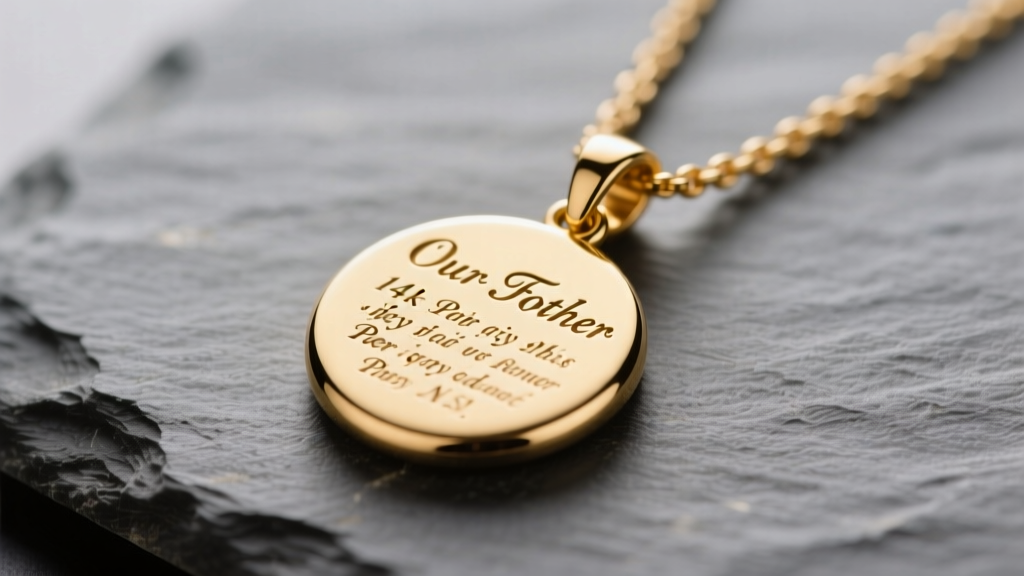
The our father necklace is a staple of devotional jewelry, often featuring the entirety of the Lord’s Prayer micro-engraved onto a 10mm spherical bead, a small cross, or a flat rectangular pendant. While spiritually significant, these pieces present unique structural and metallurgical challenges. The primary issue lies in the surface-area-to-text ratio. Cramming 60 to 70 words onto a 12mm x 8mm canvas requires font sizes smaller than 1.5 points. When manufacturers use shallow laser engraving to achieve this density, the grooves rarely exceed 0.05mm in depth. Combined with the high-friction environment of the décolletage—where skin oils, cosmetics, and fabric constantly abrade the metal—the text inevitably degrades. Furthermore, the spherical shape of the popular 'prayer bead' pendants creates an uneven center of gravity, causing the pendant to spin endlessly, which accelerates chain fatigue at the bail and jump ring. In this comprehensive troubleshooting guide, we address the most common failure modes of these necklaces and provide actionable, expert-level solutions to restore and protect your jewelry.
Troubleshooting Faded or Illegible Engravings
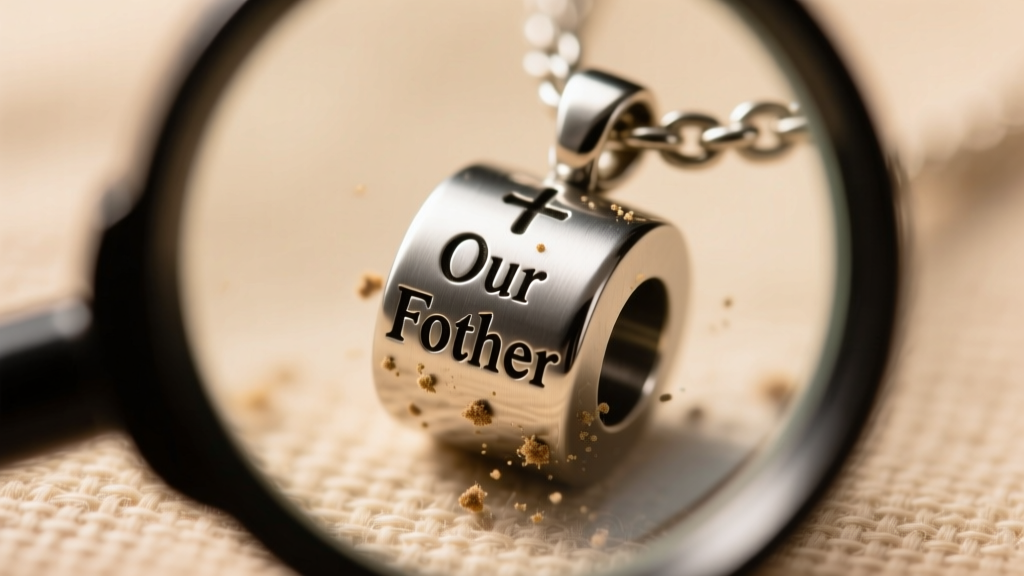
When the text on your our father necklace begins to disappear, the immediate assumption is that the metal has worn away. However, in 80% of cases, the engraving is merely obscured by a hardened matrix of sebum, dead skin cells, and cosmetic residue. Because the grooves are microscopic, standard wiping with a polishing cloth is entirely ineffective; it merely pushes the debris deeper into the lettering.
The Sebum vs. Wear Diagnostic Test
Before seeking professional re-engraving, perform a deep extraction clean. According to the Gemological Institute of America (GIA), ultrasonic cleaning is the most effective method for removing trapped particulates from intricate metalwork. Use an ultrasonic cleaner operating at 40kHz. Fill the tank with warm distilled water and two drops of ammonia-free dish soap. Suspend the pendant in the basket for exactly three minutes. If the pendant is gold-plated or silver-plated over brass, limit the ultrasonic cycle to 60 seconds to prevent the cavitation bubbles from lifting compromised plating. Once dry, inspect the grooves under a 10x jeweler's loupe. If the lettering appears sharp and deep, the issue was purely cosmetic buildup. If the edges of the letters look rounded, smoothed, or entirely shallow, the metal has suffered abrasive wear.
Restoration Options: Laser vs. Diamond Drag
If the text is genuinely worn away, restoration requires a jeweler with specialized micro-engraving equipment. Avoid standard fiber laser re-engraving (1064nm), as it relies on surface oxidation and heat, which will yield the same shallow 0.05mm depth that failed originally. Instead, request rotary diamond-drag engraving. This method uses a physical carbide diamond bit to physically plow through the metal, carving grooves up to 0.2mm deep. While it requires a slightly larger font size (meaning the jeweler may need to abbreviate or use a tighter leading), the physical depth ensures the text will survive decades of friction. For an added layer of permanence, ask the jeweler to apply a dark vitreous enamel or epoxy resin into the carved grooves, which drastically increases contrast and protects the lettering from future debris accumulation.
Solving Chain Tangling, Fatigue, and Clasp Failures
The chain is the most frequent point of catastrophic failure for an our father necklace. Many of these pendants are sold with disproportionately delicate chains—often 0.6mm or 0.8mm snake or herringbone chains—to keep the retail price low and the aesthetic minimalist. However, a solid 10mm stainless steel or sterling silver prayer bead weighs between 4 and 7 grams. When caught on a sweater or subjected to the sudden kinetic shock of a tug, a 0.6mm chain will snap instantly, as its tensile yield strength rarely exceeds 3 kilograms of force.
Chain Gauge and Topology Comparison
To prevent breakage and the notorious tangling associated with smooth, round chains, you must upgrade to a structurally sound topology. Below is a troubleshooting matrix for selecting the correct replacement chain based on pendant weight and wear habits.
| Chain Type | Recommended Gauge | Tensile Yield (Approx.) | Tangle Resistance | Best Use Case |
|---|---|---|---|---|
| Snake Chain | 0.6mm - 0.8mm | 2.5 kg - 4.0 kg | Poor (Kinks easily) | Lightweight, hollow pendants under 2g |
| Cable Chain | 1.0mm - 1.2mm | 6.0 kg - 9.0 kg | Moderate | Standard daily wear, traditional crosses |
| Box Chain | 1.0mm - 1.5mm | 12.0 kg - 18.0 kg | Excellent | Heavy solid beads, active lifestyles |
| Wheat Chain | 1.2mm - 1.8mm | 15.0 kg - 22.0 kg | Excellent | Heirloom pieces, heavy 14k/18k gold pendants |
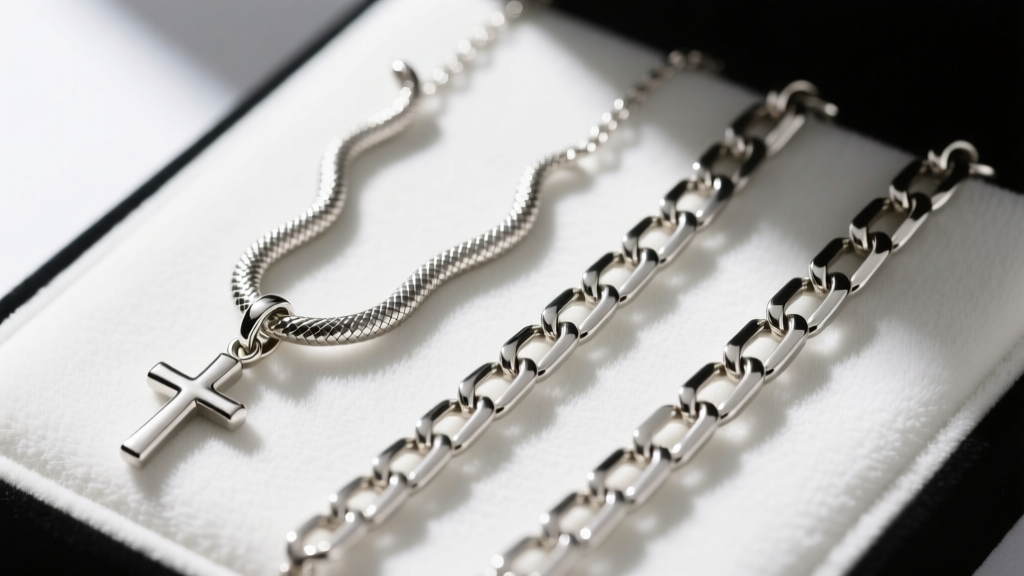
For a standard 5-gram our father bead, a 1.2mm box chain is the optimal troubleshooting upgrade. The interlocking square links lay flat against the skin, preventing the pendant from spinning wildly, while the structural geometry of the box link distributes kinetic shock across multiple solder points rather than a single weak link. Additionally, upgrade the clasp. Replace the factory-standard 4mm spring ring (which suffers from internal spring fatigue) with a 5mm or 6mm lobster clasp featuring a minimum wire thickness of 0.8mm. Ensure the jump ring connecting the clasp to the chain is soldered shut or upgraded to a split ring to prevent the chain from slipping out during wear.
Addressing Contact Dermatitis and Metal Tarnish
Skin irritation and rapid tarnishing are rampant in budget-friendly devotional jewelry. Many consumers experience a green or black discoloration on their chest, accompanied by an itchy, red rash. This is rarely an 'allergy to jewelry' in a general sense, but specifically a reaction to nickel or copper alloys leaching from the base metal.
According to the Federal Trade Commission (FTC) Jewelry Guides, the term 'hypoallergenic' is largely unregulated and carries no strict metallurgical guarantee. If your our father necklace is causing contact dermatitis, it is likely stamped '925' but alloyed with copper that is oxidizing against your skin's acidic pH, or it is a base-metal alloy plated with a microscopically thin layer of rhodium or silver that has worn through. For those with confirmed nickel allergies, the American Academy of Dermatology recommends avoiding white gold (which often contains nickel) and standard surgical steel unless it is explicitly certified as 316L low-carbon stainless steel. To permanently troubleshoot this issue without replacing the pendant, have a professional jeweler apply a PVD (Physical Vapor Deposition) titanium nitride coating or a heavy 2.5-micron rhodium electroplate. This creates an inert, biocompatible barrier that completely isolates the reactive base metals from your skin, stopping both the green tarnish and the allergic response.
The Preventative Maintenance Framework
To ensure the longevity of your our father necklace, implement this strict maintenance schedule based on current 2026 jewelry conservation standards:
- Daily: Remove the necklace before showering. The combination of hot water, sulfates in shampoo, and the mechanical friction of a washcloth will strip oils from the chain links and accelerate the degradation of micro-engravings.
- Weekly: Wipe the pendant with a dry, untreated microfiber cloth to remove the day's accumulation of sebum and perfume before the oils can harden into the lettering grooves.
- Bi-Annually: Perform the 40kHz ultrasonic clean detailed above. Inspect the bail (the loop connecting the pendant to the chain). Because the prayer bead spins, the bail experiences constant rotational friction. If the metal of the bail looks visibly thinned or grooved, take it to a jeweler to have a new heavy-duty soldered bail attached before it snaps.
By understanding the specific mechanical and chemical vulnerabilities of micro-engraved prayer jewelry, you can transition your our father necklace from a fragile, easily damaged accessory into a durable, lifelong heirloom. Proper gauge selection, advanced cleaning techniques, and mindful material upgrades are the keys to preserving both the physical integrity and the spiritual resonance of your piece.


