Starburst Gold Necklace Anatomy: Craft, Karats & Ray Geometry
Master the technical anatomy of a starburst gold necklace. Explore karat alloys, ray-casting techniques, chain pairings, and hallmark verification.


The Mathematics of Radial Symmetry
The starburst gold necklace is a masterclass in radial symmetry and mid-century celestial motifs, but beneath its vintage aesthetic lies a rigorous geometric framework. Unlike standard circular pendants, a true starburst relies on the precise mathematical distribution of primary and secondary rays emanating from a central medallion. In high-end jewelry manufacturing, the ratio of the central node's diameter to the length of the primary rays typically adheres to the Golden Ratio (1:1.618). This ensures the pendant draws the eye inward rather than appearing visually top-heavy or spindly.
Master jewelers generally utilize 12-point, 16-point, or 24-point configurations. A 16-point starburst, for instance, alternates between eight elongated primary rays and eight shorter secondary rays. The taper angle of these rays is critical; an angle between 5 and 8 degrees provides the necessary structural rigidity to prevent the gold tips from bending during daily wear, while still maintaining the sharp, explosive visual trajectory that defines the starburst silhouette. If the taper is too aggressive, the extremities become needle-thin and highly susceptible to deformation upon impact.
Metallurgy and Alloy Selection: 14k vs. 18k vs. 22k
When engineering a starburst gold necklace, the choice of karat weight is not merely a matter of color preference or intrinsic value; it is a structural decision. The elongated rays act as levers, meaning any lateral force applied to the tip is amplified at the base. Therefore, the Vickers Hardness (HV) and tensile strength of the alloy dictate the pendant's longevity.
Pure 24k gold is far too malleable (approx. 25-30 HV) for the delicate points of a starburst. Even 22k gold (~70 HV), while prized in Middle Eastern and South Asian markets for its rich, buttery hue, will quickly warp if fashioned into sharp, elongated rays. Consequently, master casters rely on 14k and 18k alloys, adjusting the copper, silver, and zinc ratios to optimize the dendritic crystal structure during the cooling phase.
| Alloy (Karat) | Vickers Hardness (HV) | Tensile Strength | Ray Durability | Best Use Case |
|---|---|---|---|---|
| 14k Yellow Gold | 120 - 150 HV | High | Excellent | Everyday wear, sharp 24-point rays, active lifestyles. |
| 18k Yellow Gold | 90 - 120 HV | Medium | Good | High-end luxury, softer ray tapers, occasional wear. |
| 18k White Gold | 130 - 160 HV | High | Excellent | Modern starbursts, nickel or palladium bleached alloys. |
| 22k Yellow Gold | 60 - 80 HV | Low | Poor | Thick, blunt-rayed designs, investment pieces only. |
According to the Gemological Institute of America (GIA), the specific trace elements in 14k gold (often higher in copper and zinc) not only increase hardness but also improve the alloy's fluidity when molten, allowing it to fill the microscopic extremities of a starburst mold more effectively than heavier 18k mixtures.
Manufacturing Techniques: Casting vs. Die-Striking
The method used to form the starburst pendant drastically affects its internal grain structure and, consequently, its durability. The vast majority of modern starburst gold necklaces are produced via lost-wax casting. While this allows for intricate, three-dimensional ray textures, it introduces specific vulnerabilities. As the molten gold enters the flask, it cools rapidly when it hits the thin, distant extremities of the rays. This rapid thermal shock can lead to gas porosity or micro-shrinkage at the very tips of the starburst.
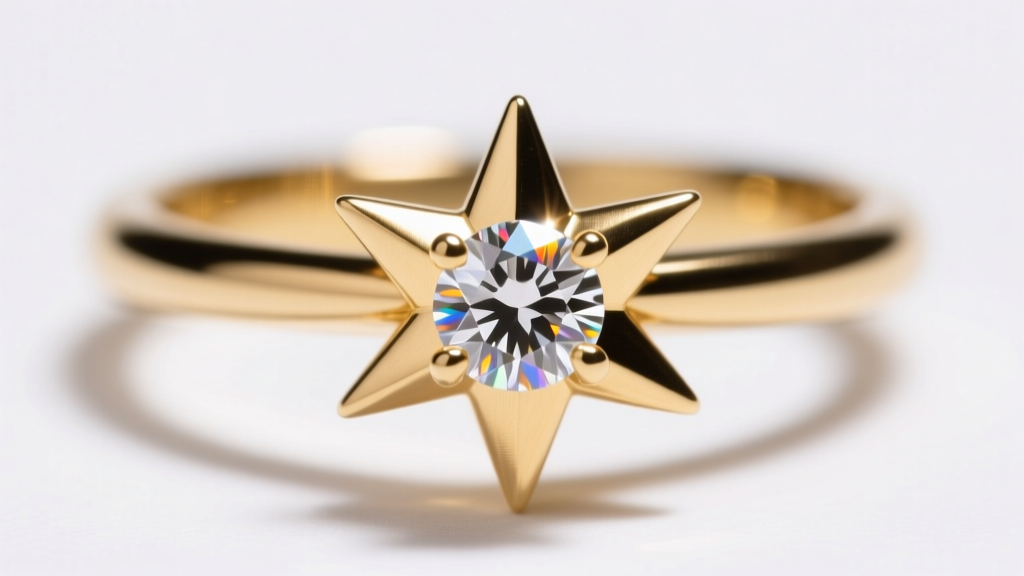
Expert jewelers mitigate this by carefully planning the sprue attachment points on the casting tree. If a sprue is attached directly to a delicate ray, the subsequent cutting and polishing leave a structural weak point. Instead, master casters attach the main sprue to the thickest part of the central medallion, utilizing micro-sprues or relying on capillary action to draw the gold into the rays. For a deeper understanding of how cooling rates affect thin extremities, the technical archives at Ganoksin provide extensive metallurgical breakdowns of casting porosity.
Conversely, vintage or high-volume commercial starbursts are often die-struck. Die-striking involves pressing a sheet of gold between two hardened steel dies under immense pressure (often exceeding 50 tons). This compresses the gold's molecular structure, aligning the grain and resulting in a pendant that is significantly denser, harder, and more resistant to bending than its cast counterpart. Identifying a die-struck starburst is relatively simple: the back will be perfectly flat or feature a crisp, mirrored negative impression of the front, whereas a cast piece will often show slight rounding or a sandblasted finish on the reverse to hide minor surface pitting.
Chain Engineering: Matching the Bail and Link Gauge
A starburst gold necklace is only as secure as the chain and bail system that supports it. The focal weight of a starburst pendant is concentrated in the center, but the wide wingspan creates a pendulum effect that can cause excessive friction against the chain links. Therefore, engineering the bail—the loop that connects the pendant to the chain—is a critical technical step.
For a standard 16-to-18-inch necklace, the bail's inner diameter (ID) must be precisely calibrated to the chain's gauge. If you are pairing the pendant with a 1.2mm rope chain, the bail ID should be no less than 2.5mm. This provides adequate clearance to prevent galvanic friction and mechanical wear. If the bail is too tight, the continuous rubbing will eventually wear through the chain links or the bail itself, a failure mode common in poorly proportioned estate jewelry.
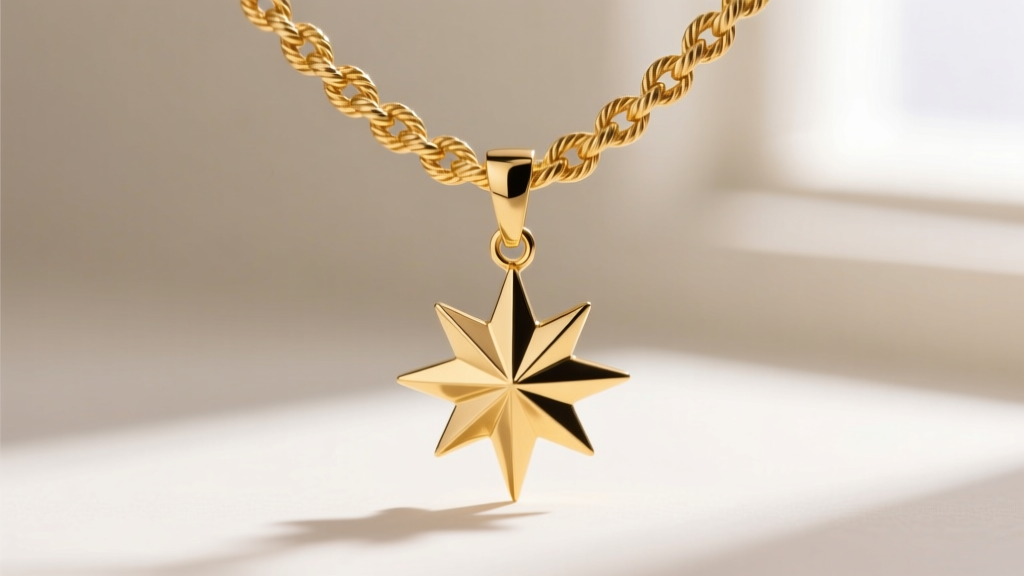
Furthermore, the type of chain matters. Box chains and wheat chains offer superior tensile strength and distribute the pendant's weight evenly across multiple links. Snake chains, while sleek, are prone to kinking under the dynamic lateral movement caused by the wide profile of a starburst pendant. For heavy, solid-gold starbursts exceeding 8 grams, a 1.5mm to 2.0mm Cuban link or Figaro chain is structurally mandated to prevent catastrophic clasp failure.
Hallmark Verification and Sourcing Standards
Verifying the authenticity of a starburst gold necklace requires looking beyond the surface polish. In the United States, the Federal Trade Commission (FTC) mandates that any item stamped with a karat mark (e.g., 14K, 18K, 750) must also bear the registered trademark or hallmark of the manufacturer. On a starburst pendant, finding this stamp can be challenging due to the lack of flat surface area on the rays.
Traditionally, hallmarking is done via steel punch stamps. However, striking a punch on the curved surface of a starburst medallion can distort the front-facing geometry. To preserve the design, modern luxury houses utilize laser hallmarking. This process vaporizes a microscopic layer of gold to etch the karat weight and maker's mark onto the flat back of the central node or the interior of the soldered bail loop without transferring kinetic shock to the delicate rays. When inspecting a vintage or contemporary starburst, always use a 10x jeweler's loupe to examine the interior of the bail and the reverse of the central hub for these dual marks. The presence of a karat stamp without a corresponding maker's mark is a primary indicator of unregulated or imported jewelry that may not adhere to strict alloy tolerance standards.


