Pearl Emerald Necklace Guide: Grading, Settings & Valuation
Explore the technical anatomy of a pearl emerald necklace. Learn gemological grading, stringing methods, metal pairings, and valuation metrics.

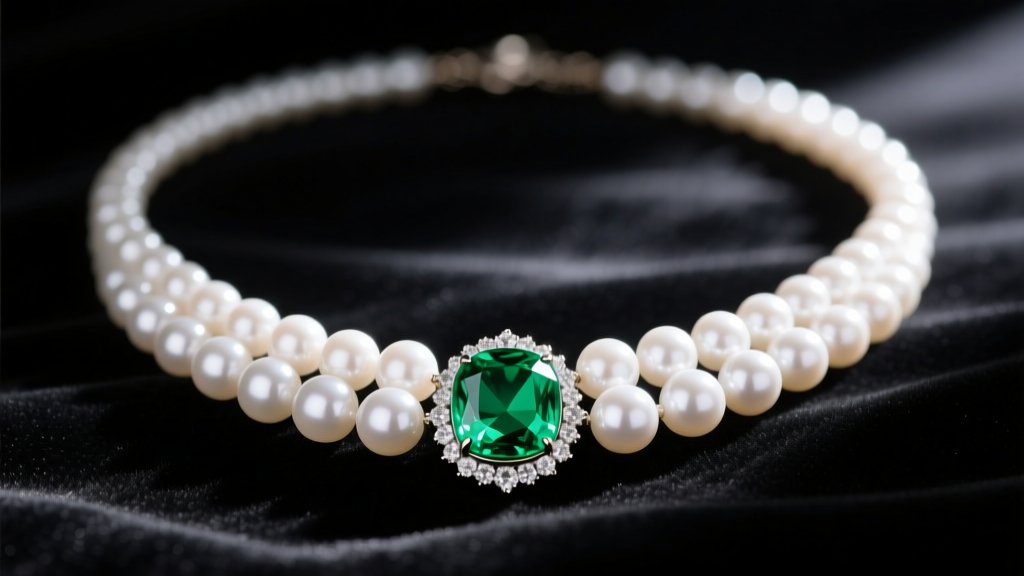
The Gemological Anatomy of a Pearl Emerald Necklace
Designing and appraising a pearl emerald necklace requires navigating the stark contrast between organic and silicate gemstones. Pearls, born from biological processes within mollusks, possess a delicate, nacreous surface. Emeralds, a variety of the mineral beryl colored by trace amounts of chromium and vanadium, are renowned for their vivid saturation but notorious for their internal brittleness. As of 2026, high jewelry collectors increasingly demand transparency in the sourcing and treatment of both materials, making a technical understanding of their gemological properties essential for any serious buyer or bench jeweler.
Unlike homogeneous diamond strands, combining these two distinct materials introduces complex structural and aesthetic challenges. The juxtaposition of a pearl's soft, light-scattering orient against an emerald's sharp, vitreous luster creates a visually striking piece, but it demands rigorous adherence to specialized stringing and setting protocols to ensure longevity.
Pearl Selection: Nacre, Luster, and Surface Metrics
The foundation of any premium pearl emerald necklace lies in the quality of the pearls. For high-end strands, Akoya and White South Sea pearls are the industry standards. The Gemological Institute of America (GIA) evaluates pearls based on seven value factors, but nacre thickness and luster are the most critical for structural integrity and visual performance.
Nacre Thickness and Orient
Akoya pearls must possess a minimum nacre thickness of 0.8mm to be considered gem-quality; anything thinner risks peeling or chipping when knotted. South Sea pearls naturally develop thicker nacre (2.0mm to 6.0mm) due to longer cultivation periods. The 'orient'—the iridescent play of colors just below the surface—is caused by the diffraction of light through overlapping aragonite platelets. A high-grade pearl emerald necklace will feature pearls with a sharp, mirror-like luster that allows the emerald's green hue to reflect beautifully off the pearl's surface without being muddied by chalky overtones.
Surface Blemishes and Matching
Because emeralds draw the eye, the pearls flanking the center stone must be meticulously matched in diameter (within 0.2mm tolerance) and body color. Rose or silver overtones in Akoya pearls are frequently chosen to complement the specific undertone of the emerald pendant or accents.
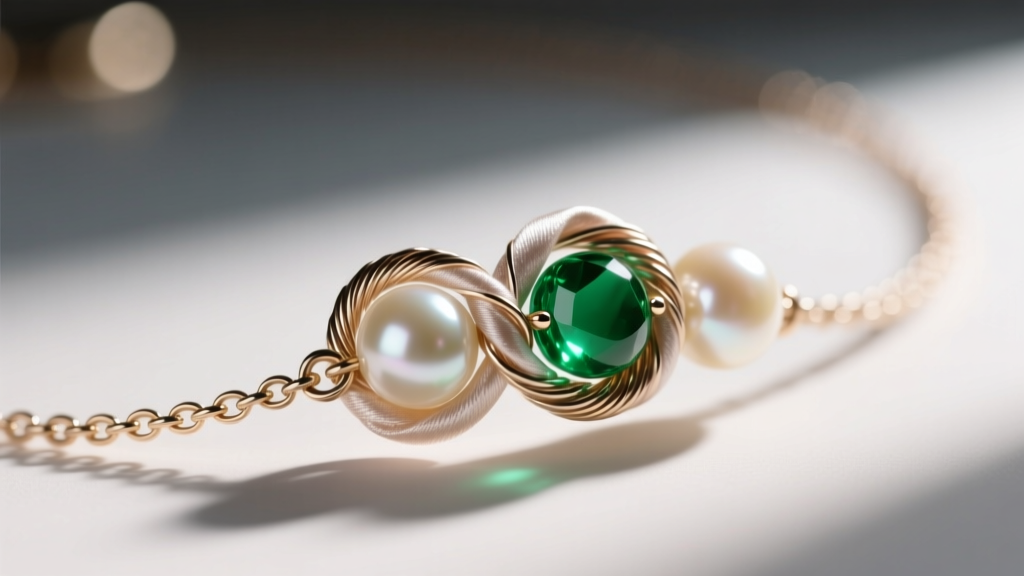
Emerald Grading: Color Saturation and the 'Jardin'
The emerald component—whether utilized as a central pendant, a clasp accent, or interspersed beads—dictates the necklace's valuation ceiling. According to the Gübelin Gem Lab, color is the paramount driver of emerald value, specifically the balance of hue, tone, and saturation.
Color Origins: Colombian vs. Zambian
Colombian emeralds (particularly from the Muzo and Chivor mines) are prized for their pure, saturated green with a slight yellowish secondary hue, driven by chromium. Zambian emeralds, colored primarily by vanadium and iron, exhibit a cooler, bluish-green tone. When paired with yellow gold and white pearls, Colombian emeralds provide a warmer, classic contrast, while Zambian stones offer a modern, icy juxtaposition against platinum or white gold hardware.
Clarity and the 'Jardin'
Unlike diamonds, emeralds are expected to have inclusions. These internal fractures and mineral deposits are poetically termed the 'jardin' (French for garden). However, surface-reaching fissures compromise the stone's structural integrity. For a pearl emerald necklace, emeralds should be cut as cabochons or heavily bezel-set if they possess significant surface fractures, preventing the pearls from scratching the emerald's vulnerable fault lines during wear.
Enhancement and Treatment Protocols
Nearly 90% of commercial emeralds undergo clarity enhancement. The trade standard involves filling surface-reaching fractures with colorless oils (like cedar oil) or synthetic resins (like Opticon) to improve apparent clarity. The GIA clarity enhancement scale grades these treatments as None, Minor, Moderate, or Significant. In the 2026 market, 'No Oil' or 'Minor' emeralds command a 40% to 60% premium over 'Moderate' stones, as oils can dry out or leak over time, especially when exposed to the heat of a jeweler's torch during clasp repairs.
Structural Engineering: Stringing and Setting Challenges
Combining organic pearls and brittle emeralds on a single strand is a masterclass in bench jewelry engineering. The primary adversary is the Mohs scale of mineral hardness.
| Gemological Property | Pearl (Akoya/South Sea) | Emerald (Beryl) |
|---|---|---|
| Mohs Hardness | 2.5 - 4.5 | 7.5 - 8.0 |
| Specific Gravity | 2.61 - 2.85 | 2.67 - 2.78 |
| Refractive Index | 1.52 - 1.66 | 1.577 - 1.583 |
| Toughness | Good (but scratches easily) | Poor (highly brittle) |
| Primary Treatment | Bleaching / Polishing | Oil / Resin Filling |
The French Wire and Knotting Technique
Pearls must be individually knotted on Size E or F silk thread to prevent total strand loss if the necklace breaks. However, the sharp edges of emerald beads or the metal loops of an emerald pendant will quickly saw through silk. To mitigate this, master stringers use 'French wire' (also known as gimp)—a microscopic, hollow, coiled metal wire made of 14k gold or sterling silver. The silk thread passes through the gimp where it meets the emerald setting, creating a flexible, abrasion-resistant barrier. Furthermore, 18k gold or platinum spacer beads are often placed between pearls and emeralds to prevent the harder beryl from scratching the softer nacre.
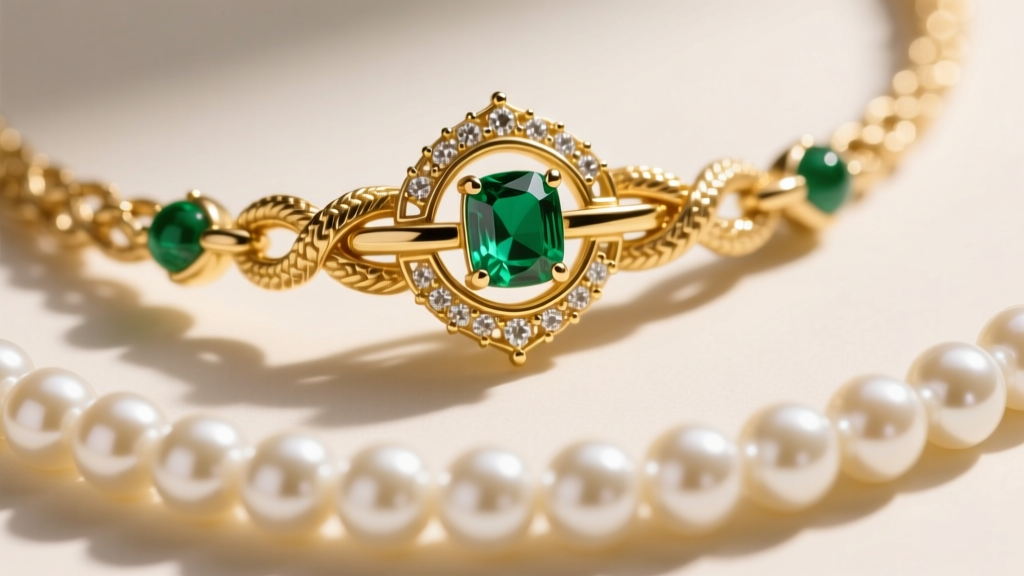
Metal Pairings and Clasp Mechanics
The hardware of a pearl emerald necklace must balance security with aesthetic harmony. Traditional spring-ring clasps are insufficient for high-value strands. Instead, custom-fabricated 18k gold or platinum ball clasps, box clasps, or filigree barrel clasps are utilized.
Many high-jewelry houses integrate the emerald directly into the clasp mechanism. A prong-set or bezel-set emerald on an 18k yellow gold box clasp serves a dual purpose: it acts as a secure, double-locking safety mechanism while providing a secondary focal point when the necklace is viewed from the side or back. Platinum is preferred for the actual prongs holding the emerald due to its superior tensile strength and lack of memory, ensuring the stone remains secure even if the necklace is dropped or snagged.
Valuation and Authentication Framework
Appraising a pearl emerald necklace requires a bifurcated approach, as the value of the pearls and the emeralds are calculated on entirely different matrices. Authentication via independent gemological laboratories is non-negotiable for investment-grade pieces.
Pricing Tiers by Material Grade
- Commercial Tier ($800 - $2,500): Features freshwater pearls with thick blemishes and heavily treated (Moderate to Significant) Zambian or Brazilian emeralds. Typically strung on synthetic cord without French wire protection.
- Fine Jewelry Tier ($4,000 - $15,000): Showcases matched Akoya pearls (7.5mm - 8.5mm) with sharp luster and a Minor-oil Colombian emerald pendant (1.5 to 3.0 carats). Includes 18k gold hardware and proper silk knotting.
- Investment/High Jewelry Tier ($30,000 - $150,000+): Features flawless White South Sea pearls (12mm+) and a 'No Oil' Muzo emerald of exceptional color saturation, accompanied by reports from both the GIA and the Gübelin Gem Lab. Hardware is custom-fabricated platinum or 22k gold.
Certification Requirements
When acquiring a pearl emerald necklace, buyers must demand two separate reports if the emerald is over 1.0 carat. The GIA Pearl Classification Report will detail the nacre, luster, and surface quality, while the GIA Emerald Report will explicitly state the geographic origin (if determinable) and the exact level of clarity enhancement. Avoid necklaces where the emerald's treatment status is listed as 'Unknown' or 'Indeterminate,' as this severely depresses the secondary market liquidity of the piece.
Conclusion
A pearl emerald necklace is far more than a simple assembly of beautiful stones; it is a complex exercise in material science and lapidary art. By understanding the precise gemological metrics of nacre thickness and emerald clarity enhancement, as well as the critical stringing techniques required to protect these disparate gems, collectors can confidently acquire pieces that will endure both structurally and stylistically for generations.


