Identifying an Antique Pools of Light Necklace: Quartz vs Glass
Discover how to authenticate an antique pools of light necklace by comparing rock crystal quartz properties against glass and synthetic replicas.

The Origins and Optical Magic of the Pools of Light Necklace
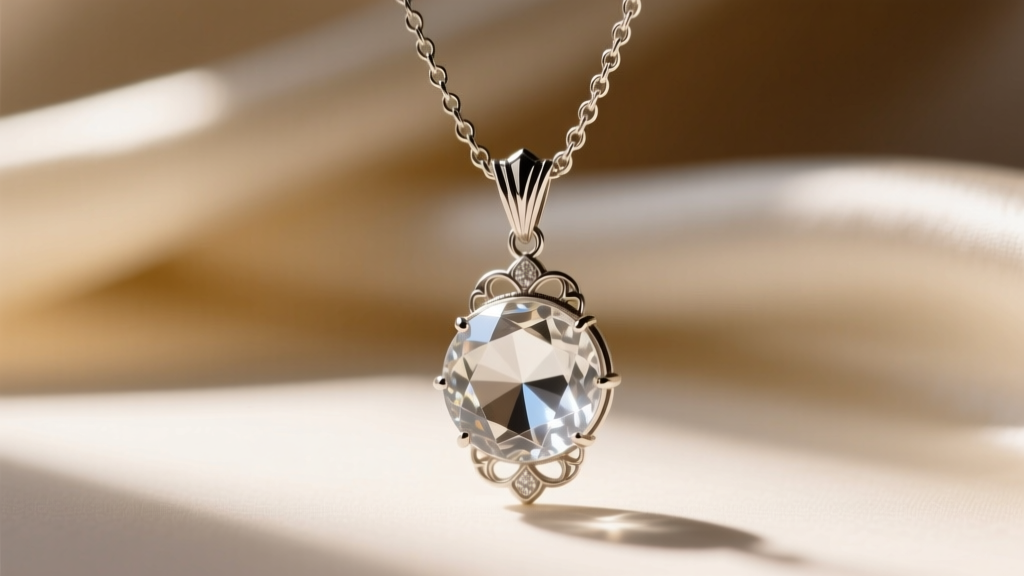
The term 'pools of light necklace' refers to one of the most captivating and highly sought-after styles of antique jewelry, originating primarily during the Art Deco era of the 1920s and 1930s. Unlike traditional faceted gemstones that rely on external light return for their sparkle, a true pools of light pendant utilizes a perfectly spherical, unmounted, or minimally capped gemstone to capture, bend, and trap light. When illuminated, the sphere appears to hold a glowing, luminous pool of light within its core. While the aesthetic is undeniably mesmerizing, the material composition is what truly dictates the value, authenticity, and optical performance of these remarkable pieces. As we navigate the 2026 antique jewelry market, distinguishing between genuine antique rock crystal quartz and later glass or synthetic replicas is an essential skill for collectors and enthusiasts alike.
Material Deep Dive: Rock Crystal vs. Glass vs. Synthetics
To understand the pools of light effect, we must examine the gemological properties of the materials historically used to craft these spheres. The optical phenomenon relies heavily on the material's refractive index (RI) and its internal clarity.
Genuine Rock Crystal Quartz (The Antique Standard)
The original and most prized pools of light necklaces were crafted from rock crystal quartz, a colorless, transparent variety of macrocrystalline quartz (SiO2). According to the Gemological Institute of America (GIA), rock crystal possesses a refractive index of 1.544 to 1.553 and a Mohs hardness of 7. This specific RI allows light to enter the sphere, bounce off the curved interior walls via total internal reflection, and concentrate into a bright, centralized glow. Genuine antique rock crystal is rarely flawless; it typically contains microscopic liquid inclusions, two-phase inclusions, or subtle internal fractures that serve as fingerprints of its natural origin.
Leaded Glass and Crystal Replicas
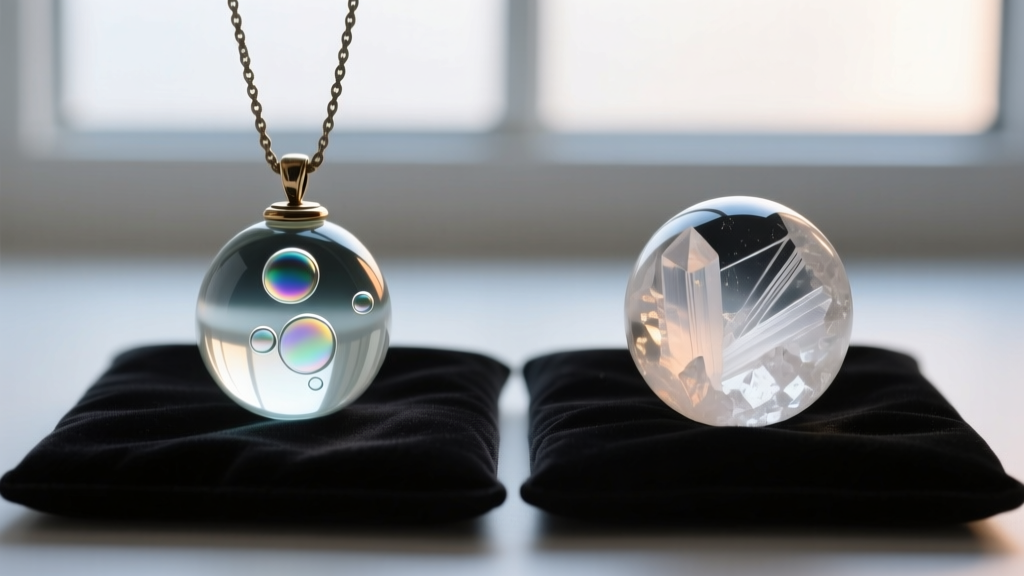
As the popularity of the pools of light necklace surged in the mid-20th century, manufacturers began producing more affordable replicas using high-lead-content glass or early crystal compositions. Glass has a variable RI (typically 1.50 to 1.70, depending on lead oxide content) and a much lower Mohs hardness of 5 to 6. While leaded glass can mimic the heavy, substantial feel of quartz and offer a high surface luster, it lacks the crystalline structure required to produce the sharp, defined 'pool' of light. Instead, glass tends to scatter light more diffusely, resulting in a murky or overly brilliant but shallow glow.
Synthetic Quartz and Cubic Zirconia
Modern reproductions may utilize hydrothermal synthetic quartz or cubic zirconia (CZ). Synthetic quartz shares the exact chemical and optical properties of natural rock crystal, making it incredibly difficult to identify without advanced gemological equipment. CZ, on the other hand, is a dense, highly dispersive material with an RI of 2.15 and a Mohs hardness of 8 to 8.5. A CZ sphere will not create a soft pool of light; rather, it will exhibit intense, rainbow-like fire and extreme brilliance that entirely ruins the subtle, ghostly aesthetic intended by the original Art Deco designers.
Comparative Material Properties Table
When evaluating a suspected antique pools of light necklace, gemologists rely on a strict set of physical and optical properties. The table below outlines the critical data points used to separate natural quartz from common imitations.
| Property | Natural Rock Crystal Quartz | Leaded Glass / Crystal | Cubic Zirconia (CZ) | Hydrothermal Synthetic Quartz |
|---|---|---|---|---|
| Chemical Composition | SiO2 | SiO2 + PbO | ZrO2 | SiO2 |
| Mohs Hardness | 7 | 5 - 6 | 8 - 8.5 | 7 |
| Refractive Index (RI) | 1.544 - 1.553 | 1.50 - 1.70 | 2.15 - 2.18 | 1.544 - 1.553 |
| Specific Gravity (SG) | 2.66 | 2.80 - 3.50 | 5.60 - 6.00 | 2.66 |
| Optical Character | Uniaxial Positive | Isotropic (Singly Refractive) | Isotropic | Uniaxial Positive |
| Typical Inclusions | Liquid feathers, mineral crystals | Spherical gas bubbles, flow lines | None (usually flawless) | Seed plates, 'bread crumb' spicules |
How to Authenticate Your Pools of Light Pendant
Authenticating an antique pools of light necklace requires a systematic approach, combining tactile tests, visual inspection, and an understanding of historical manufacturing techniques. The International Gem Society notes that while basic tests can rule out glass and CZ, separating natural from synthetic quartz often requires a professional gemologist.
The Loupe Test: Inclusions and Bubbles
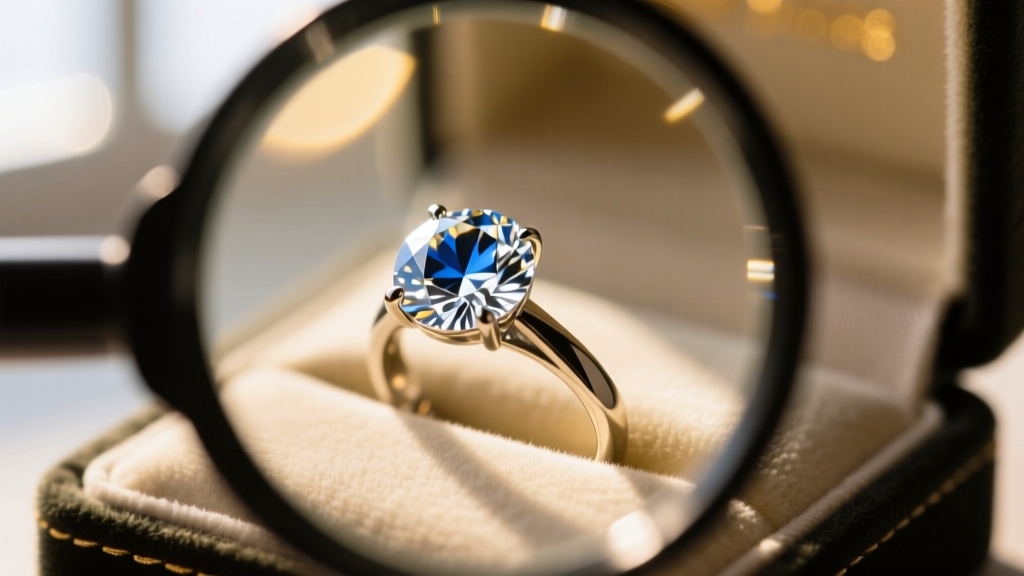
Using a 10x triplet jeweler's loupe, examine the interior of the sphere. If you spot perfectly round, spherical gas bubbles, the piece is undoubtedly glass. Natural rock crystal will never contain round bubbles; instead, look for jagged liquid inclusions, 'feathers' (internal fractures), or tiny solid mineral crystals trapped within the stone. If the sphere is completely, flawlessly clean under 10x magnification, you are likely dealing with synthetic quartz or glass.
Thermal Conductivity and Touch
Quartz is a superior thermal conductor compared to glass. When you press a genuine rock crystal sphere against your cheek or the inside of your wrist, it will feel distinctly cold and will take several seconds to warm up to your body temperature. Glass, being an amorphous solid and a thermal insulator, will feel closer to room temperature and will warm up almost instantly upon contact.
Examining the Drill Holes and Mountings
Antique rock crystal spheres were typically drilled by hand or with early mechanical lathes to accommodate the wire or chain. Under magnification, an antique drill hole will often appear slightly conical, with a frosted or matte interior texture, and may show minor chipping at the exit point. Conversely, molded glass replicas often feature perfectly smooth, cylindrical holes, or worse, a visible mold line running down the equator of the sphere where the two halves of the mold met.
Sourcing and Valuation in the Modern Market
The valuation of a pools of light necklace varies wildly based on its material authenticity, age, and the quality of its mounting. According to Lang Antiques University, rock crystal was heavily championed by prestigious French houses like Cartier, Boucheron, and Georges Fouquet during the 1925 Paris Exposition Internationale des Arts Décoratifs. Consequently, pieces with provenance or hallmarks from these era-defining houses command premium prices.
- Authentic Antique Rock Crystal (1920s-1930s): Featuring platinum or white gold caps, often set with rose-cut or old European cut diamonds. Market values typically range from $4,500 to $18,000+, depending on the diamond weight and maker's marks.
- Mid-Century Glass/Crystal Replicas (1950s-1970s): Often set in silver or base metals with rhinestone accents. These are decorative and fun, but their market value generally sits between $75 and $250.
- Modern Synthetic/CZ Reproductions: Mass-produced for the costume jewelry market. These hold virtually no secondary market value and are priced strictly as fashion accessories ($30 - $80).
Conclusion
The pools of light necklace remains a masterclass in minimalist jewelry design, relying entirely on the physics of light and the purity of the material to make a statement. Whether you are a seasoned collector hunting for a 1920s Cartier rock crystal piece or a vintage enthusiast looking for a beautiful mid-century glass replica, understanding the gemological properties of quartz versus glass is your best defense against misrepresentation. Always prioritize pieces with natural inclusions, proper thermal conductivity, and historically accurate drill holes to ensure your pendant truly holds that magic, glowing pool of light.


