Red Flower Necklace Guide: Enamel, Gemstones & Setting Anatomy
Discover the technical anatomy of a red flower necklace. Compare plique-à-jour enamel, guilloché, and red gemstone inlays for lasting floral jewelry.

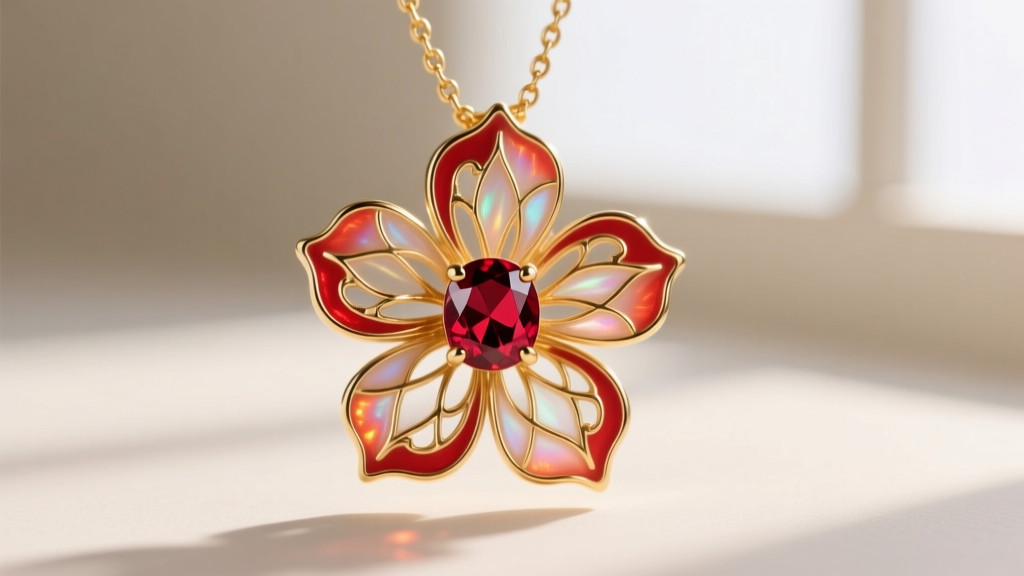
The Engineering of Floral Pendants: Beyond Aesthetics
When evaluating a red flower necklace, most buyers focus solely on the visual appeal of the crimson petals and the brilliance of the center stone. However, from a master jeweler's perspective, a floral pendant is a complex exercise in structural engineering, material science, and center-of-gravity management. Unlike geometric or symmetrical pendants, floral designs are inherently asymmetrical and top-heavy. If the bail (the loop that connects the pendant to the chain) is not precisely positioned over the pendant's true center of mass, the red flower necklace will perpetually tilt, causing uneven wear on the chain links and the bail itself.
To counteract this, expert bench jewelers utilize hidden bails or weighted lower petals. By casting the bottommost petal in a slightly denser metal alloy or incorporating a heavier gemstone at the base of the floral arrangement, the pendulum effect is neutralized. Furthermore, the chain gauge must be carefully matched to the pendant's weight. A 35mm floral pendant weighing over 12 grams requires a minimum 1.5mm rolo or cable chain; anything thinner will succumb to pendulum friction, eventually wearing through the interior of the chain links.
Enameling Techniques: The Science of Red Pigments
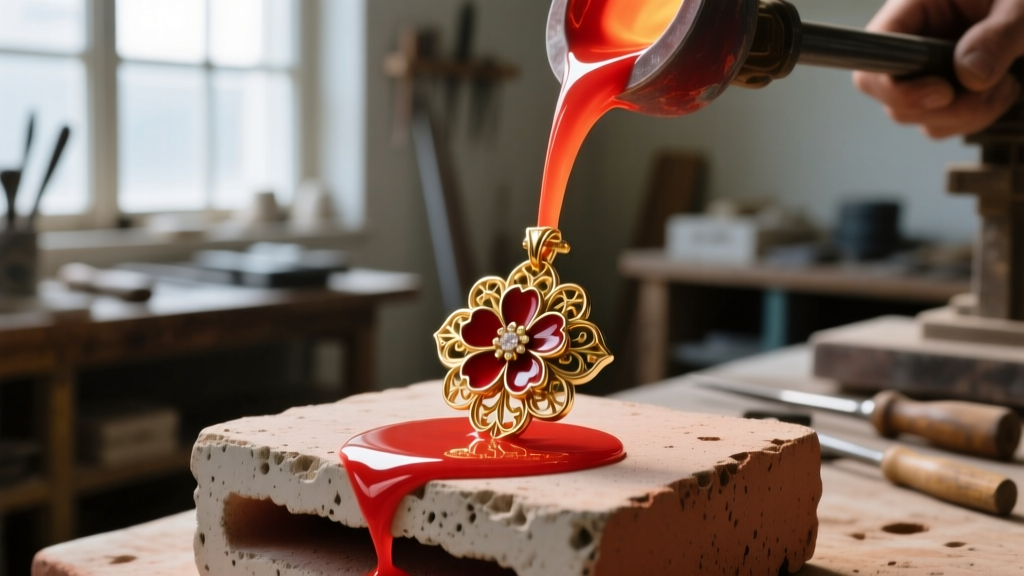
Achieving a true, vibrant red in vitreous enamel is notoriously one of the most difficult challenges in jewelry manufacturing. Unlike blue or green enamels, which rely on stable cobalt or copper oxides fired at high temperatures (800°C–850°C), red enamel requires highly volatile compounds. Historically, copper oxide was used to create 'bull's blood' red, but it requires a strictly reducing atmosphere (zero oxygen) in the kiln; otherwise, the copper oxidizes and turns black or green. Today, master enamelists rely on cadmium-selenide frits to achieve brilliant scarlet and ruby hues in a red flower necklace.
Cadmium-selenide reds fire at lower temperatures (around 700°C–750°C). In multi-colored floral pendants, the red enamel must always be fired in the final kiln cycles. If exposed to the higher temperatures required for white or blue enamels, the cadmium boils off, leaving a muddy, brownish residue. According to the Lang Antiques University, the mastery of temperature sequencing is what separates heirloom-quality enameled florals from mass-produced costume jewelry.
Plique-à-Jour vs. Champlevé vs. Guilloché
The technique used to house the red enamel drastically alters the light dynamics and durability of the necklace. Below is a technical comparison of the three primary enameling methods used in high-end floral pendants:
| Technique | Light Transmission | Durability (Impact) | Relative Cost | Best Floral Application |
|---|---|---|---|---|
| Plique-à-Jour | High (Stained Glass) | Low (Fragile) | $$$$$ | Translucent, delicate petals |
| Champlevé | None (Opaque Base) | High | $$$ | Bold, graphic petal outlines |
| Guilloché | Medium (Reflective) | Medium-High | $$$$ | Textured, light-catching petals |
Plique-à-jour is the pinnacle of the enamelist's art, requiring the red glass to be suspended in a microscopic gold lattice without a metal backing. While breathtaking, a plique-à-jour red flower necklace must never be subjected to ultrasonic cleaning, as the high-frequency vibrations will shatter the glass frit.
Gemstone Inlays: Selecting the Optimal Red Mineral
When enamel is not utilized, the red petals of a floral necklace are typically carved from or set with red gemstones. The selection of the mineral is governed by the Mohs hardness scale, specific gravity, and cleavage planes. Petal shapes often require marquise, pear, or custom fantasy cuts, which create sharp, vulnerable points that are prone to chipping if the wrong stone is chosen.
According to the GIA Gem Encyclopedia, understanding the crystal habit and cleavage of red minerals is critical for lapidaries cutting stones for floral settings. A stone with perfect cleavage (like topaz) is a liability in a petal setting, as a single knock against a tabletop can split the stone along its crystallographic plane.
Gemstone Specifications for Floral Settings
- Burmese Ruby (Corundum): Mohs 9. No true cleavage, though it exhibits parting. Exceptional durability for daily-wear petal tips. High refractive index (1.76-1.77) provides excellent brilliance, though heavy rutile silk can reduce transparency.
- Red Spinel: Mohs 8. Isotropic (singly refractive), meaning it lacks pleochroism and shows the same pure red from every angle. Lacks cleavage, making it highly resistant to chipping during the setting process. Often preferred over ruby for custom-calibrated petal cuts due to its superior clarity and lower cost per carat.
- Pyrope Garnet: Mohs 7.5. No cleavage, but relatively brittle. Deep red hues often border on brownish-red in larger sizes, making it best suited for small, micro-pavé petal accents rather than large central floral stones.
- Carnelian (Chalcedony): Mohs 6.5-7. Excellent for cabochon petals or carved intaglio flowers. Lacks crystalline cleavage, meaning it chips rather than splits. Highly durable for everyday wear, though it lacks the optical fire of faceted gems.
Metallurgy and Prong Architecture for Petal Settings
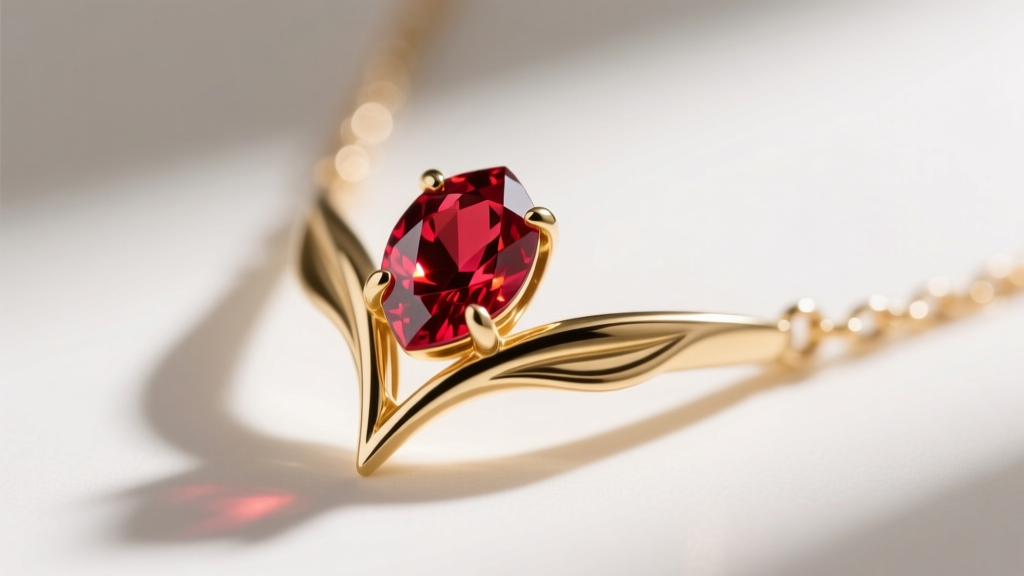
The metal alloy chosen for a red flower necklace dictates both the longevity of the setting and the color contrast of the red elements. While platinum is highly durable, its high melting point and density make it less ideal for intricate, multi-petal micro-pavé settings. 18k yellow gold (75% pure gold, alloyed with copper and silver) remains the industry standard for high-end floral pendants. The copper content in 18k gold not only provides a warm undertone that complements red enamel and rubies but also yields a tensile strength that holds prongs securely without the 'memory' issues associated with platinum.
For marquise-cut gemstones used as petals, standard round prongs are a structural failure waiting to happen. Expert setters utilize V-prongs at the acute tips of the marquise stones. A V-prong wraps entirely around the vulnerable point, distributing pressure evenly and shielding the tip from lateral impacts. Furthermore, the gallery (the underside of the pendant) should feature honeycomb or azuring cutouts. This not only reduces the overall weight of the gold but also allows light to enter the back of the gemstone petals, maximizing their internal reflection.
Maintenance and Ultrasonic Cleaning Risks
The intersection of organic shapes, varied materials, and complex settings makes cleaning a red flower necklace a nuanced process. Ultrasonic cleaners, while excellent for diamond solitaires, are highly destructive to floral jewelry. The cavitation bubbles generated by ultrasonic waves can easily fracture included rubies, shake loose micro-pavé accent stones, and shatter vitreous enamel.
Instead, a technical cleaning protocol should be followed:
- Use a soft-bristled baby toothbrush and a solution of warm distilled water with a single drop of pH-neutral dish soap.
- Gently agitate the brush over the gemstone tables and the bail hinge, where sebum and cosmetic dust accumulate.
- Rinse with lukewarm distilled water (avoiding tap water to prevent hard water spot deposits on the gold).
- Dry using compressed air or a microfiber cloth, ensuring no lint is caught in the prong settings.
By understanding the material science, lapidary constraints, and structural engineering behind these pieces, collectors and enthusiasts can properly evaluate, wear, and preserve the intricate beauty of a master-crafted floral pendant for generations.


