Restore a Vintage Native American Beaded Necklace Safely
Learn how to authenticate, clean, and repair a vintage Native American beaded necklace. Expert troubleshooting for broken sinew and delicate seed beads.

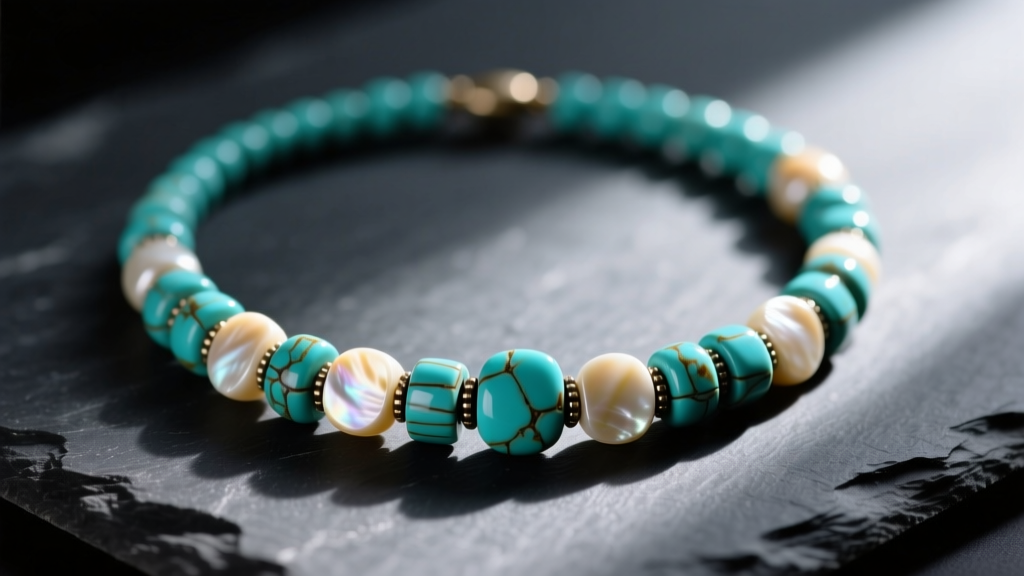
Owning a vintage Native American beaded necklace is akin to holding a piece of living history. Whether it is a multi-strand Navajo turquoise piece, a Kewa (Santo Domingo) Pueblo heishi necklace, or a Zuni petit point masterpiece, these artifacts represent generations of indigenous artistry. However, aging materials present unique conservation challenges. From degrading cotton threads to porous gemstones that react poorly to modern cleaners, restoring these pieces requires a meticulous, chemistry-aware approach. This comprehensive troubleshooting guide will walk you through authenticating, repairing, and preserving your vintage Native American beaded necklace without compromising its historical integrity or market value.
The Anatomy of Authenticity: Identifying True Vintage Pieces
Before attempting any repairs or cleaning, you must verify the authenticity of your vintage Native American beaded necklace. The secondary market is flooded with mass-produced imitations, particularly from overseas manufacturers. According to the Indian Arts and Crafts Board (IACB), misrepresenting jewelry as Native American-made is a violation of federal law, yet the vintage market remains a minefield for uneducated buyers.
When examining Kewa Pueblo heishi (which translates to "shell" in the Keresan language), run your fingers along the strand. True vintage hand-ground heishi will have microscopic variations in diameter and a slightly organic, imperfect feel. Conversely, modern imitations are often injection-molded plastic or machine-cut stone with laser-perfect uniformity. For pieces featuring silver spacers or conchos, look for the soft, uneven patina of aged coin silver or early sterling, rather than the harsh, artificial oxidation applied to modern castings. If the piece features turquoise, examine the matrix (the host rock webbing); vintage stones often exhibit natural, asymmetrical matrix patterns, whereas dyed howlite or reconstituted turquoise blocks will show uniform, printed-looking webbing.
Troubleshooting Common Structural Failures
The most frequent issue with vintage beadwork is structural degradation. Mid-century pieces were often strung on cotton thread, early nylon (like Nymo), or traditional animal sinew. While sinew is incredibly strong when dry, it is highly susceptible to rot in humid environments. Cotton thread simply dry-rots and snaps under the weight of heavy stone beads.
Snapped Sinew and Cotton Thread: The Restringing Protocol
If your necklace has sagging, stretched gaps between beads, or a visible fraying near the clasp, it requires immediate restringing. Do not attempt to simply "patch" a broken strand; the entire necklace must be re-strung to prevent catastrophic failure and bead loss.
Materials Required for Museum-Grade Restringing:
- Thread: Braided polyethylene line (e.g., Fireline) in 6lb or 8lb test. This mimics the tensile strength of traditional sinew but is entirely impervious to moisture and UV degradation.
- Needles: Size 10 or 12 flexible beading needles (Tulip or John James brands).
- Abrasion Guards: French wire (bullion) or sterling silver wire guards to protect the thread at the clasp connection point.
- Findings: Sterling silver micro-crimp tubes and a secure lobster or toggle clasp.
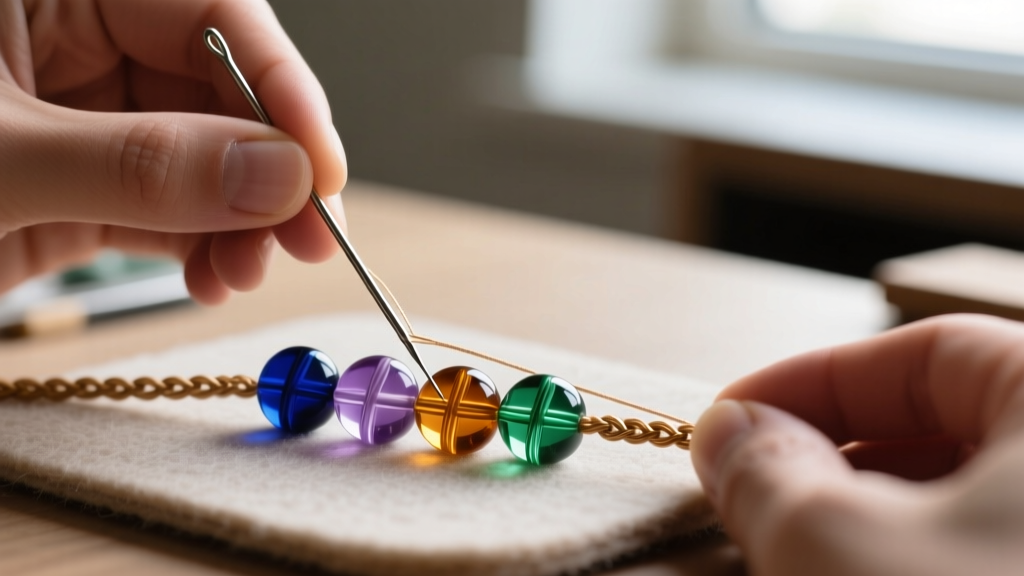
When restringing a multi-strand necklace, work on one strand at a time to maintain the original tension and drape. Use a beading mat with a velvety surface to prevent the vintage glass or stone beads from rolling away. Always use a crimping tool to flatten the micro-crimps into a neat, rounded shape, ensuring the sharp edges of a crushed crimp do not eventually slice through your new polyethylene thread.
Tarnished Silver Spacers and Conchos
Many vintage Native American beaded necklaces incorporate silver beads, spacers, or naja pendants. Silver naturally tarnishes when exposed to sulfur in the air. Never use commercial liquid silver dips on vintage jewelry. These harsh chemicals will strip the natural patina from the silver and can permanently discolor porous stones like turquoise or coral if the liquid seeps into the bead holes.
The Cleaning Matrix: Material-Specific Protocols
Cleaning a vintage Native American beaded necklace is not a one-size-fits-all process. The indigenous artisans of the American Southwest utilized a diverse array of organic and inorganic materials, each with distinct chemical vulnerabilities. The Smithsonian National Museum of the American Indian emphasizes that improper cleaning can cause irreversible damage to historical artifacts.
| Material | Chemical Composition | Primary Vulnerability | Safe Cleaning Protocol |
|---|---|---|---|
| Turquoise | Hydrous copper/aluminum phosphate | Porous; absorbs oils/chemicals; turns green | Dry microfiber cloth only. Never submerge in water. |
| Red Coral | Calcium carbonate (organic) | Acidic etching; dissolves in harsh cleaners | Damp cloth with distilled water. No soaps or acids. |
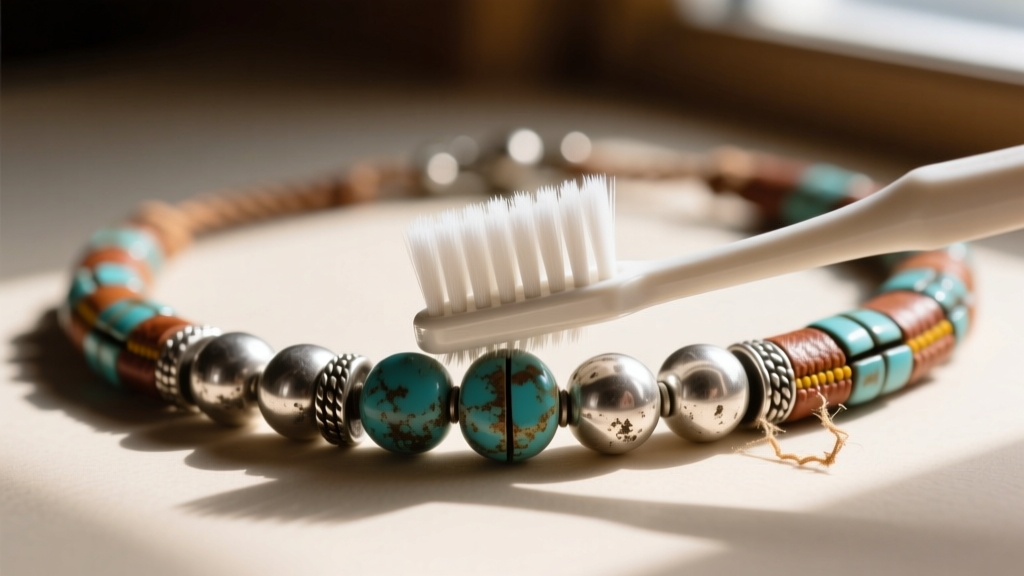
| Antique Glass | Silica, soda ash, limestone | Scratching; degradation of painted foils | Mild castile soap, soft baby toothbrush, quick rinse. |
| Bone/Shell | Calcium phosphate / Calcium carbonate | Staining; warping from prolonged moisture | Dry brush. Use a tiny amount of mineral oil for dry bone. |
| Silver Spacers | Sterling or Coin Silver (Ag/Cu alloy) | Sulfur tarnish; scratching from abrasives | Sunshine polishing cloth; avoid liquid dips entirely. |
Expert Insight on Turquoise Chemistry: Turquoise is relatively soft (Mohs hardness 5-6) and highly porous. The copper content that gives it its brilliant blue hue can oxidize or react with lipids (skin oils, lotions), causing the stone to shift to a dull, muddy green over decades of wear. If your vintage turquoise beads have already turned green due to oil absorption, this is considered a natural part of the stone's history. Do not attempt to "bleach" or chemically strip the oil, as this will destroy the stone's matrix and structural integrity.
Storage and Environmental Damage Prevention
How you store your vintage Native American beaded necklace is just as critical as how you clean it. The wrong storage environment can accelerate thread rot, metal tarnish, and stone dehydration.
The Dangers of PVC and Cardboard
Never store vintage beadwork in standard cardboard boxes or PVC plastic bags. Cardboard is highly acidic and can off-gas chemicals that degrade organic beads like bone, shell, and coral. PVC plastics release polyvinyl chloride gases over time, which can create a corrosive microclimate that pits silver spacers and clouds antique glass beads.
The Museum-Grade Storage Solution
"For long-term preservation, wrap the necklace loosely in unbuffered, acid-free archival tissue paper. Place it inside an airtight polyethylene (PE) or polypropylene (PP) plastic bin, and include a 3M anti-tarnish strip to absorb ambient sulfur. Store the bin in a climate-controlled interior closet, avoiding attics or basements where humidity fluctuations can cause animal sinew to expand and contract, leading to micro-fractures in tightly strung stone beads."
Furthermore, always store multi-strand necklaces flat rather than hanging. Hanging heavy vintage stone beads places continuous gravitational stress on the topmost beads and the clasp connection, eventually causing the thread to stretch or the beads to crack around the drill holes.
When to Call a Professional Conservator
While restringing and basic polishing can be safely performed at home with the right tools, certain scenarios demand the expertise of a professional jewelry conservator or a specialized Native American art restorer. If your vintage Native American beaded necklace features:
- Historical Provenance: Pieces dating back to the late 19th or early 20th century with documented tribal origins should never be altered without professional consultation, as replacing original thread or clasps can destroy its anthropological value.
- Cracked or Spalling Turquoise: If the stone beads are developing micro-fractures or flaking, a conservator can apply specialized, reversible consolidants (like Paraloid B-72) to stabilize the stone without altering its appearance.
- Complex Zuni Needlepoint or Petit Point: These styles involve dozens of tiny, delicate silver bezels holding slivers of turquoise. Repairing a broken bezel on a vintage strung necklace requires advanced silversmithing skills and a torch, which poses a severe burn risk to the adjacent beads if not properly shielded.
By understanding the specific materials, structural weaknesses, and chemical sensitivities of your vintage Native American beaded necklace, you can transition from a passive owner to an active conservator. Treat these pieces with the respect their craftsmanship demands, and they will survive to tell their stories for generations to come.


