Technical Guide: Choosing a Ruby and Diamond Heart Necklace
Master the technical details of buying a ruby and diamond heart necklace. Learn about gemstone grades, setting durability, and chain mechanics.

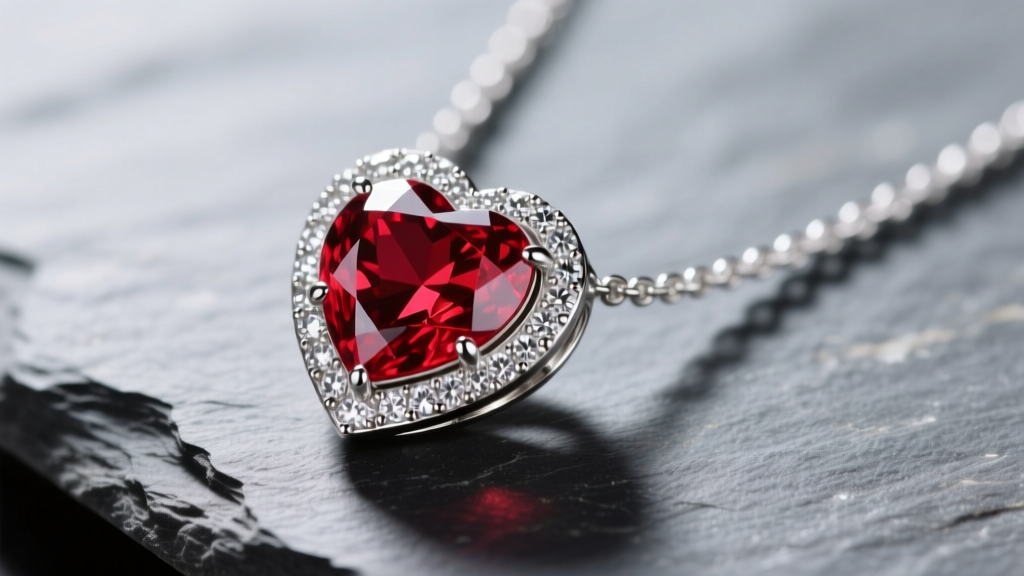
The Gemological Reality of Heart-Cut Rubies
Evaluating a ruby and diamond heart necklace requires looking far beyond the romantic silhouette of the pendant. From a lapidary perspective, the heart cut is one of the most demanding and wasteful shapes to execute. To achieve the necessary symmetry—where the cleft is distinct but not structurally compromising, and the wings are perfectly rounded—a gem cutter must sacrifice a significant portion of the original rough crystal. Consequently, heart-cut rubies over 1.50 carats are exceptionally rare and command a substantial premium per carat compared to oval or cushion cuts of the same weight.
When inspecting the center stone, pay close attention to the depth percentage. A heart-cut ruby that is cut too shallow (below 45% depth) will suffer from 'windowing,' a phenomenon where light leaks through the bottom of the stone rather than reflecting back to the eye, resulting in a washed-out, lifeless center. Conversely, a stone cut too deep (over 65%) will trap light, creating dark, muddy extinction zones that obscure the ruby's natural crimson hue. The ideal depth percentage for a heart-shaped ruby sits between 54% and 60%, ensuring optimal brilliance and color saturation.
Evaluating Ruby Origin, Fluorescence, and Treatment
The geographic origin of a ruby dramatically dictates its optical properties and market value. Burmese (Myanmar) rubies are prized for their high chromium and low iron content. This specific chemical makeup results in strong red fluorescence under ultraviolet light, including natural sunlight. This fluorescence causes the stone to appear as though it is glowing from within, a highly coveted trait in fine jewelry. Mozambican rubies, while often boasting excellent clarity and larger carat weights, possess higher iron content, which quenches this fluorescence, resulting in a darker, more garnet-like appearance in certain lighting conditions.
As noted by the Gemological Institute of America (GIA), treatment disclosure is the most critical factor in ruby valuation. While traditional heat treatment is universally accepted and permanently stabilizes the stone's color, you must aggressively avoid 'glass-filled' or 'fracture-filled' rubies for daily-wear pendants. This treatment involves injecting lead glass into surface-reaching fractures to improve apparent clarity. Lead glass has a vastly different hardness and refractive index than corundum, and it is highly susceptible to degradation from mild acids, including everyday substances like lemon juice or household cleaning sprays. A glass-filled ruby set in a heart pendant will eventually cloud, crack, or lose its structural integrity, rendering the jewelry worthless.
Diamond Halo Specifications and Light Performance
The diamond halo surrounding the ruby is not merely decorative; it serves to amplify the light return of the center stone. However, manufacturers often cut corners on the melee diamonds (stones weighing between 0.01 and 0.18 carats) used in these halos. To ensure the diamond accents do not detract from the ruby, you must demand specific minimum grades.
- Color Grade: Insist on G or H color melee diamonds. If the jeweler uses I or J color stones, the yellowish tint will be glaringly obvious against the white metal setting and will clash with the cool tones of the ruby.
- Clarity Grade: SI1 is the absolute minimum. Because melee diamonds are small, I1 or I2 clarity stones will feature visible black carbon inclusions that look like dirt or scratches to the naked eye, disrupting the continuous sparkle of the halo.
- Setting Style: Micro-pavé settings should utilize bright-cut edges. The tiny beads of metal holding the melee diamonds should be uniform and polished, ensuring maximum light entry into the crown of each diamond.
According to GIA Diamond Grading standards, even small melee diamonds should exhibit precise facet alignment. Poorly cut melee will result in a 'dead' halo that fails to contrast beautifully with the vivid red center stone.
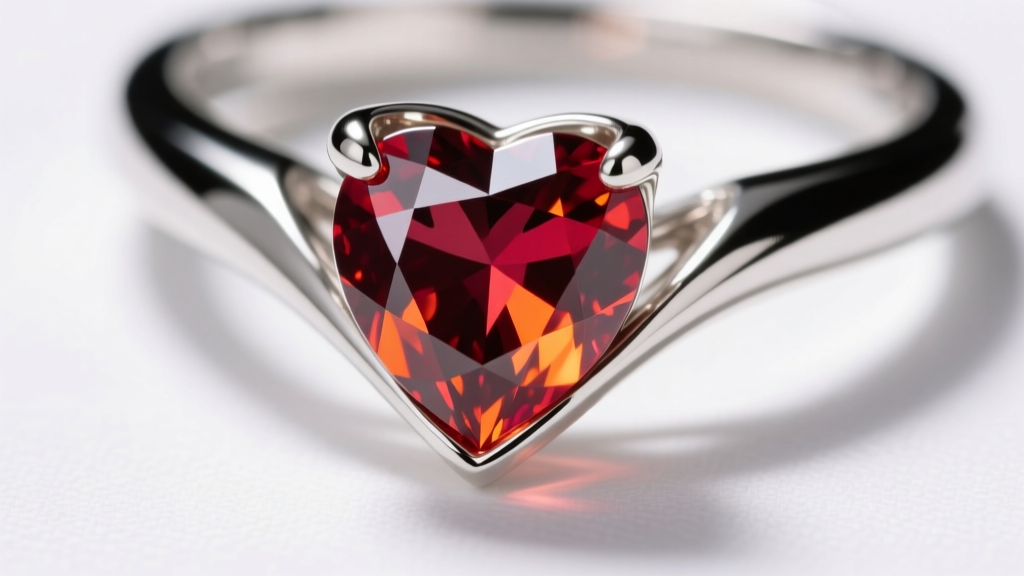
Setting Mechanics: Protecting the Heart's Vulnerabilities
The geometry of a heart-cut gemstone introduces two severe structural vulnerabilities: the cleft (the inward dip at the top) and the point (the bottom tip). While ruby is a 9 on the Mohs hardness scale, making it highly resistant to scratching, it possesses distinct parting planes. A sharp impact to the bottom point can easily cause a cleavage fracture, splitting the stone in half.
To mitigate this, the setting must employ a specialized V-prong at the bottom tip. Unlike standard round prongs that merely rest on top of the stone's edge, a V-prong wraps entirely around the corner, encasing the fragile point in a protective metal sheath. For a ruby over 1.00 carat, the V-prong should be cast or forged with a minimum thickness of 0.9mm to withstand daily impacts. Furthermore, the prongs securing the cleft must be carefully notched to avoid putting uneven lateral pressure on the narrow bridge of stone between the two lobes. Platinum is the superior metal for this application; its high tensile strength and malleability allow prongs to bend rather than snap if caught on clothing, keeping the ruby securely locked in place.
Chain Metallurgy and Clasp Failure Modes
A heavy ruby and diamond heart pendant requires a chain engineered for high tensile strength and fatigue resistance. The 'pendulum effect'—the constant swinging and pulling of a heavy pendant against the neckline—places immense stress on the chain links and the clasp connection.
| Chain Type | Tensile Strength | Failure Mode | Recommendation |
|---|---|---|---|
| Cable Chain | Moderate | Links stretch and deform under heavy pendants | Avoid for pendants over 3 grams |
| Box Chain | High | Kinks easily; difficult to repair once bent | Good for medium-weight pendants |
| Wheat Chain | Very High | Highly resistant to stretching; woven links distribute weight | Ideal for heavy ruby heart pendants |
The most common point of failure in necklace mechanics is the jump ring—the small circular wire connecting the pendant bail to the chain. If this jump ring is merely pressed closed, the pendulum motion will eventually pull the ends apart, resulting in the loss of the pendant. You must verify that the jump ring is securely soldered closed with laser or torch welding. Additionally, avoid spring-ring clasps, which suffer from internal spring fatigue. A forged lobster clasp with a reinforced spine is mandatory for securing high-value gemstone jewelry.
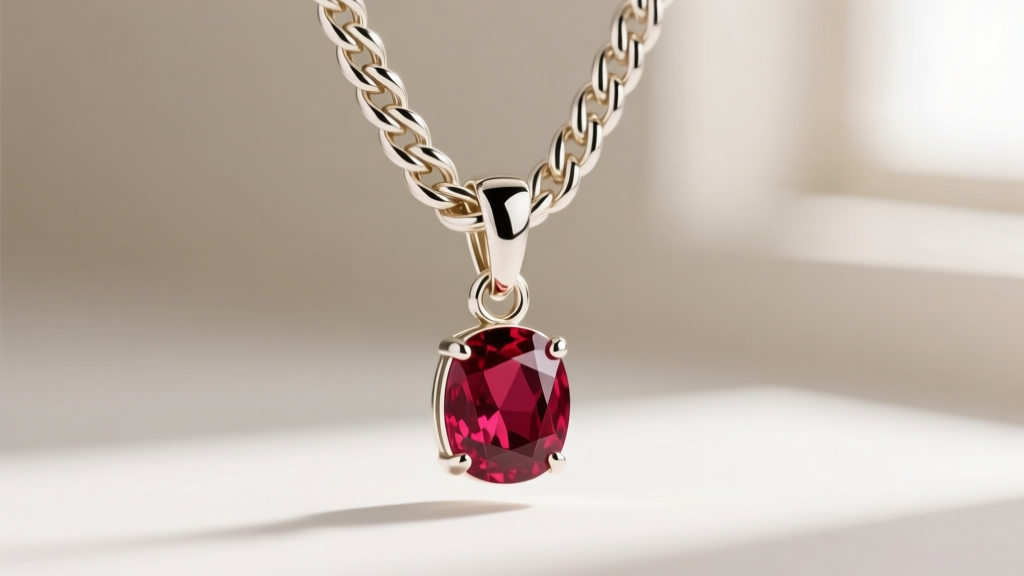
Pricing Matrix and Market Value
Understanding the pricing tiers for a ruby and diamond heart necklace requires analyzing the intersection of origin, treatment, and carat weight. The following matrix provides estimated retail price ranges for the pendant alone (excluding the chain) based on current market valuations for natural, untreated, or traditionally heat-treated stones.
| Origin | Treatment Status | Carat Weight (Heart) | Diamond Halo Weight | Estimated Retail Price (USD) |
|---|---|---|---|---|
| Mozambique | Heat Treated | 0.80 - 1.20 ct | 0.25 ctw | $3,500 - $6,000 |
| Mozambique | Untreated | 1.00 - 1.50 ct | 0.40 ctw | $8,000 - $14,000 |
| Burma (Myanmar) | Heat Treated | 1.00 - 1.50 ct | 0.40 ctw | $15,000 - $25,000 |
| Burma (Myanmar) | Untreated (Pigeon Blood) | 1.00 - 1.50 ct | 0.50 ctw | $40,000 - $85,000+ |
When investing in a piece of this caliber, always require a grading report from a top-tier, independent gemological laboratory such as the GIA or AGL (American Gemological Laboratories). These reports will definitively map the stone's inclusions, confirm the absence of lead-glass filling, and provide the precise color grading necessary to justify the investment in your ruby and diamond heart necklace.


