Ruby Heart Necklace Gold Settings: A Gemological & Technical Guide
Discover the technical nuances of a ruby heart necklace gold setting. Learn about gemstone treatments, gold alloys, and heart-cut faceting mechanics.

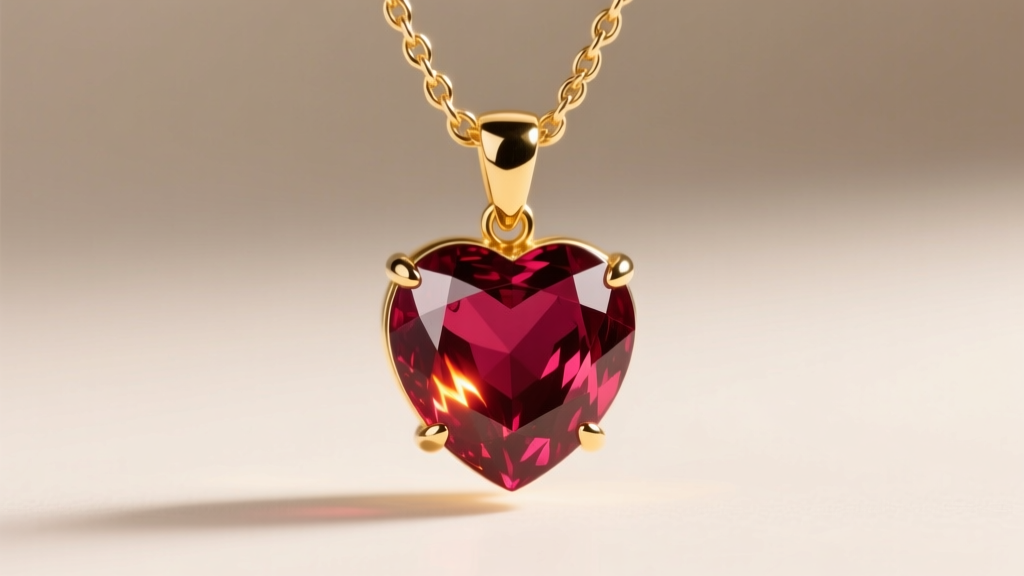
The search for the perfect ruby heart necklace gold piece often ends in a labyrinth of marketing jargon, synthetic imitations, and poorly executed lapidary work. As of 2026, the market is saturated with treated corundum and subpar alloy settings that compromise both the structural integrity and the optical performance of the jewelry. Evaluating a heart-cut ruby set in gold requires a rigorous understanding of gemological faceting, metallurgical tensile strength, and gemstone enhancement protocols. This technical guide strips away the romance to examine the exact specifications, failure modes, and grading metrics that define a high-caliber ruby heart pendant.
The Gemological Reality of Heart-Cut Rubies
The heart shape is a modified brilliant cut, typically featuring 59 to 62 facets. However, translating a rough corundum crystal into a symmetrical heart presents severe lapidary challenges. Unlike round brilliants, which optimize light return through mathematical symmetry, heart cuts require the cutter to navigate the stone's natural crystallographic axes while preserving carat weight.
Symmetry and the "Bowtie" Extinction
The most critical flaw in commercial-grade heart rubies is asymmetry. A deviation of just 2% to 3% between the left and right lobes is immediately visible to the naked eye. Furthermore, heart cuts are highly susceptible to the "bowtie" effect—a dark, bowtie-shaped area of light extinction across the center of the stone. This occurs when the pavilion angles are cut too shallow or too steep, preventing light from reflecting back through the table. An expertly cut ruby heart will have a pavilion depth percentage between 60% and 68%, minimizing this extinction zone while maximizing the stone's natural fluorescence.
The Cleft Vulnerability
The cleft (the V-shaped dip at the top of the heart) is a structural weak point. If the cutter leaves this area too thin to save carat weight, it becomes highly prone to chipping during the setting process. A technically sound heart ruby will feature a slightly rounded or blunted cleft, sacrificing a fraction of a millimeter in sharpness to ensure long-term durability.
Decoding Ruby Treatments: What You Are Actually Buying
According to the Gemological Institute of America (GIA), over 95% of rubies on the market undergo some form of thermal enhancement. Understanding the exact treatment is non-negotiable when pricing a ruby heart necklace gold pendant, as the valuation gap between treatment types is exponential.
| Treatment Type | Technical Process | Durability & Care | Market Price Impact (Per Carat) |
|---|---|---|---|
| Unheated (No Heat) | Zero thermal or chemical alteration. Retains natural rutile silk. | Excellent. Standard ultrasonic safe. | Premium ($15,000 - $100,000+) |
| Traditional Heat | Heated to 1600°C+ to dissolve rutile inclusions and improve clarity/color. | Excellent. Permanent and stable. | Standard ($3,000 - $15,000) |
| Composite (Lead-Glass Filled) | Fractures filled with high-lead-content glass to mask severe opacity. | Poor. Destroyed by ultrasonic cleaners and mild acids (e.g., lemon juice). | Commercial ($10 - $50) |
Composite rubies are the most prevalent trap in the vintage and estate jewelry market. The lead-glass filling has a refractive index (RI) very close to corundum (1.76), making the fractures nearly invisible to the untrained eye. However, under magnification, you will observe a "flash effect"—blue and orange iridescence along the fracture planes. If a seller cannot provide an AGL or GIA report explicitly stating "No indications of heating" or "Traditional heat only," assume the stone is heavily treated or composite.
Metallurgy and Gold Alloys for Heart Pendants
The gold alloy chosen for a ruby heart necklace gold setting is not merely an aesthetic choice; it dictates the tensile strength of the prongs and the optical environment of the gemstone.
14k vs. 18k Gold: The Tensile Strength Paradox
Conventional wisdom suggests that 14k gold (58.3% pure gold) is more durable than 18k gold (75% pure gold) due to its higher alloy content. While 14k is more resistant to scratching and bending, 18k gold is actually superior for setting fragile gemstone shapes like hearts. The higher pure gold content in 18k makes the metal more malleable. This allows the jeweler to burnish the prongs tightly against the ruby's vulnerable cleft and pointed culet without the metal "springing back" or snapping, which is a common failure mode with harder 14k white gold alloys.
The Color Reflection Hazard of Rose Gold
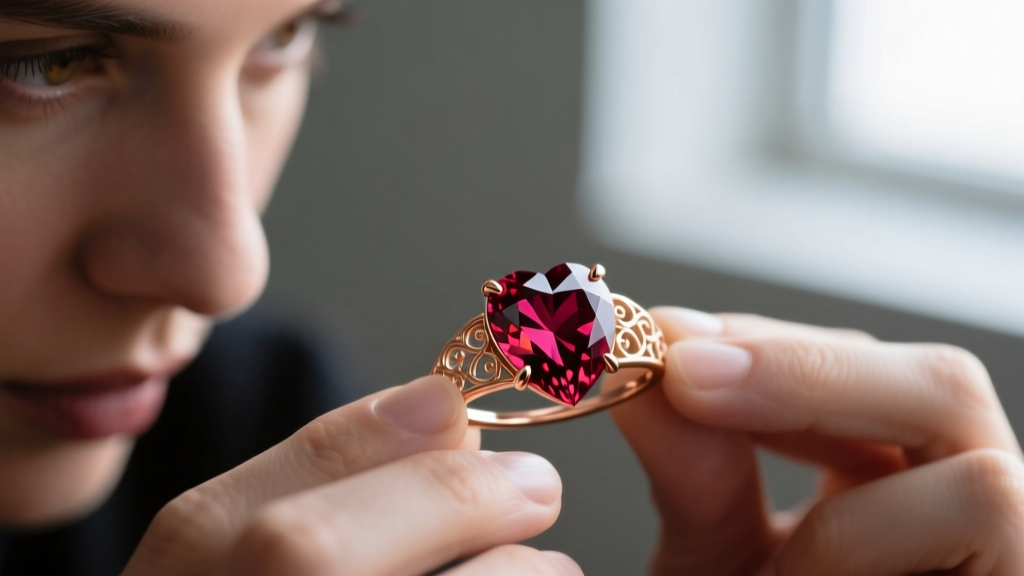
Rose gold achieves its pinkish hue through a high copper content (often up to 20% or more in 14k alloys). When setting a ruby, the copper reflection can bounce pink wavelengths back through the pavilion of the stone. While this might enhance a low-grade pinkish ruby, it will actively muddy the color of a premium "pigeon's blood" red ruby, artificially shifting its perceived hue and potentially masking its true color grade. For top-tier color saturation, 18k yellow gold or platinum remains the metallurgical standard.
Setting Mechanics: The 5-Prong Minimum
Never purchase a heart-cut ruby secured with only three or four prongs. The geometry of the heart demands a minimum of five prongs to distribute mechanical stress evenly:
- The Cleft Prong: Must be a reinforced V-prong or a custom-milled chevron prong to encapsulate the fragile top dip.
- The Lobe Prongs (x2):strong> Secured over the widest part of the upper curves to prevent lateral shifting.
- The Lower Curve Prongs (x2):strong> Placed strategically along the lower belly to support the stone's center of gravity.
- The Culet Protection: The bottom point of the heart (the culet) must either be protected by a V-prong or suspended slightly above the skin by a reinforced gallery wire to prevent snapping upon impact.
Chain Mechanics and Bail Engineering
The structural integrity of a ruby heart necklace gold piece extends beyond the pendant itself. A 2.0-carat ruby set in a solid 18k gold halo can easily weigh between 5 and 8 grams. Suspending this weight requires precise chain engineering.
Chain Gauge and Link Failure Points
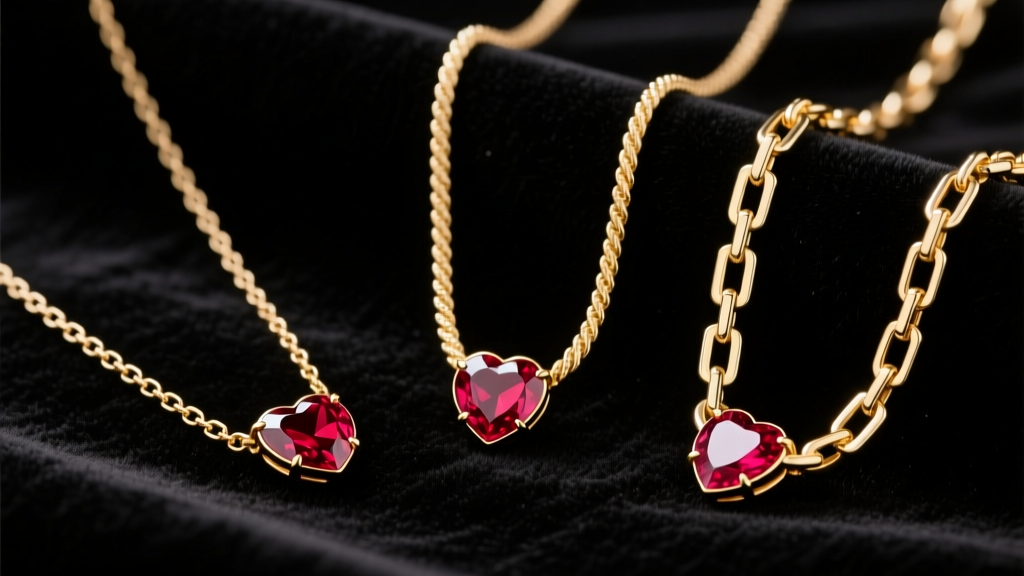
A 1.0mm or 1.2mm chain is insufficient for a solid gold heart pendant of this mass. Over time, the friction at the bail will wear through the links, leading to catastrophic failure. Experts recommend a minimum chain gauge of 1.5mm for pendants weighing over 4 grams. Box chains and rope chains offer superior tensile strength compared to delicate cable or serpentine chains, as their interlocking geometries distribute the pendant's kinetic energy across multiple link joints rather than a single soldered ring.
Bail Construction
The bail (the loop connecting the pendant to the chain) should be cast as a single piece with the pendant's gallery or laser-welded using high-temperature solder. Avoid glued bails or bails attached with low-temperature silver solder, as the thermal expansion rates of the gold and the solder differ, leading to eventual separation when exposed to body heat and environmental temperature shifts.
Pricing Frameworks and Authentication
When evaluating high-value ruby heart pendants, independent laboratory certification is mandatory. The American Gemological Laboratories (AGL) and Lotus Gemology are the industry benchmarks for colored stone origin and treatment analysis. A GIA Diamond Grading Report is irrelevant here; you specifically need a Colored Stone Report that details the geographic origin (e.g., Mogok, Burma vs. Mozambique) and the exact nature of any clarity enhancements.
Expert Troubleshooting Tip: If a seller provides a certificate from an in-house or unrecognized laboratory for a "Burmese Unheated" ruby heart, request a secondary evaluation. Synthetic flux-grown rubies (like Chatham created rubies) possess natural-looking fingerprint inclusions that can easily fool basic refractometer and dichroscope tests, requiring advanced spectroscopic analysis to differentiate from mined corundum.
Ultimately, a technically sound ruby heart necklace gold setting is an exercise in precision. From the pavilion angles that eliminate the bowtie effect to the malleability of 18k gold securing the fragile cleft, every millimeter dictates the longevity and optical brilliance of the piece. Demand transparency in treatments, insist on robust prong architecture, and never compromise on independent gemological verification.


