The Ruby Station Necklace: 2026 Trend & Style Analysis
Explore 2026 ruby station necklace trends, from asymmetric layouts and lab-grown gems to exact chain gauges, pricing tiers, and expert styling frameworks.

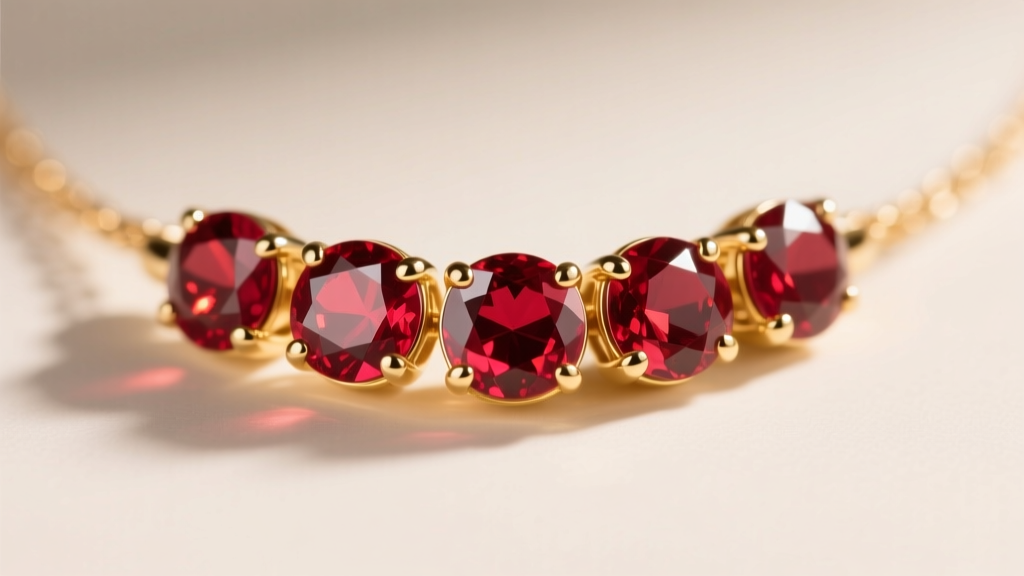
The Resurgence of the Ruby Station Necklace in 2026
The station necklace—a chain punctuated by evenly or asymmetrically spaced gemstones—has long been a staple of minimalist fine jewelry. However, as we navigate the style landscape of 2026, the classic diamond station is being rapidly eclipsed by the ruby station necklace. Driven by a consumer shift toward personalized, color-rich luxury and the romantic symbolism of corundum, rubies are redefining the everyday fine jewelry wardrobe. According to market analyses by National Jeweler, colored gemstone demand in demi-fine and fine categories has surged, with red and pink hues leading the charge. This guide deconstructs the anatomy, emerging design trends, and precise specifications of the modern ruby station necklace, offering actionable insights for collectors and stylists alike.
Anatomy of a Modern Station Necklace
To evaluate a ruby station necklace beyond its surface aesthetics, one must understand the structural engineering that dictates its drape, durability, and price point. The interplay between the chain gauge and the gemstone setting is critical.
Chain Profiles and Gauge Specifications
The chain must be robust enough to support the weight of the rubies without stretching, yet delicate enough to maintain the "floating" illusion. In 2026, the optimal chain gauge for a station necklace ranges between 0.9mm and 1.2mm. Anything thinner (e.g., 0.5mm) risks snapping under the stress of a 5mm gemstone, while anything thicker (1.5mm+) visually competes with the rubies.
- Cable Chains: The traditional choice. Oval links offer classic flexibility but can catch on fine-knit fabrics.
- Rolo Chains: Featuring uniform, round links, rolo chains provide superior structural integrity and a slightly more industrial, modern aesthetic.
- Box Chains: Geometric and highly reflective, box chains in 1.0mm offer a contemporary backdrop that enhances the angularity of step-cut rubies.
Ruby Cut, Carat Weight, and Spacing
Station necklaces typically feature smaller-calibrated gemstones to maintain wearability. The standard ruby size ranges from 2mm (approx. 0.03 carats) to 5mm (approx. 0.50 carats). A traditional 16-inch necklace usually hosts between 5 and 9 stones, resulting in a Total Carat Weight (TCW) of 0.50 to 2.50 carats. The Gemological Institute of America (GIA) notes that while clarity is important, color saturation (specifically the coveted "pigeon blood" red) remains the primary value driver in calibrated ruby parcels.
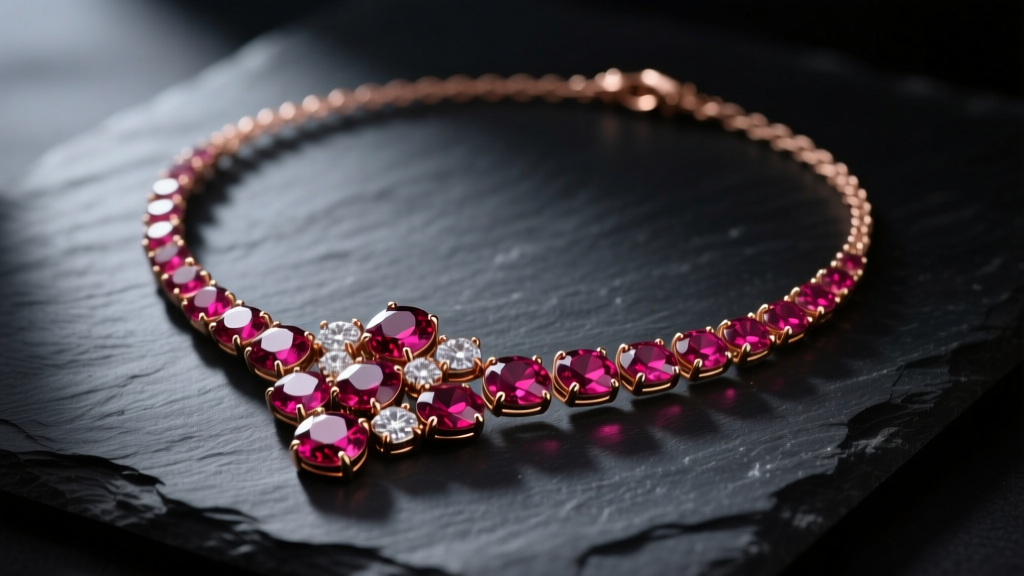
2026 Design Trends: Asymmetry and Mixed Metals
The rigid, perfectly spaced station necklaces of the early 2010s have given way to organic, rule-breaking designs. The 2026 ruby station necklace embraces intentional imperfection.
The Asymmetric Gradient
Designers are now clustering rubies toward the center-bottom of the chain, utilizing a gradient of sizes—perhaps three 2mm stones flanking a central 5mm ruby. This creates a focal point that mimics a pendant while retaining the structural benefits of a station layout. Furthermore, varying the spacing (e.g., placing stones 1.5 inches apart on the left and 2.5 inches apart on the right) creates a dynamic, kinetic movement that adapts to the wearer's neckline.
Bezel vs. Prong Settings
While traditional 4-prong settings maximize light entry, the 2026 trend heavily favors smooth bezel settings for rubies. Rubies rank at a 9 on the Mohs scale of hardness, making them highly durable, but prong settings are notorious for snagging on silk blouses and cashmere. A 14k or 18k gold bezel not only provides a sleek, modern frame that intensifies the ruby's red saturation but also ensures a completely snag-free wearing experience.
Natural vs. Lab-Grown: A Buyer’s Matrix
The proliferation of lab-grown rubies has bifurcated the market, offering distinct pathways for different consumer budgets and ethical preferences. Below is a comparative framework for buyers evaluating ruby station necklaces in the current market.
| Feature | Natural Mined Rubies | Lab-Grown Rubies |
|---|---|---|
| Origin & Ethics | Mined (often Myanmar, Mozambique); requires rigorous supply chain tracing. | Created via Czochralski or Flame Fusion; 100% conflict-free and traceable. |
| Inclusions | Rutile silk, fingerprints, and crystals are common and prove natural origin. | Exceptionally clean; may show curved striae or flux inclusions depending on method. |
| Color Consistency | Requires expert matching; slight variations add organic character. | Perfectly matched saturation and tone across all station points. |
| Avg. Price (16-inch, 1.00 TCW) | $3,500 – $8,000+ (highly dependent on origin and heat treatment). | $600 – $1,200 (set in 14k solid gold). |
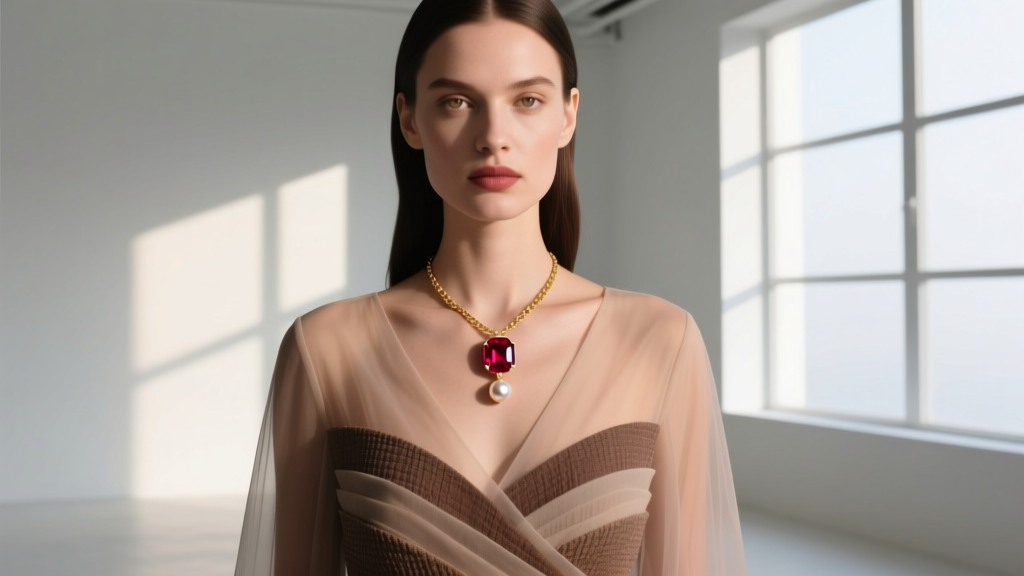
Styling Frameworks: Necklines and Layering
A ruby station necklace is remarkably versatile, but its styling requires an understanding of proportion and color theory. The deep crimson of a ruby pairs exceptionally well with both warm and cool tones, acting as a neutral anchor in a jewelry stack.
The Layering Protocol
When layering a ruby station necklace, adhere to the two-inch rule. If your ruby station piece is 16 inches, pair it with a 14-inch solid gold choker (like a 1.5mm herringbone) and an 18-inch lariat or pendant necklace. This prevents the chains from tangling and ensures the rubies remain the undisputed focal point. Avoid layering with other colored gemstones; the ruby's strong visual weight demands breathing room.
Neckline Pairings
"The beauty of the station necklace lies in its negative space. A 5-station ruby piece over a structured crew neck creates a striking geometric contrast, while the same piece layered over a deep V-neck elongates the décolletage and draws the eye downward."
- Crew Necks & Turtlenecks: Opt for shorter, 15-to-16-inch station necklaces with larger 4mm-5mm rubies to sit prominently above the fabric line.
- V-Necks & Scoop Necks: Choose 18-inch lengths with smaller 2mm-3mm rubies that trace the perimeter of the collarbone, creating a delicate, framing effect.
- Evening Wear: A 20-inch opera-length ruby station necklace with 9 or 11 stones provides a dramatic, sweeping line that pairs beautifully with backless gowns or off-the-shoulder silhouettes.
Care and Maintenance for Ruby Stations
While rubies are exceptionally hard (second only to diamonds), the settings and chain links of a station necklace require specific care protocols. Ultrasonic cleaners are generally safe for untreated, lab-grown, or heat-treated rubies. However, if your natural rubies have been fracture-filled with lead glass—a common treatment for lower-tier commercial stones—ultrasonic waves and harsh chemicals can dissolve the filler, leaving the stone cloudy and structurally compromised.
For routine maintenance, use a few drops of pH-neutral dish soap in lukewarm water. Soak the necklace for five minutes, then gently agitate with a soft-bristled baby toothbrush, paying special attention to the backs of the bezel or prong settings where skin oils and cosmetics accumulate. Always dry the chain completely with a microfiber cloth to prevent water spots on the gold links, and store the necklace flat or suspended to prevent the delicate 1.0mm chain from knotting.
Final Verdict
The ruby station necklace in 2026 is far more than a fleeting trend; it is a structural evolution of the classic gemstone chain. By prioritizing optimal chain gauges, embracing asymmetric bezel designs, and making informed choices between natural and lab-grown corundum, collectors can secure pieces that offer both enduring heirloom value and contemporary sartorial relevance.


