The S.Steel Necklace Deep Dive: 316L vs 304 Alloys & PVD Coatings
Explore the metallurgy of the s.steel necklace. We compare 304 vs 316L alloys, PVD coating thickness, and tensile strength for lasting wear.

Decoding the 'S.Steel' Designation in Modern Jewelry
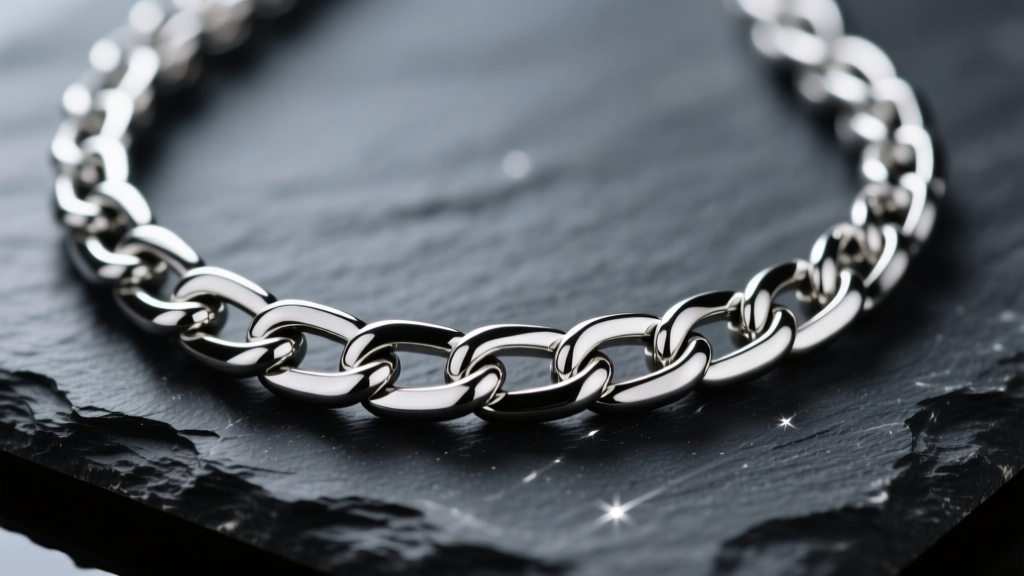
In wholesale catalogs, manufacturing manifests, and global trade databases, the term s.steel necklace is ubiquitous shorthand for stainless steel. However, for the discerning buyer and the jewelry technician, treating all stainless steel as a monolith is a critical error. The durability, hypoallergenic properties, and corrosion resistance of a steel chain or pendant depend entirely on its specific metallurgical grade and surface treatment. This guide strips away the marketing fluff to examine the exact alloy compositions, physical vapor deposition (PVD) metrics, and structural engineering that separate a premium s.steel necklace from one that will degrade within months.
Metallurgical Breakdown: 304 vs. 316L Alloys
The foundation of any high-quality steel pendant or chain is its alloy matrix. While 304 stainless steel is common in kitchenware and budget jewelry, the 316L grade is the undisputed standard for premium body-safe accessories. The addition of molybdenum in 316L drastically alters its pitting resistance equivalent number (PREN), making it highly resistant to the chlorides found in human sweat and swimming pools.
| Alloy Grade | Chromium (Cr) | Nickel (Ni) | Molybdenum (Mo) | Carbon (C) | Primary Jewelry Application |
|---|---|---|---|---|---|
| 304 | 18.0 - 20.0% | 8.0 - 10.5% | None | < 0.08% | Budget fashion chains, display props |
| 316L | 16.0 - 18.0% | 10.0 - 14.0% | 2.0 - 3.0% | < 0.03% | Premium s.steel necklace chains, pendants |
| 316LVM | 17.0 - 19.0% | 13.0 - 15.0% | 2.0 - 3.0% | < 0.03% | Surgical implants, high-end body jewelry |
The "L" in 316L stands for "Low Carbon." During the manufacturing process, particularly when chain links are welded, high carbon content can lead to carbide precipitation. This depletes the surrounding chromium, creating microscopic weak points susceptible to intergranular corrosion. By keeping carbon below 0.03%, 316L maintains its structural integrity and passive chromium oxide layer even after intense heat exposure.
The EU REACH Standard and Nickel Sensitization
A common misconception is that stainless steel is entirely nickel-free. It is not. However, the nickel in 316L is tightly bound within the crystalline matrix. Under the European Union's REACH regulation (specifically the EN 1811:2011 standard), jewelry intended for prolonged skin contact must not release more than 0.5 µg/cm²/week of nickel. Properly passivated 316L s.steel necklaces comfortably pass this threshold, whereas unpolished or poorly finished 304 alloys frequently fail due to surface-level nickel leaching.
Surface Engineering: PVD vs. Traditional Electroplating
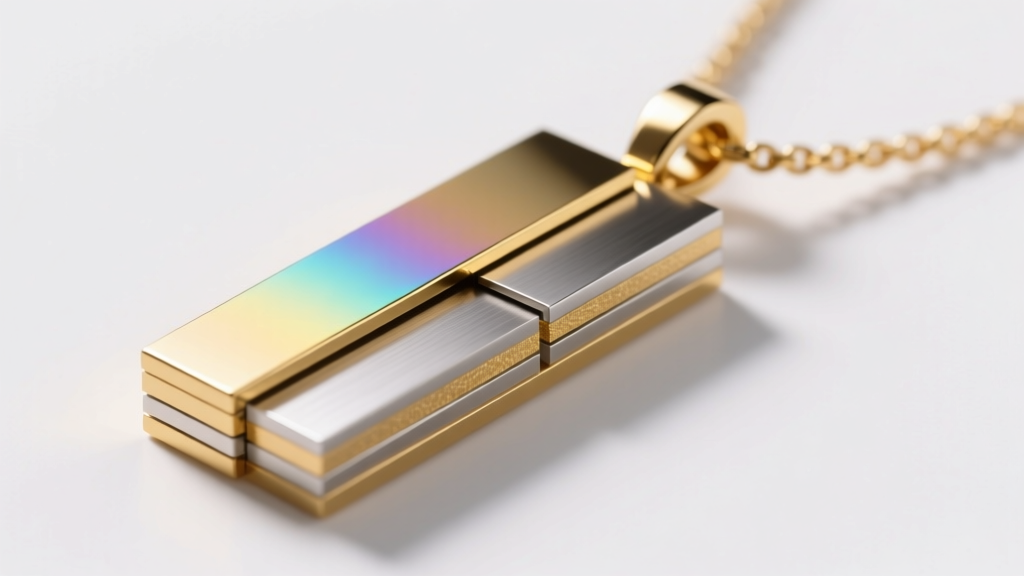
When an s.steel necklace is marketed as "18K Gold Plated" or "Black Rhodium Finished," the application method dictates its lifespan. Traditional electroplating involves submerging the steel in a chemical bath (often cyanide-based) and using an electrical current to bond a microscopic layer of gold. This layer is typically 0.1 to 0.5 microns thick and wears away rapidly against the friction of skin and clothing.
In contrast, Physical Vapor Deposition (PVD) is a vacuum-based coating process. According to the principles of PVD, the target material (such as titanium nitride for a gold hue) is vaporized in a high-vacuum chamber using a cathodic arc or sputtering. The vaporized ions condense onto the s.steel necklace, forming a dense, hard, and chemically inert ceramic layer.
Comparing Coating Durability Metrics
- Thickness: Electroplating (0.1 - 0.5 µm) vs. PVD (0.5 - 2.5 µm).
- Surface Hardness: Electroplated gold (~130 Vickers) vs. TiN PVD (~2400 Vickers).
- Chemical Resistance: Electroplating degrades upon contact with sulfur and chlorine; PVD is virtually impervious to cosmetic chemicals and saltwater.
- Environmental Impact: PVD is a green technology producing zero hazardous liquid waste, unlike traditional wet plating.
Note on Marketing Terminology: You will often see the term "IP Plating" (Ion Plating). In the context of an s.steel necklace, Ion Plating is simply a specific subset of the PVD process where an inert gas like argon is ionized to accelerate the coating material toward the substrate, resulting in even denser adhesion.
Chain Link Architecture and Tensile Failure Points
The longevity of a chain necklace is not just about the alloy; it is about mechanical engineering. The tensile strength of a chain is dictated by its gauge (wire thickness) and its welding methodology.
Laser Welding vs. Traditional Soldering
In mass-produced steel chains, links are often joined using traditional silver or brass solder. Because solder has a much lower melting point and different galvanic properties than 316L steel, these joints become the primary failure points. They are prone to snapping under tension and can tarnish or corrode when exposed to sweat, creating a visible dark spot on the link.
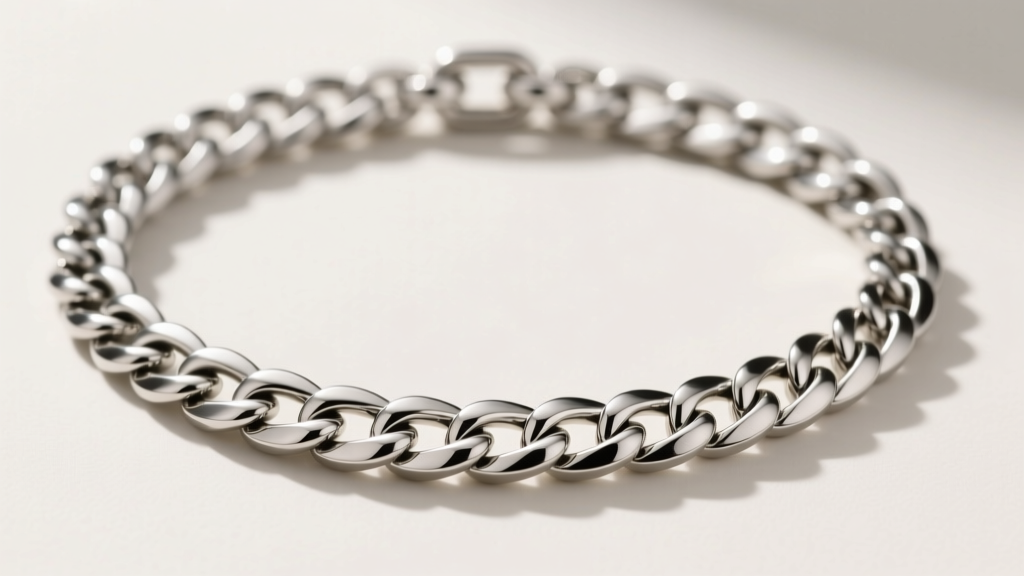
Premium s.steel necklace manufacturers utilize laser welding. A focused laser beam melts the exact point where the two ends of the steel link meet, fusing them without introducing any foreign filler metals. This results in a joint that possesses the exact same tensile strength and corrosion resistance as the parent wire. When evaluating a heavy Cuban or Figaro chain, inspect the seams under a jeweler's loupe; a laser weld will appear as a microscopic, seamless bead, whereas soldered joints often show slight discoloration or excess filler material.
Advanced Maintenance and Chloride Stress Corrosion
While 316L is highly resistant to tarnish, it is not invincible. The most significant threat to an s.steel necklace is Chloride Stress Corrosion Cracking (CSCC). This occurs when the passive chromium oxide layer is penetrated by high concentrations of chlorides (found in heavily chlorinated pools, hot tubs, and certain harsh cleaning agents) while the metal is under physical tension.
Expert Cleaning Protocols
To maintain the structural and aesthetic integrity of your steel jewelry, adhere to the following maintenance framework:
- Routine Degreasing: Submerge the necklace in a solution of warm distilled water and a few drops of pH-neutral dish soap. Use a soft-bristled infant toothbrush to dislodge sebum and dead skin cells from the interstitial spaces of the links.
- Ultrasonic Cleaning: For intricate pendants or rope chains, an ultrasonic cleaner operating at 40 kHz for 3 minutes will safely cavitate debris without scratching the PVD coating or the bare steel.
- Chemical Bans: Never use bleach, ammonia, or silver dip solutions on an s.steel necklace. These chemicals will permanently etch the surface and destroy the passive oxide layer, leading to rapid, irreversible pitting.
- Drying: Always dry the chain completely with a microfiber cloth. Allowing tap water to air-dry on the surface will leave calcium carbonate deposits that mimic the appearance of micro-scratches.
Sourcing and Verification: The ASTM F138 Benchmark
For buyers seeking the absolute highest grade of steel for sensitive skin, look for manufacturers that certify their materials against the ASTM F138 standard. This is the exact specification required for wrought 18Chromium-14Nickel-2.5Molybdenum stainless steel used in surgical implants. While an ASTM F138 certified s.steel necklace will command a higher price point, it guarantees a vacuum-melted (VM) alloy with near-zero inclusion rates, ensuring maximum biocompatibility and lifelong durability.
The Expert Verdict: When investing in an s.steel necklace, bypass generic "surgical steel" claims. Demand 316L or 316LVM alloys, verify that any color finishes are applied via PVD rather than electroplating, and inspect the link seams for laser welding. These three technical pillars are the true indicators of a garment that will outlast its wearer.


