How to Choose and Style the Perfect San Benito Necklace
Master the art of selecting a San Benito necklace. Learn about metal grades, chain tensile strength, enamel types, and expert layering techniques.

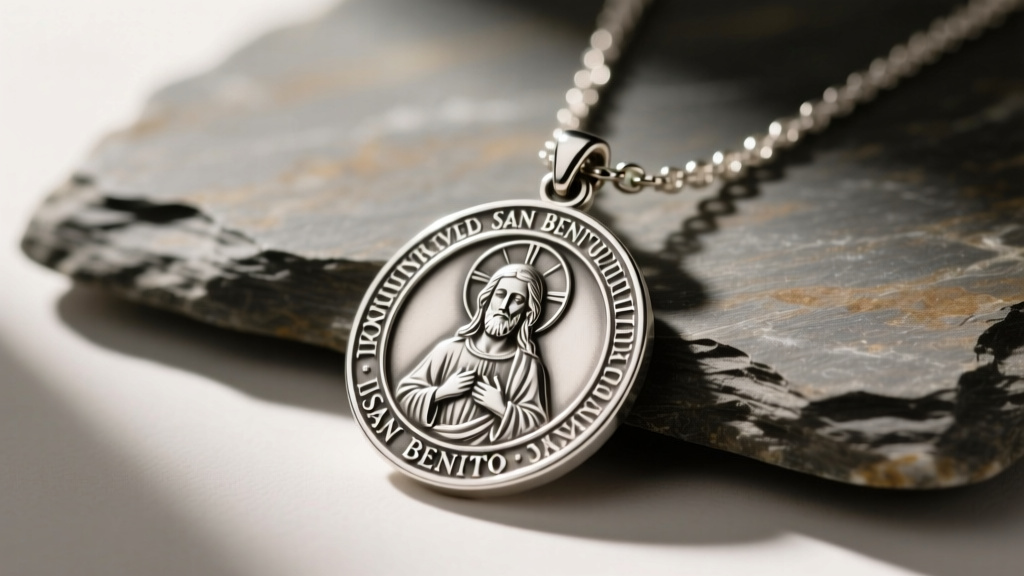
The San Benito necklace, deeply rooted in the centuries-old tradition of the Saint Benedict medal, transcends its origins as a simple talisman of spiritual protection to become a cornerstone of heritage and fine jewelry. Whether you are drawn to its profound historical significance or its striking aesthetic, selecting the right piece requires a keen understanding of metallurgy, chain engineering, and stylistic balance. In this comprehensive guide, we move beyond mass-produced souvenirs to explore how to authenticate, select, and style a high-quality San Benito necklace that will endure a lifetime of daily wear.
Decoding the Anatomy of a San Benito Medal
Before evaluating the metal or chain, a true jewelry connoisseur must understand the anatomical details of the medal itself. The traditional design is a masterclass in miniature bas-relief storytelling, originating from the Monte Cassino abbey traditions. According to historical archives documented by Encyclopedia Britannica, the iconography is dense with specific symbolism that dictates the quality of the casting.
The Obverse (Front)
The front typically features the portrait of Saint Benedict. To his right, a raven is depicted carrying away a loaf of poisoned bread; to his left, a shattered cup represents the poisoned wine he miraculously survived. High-end castings will feature distinct, high-relief feathers on the raven and readable micro-texture on the saint's habit. Cheap, stamped versions will flatten these details into muddy, indistinct shapes.
The Reverse (Back) and Latin Acronyms
The reverse features the Jubilee Cross surrounded by specific Latin abbreviations. When authenticating a premium San Benito necklace, use a jeweler's loupe to verify the crispness of these letters:
- C.S.P.B. (Crux Sancti Patris Benedicti) - The Cross of our Holy Father Benedict.
- C.S.S.M.L. (Crux Sacra Sit Mihi Lux) - May the holy cross be my light.
- N.D.S.M.D. (Non Draco Sit Mihi Dux) - May the dragon never be my overlord.
- V.R.S.N.S.M.V. (Vade Retro Satana) - Begone Satan.
"A genuine high-relief cast medal will have deeply recessed backgrounds and sharply raised lettering, allowing for enamel pooling or dramatic light contrast, whereas die-struck medals often lack this dimensional depth."
Metallurgy and Material Grades: What to Buy
The longevity of your necklace depends entirely on the base metal and its finishing treatments. Because the San Benito medal rests against the sternum—an area prone to perspiration and friction—material selection is critical. The Gemological Institute of America (GIA) emphasizes that understanding metal alloys is the first step in jewelry preservation.
| Material Grade | Composition & Finish | Durability & Tarnish Resistance | Ideal Use Case |
|---|---|---|---|
| 925 Sterling Silver (Rhodium) | 92.5% Silver, 7.5% Copper, plated in Rhodium | High. Rhodium prevents silver sulfide tarnishing. | Daily wear, high-contrast styling. |
| 14k Solid Gold | 58.5% Pure Gold, alloyed with copper/zinc | Exceptional. Will not oxidize or corrode from sweat. | Lifetime heirloom pieces, shower/swim wear. |
| Gold Vermeil | Sterling silver base with >2.5 microns of 14k/18k gold | Moderate. Will eventually wear down to silver over years. | Occasional wear, budget-conscious luxury. |
| Brass / Base Metal | Copper/Zinc alloy, often thinly flash-plated | Poor. Sweat degrades plating rapidly, causing green skin. | Avoid for daily or long-term wear. |
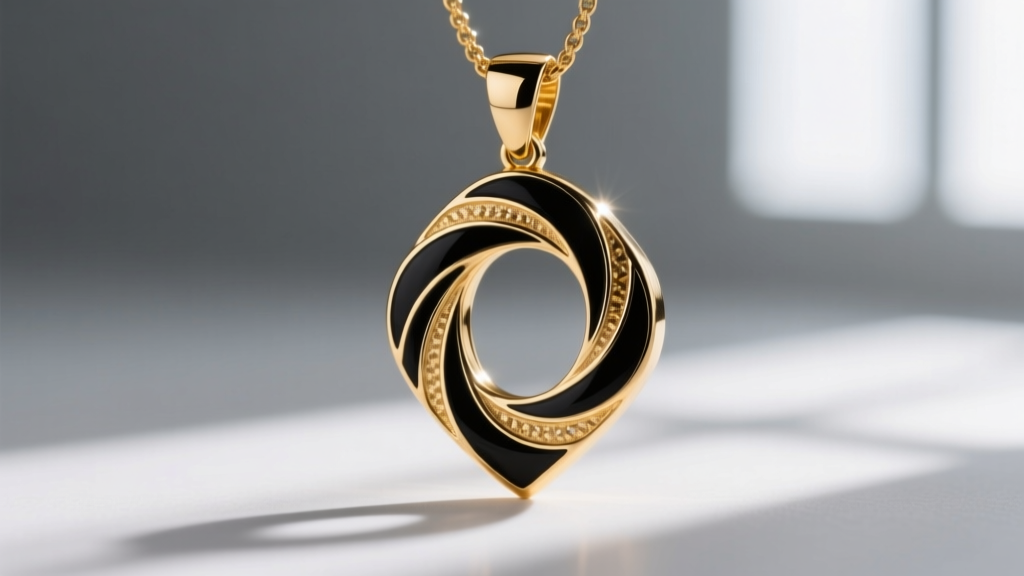
The Enamel Factor: Epoxy vs. Vitreous vs. Niello
Many premium San Benito necklaces feature black inlay to make the Latin text pop. You must identify the type of inlay used. Cold enamel (epoxy resin) is common in mid-tier jewelry but will yellow and chip within two to three years of UV and sweat exposure. Vitreous enamel is powdered glass fired at over 1,400°F, fusing permanently to the metal. Niello is a traditional black mixture of copper, silver, and lead sulfides, rubbed into engraved lines and fired. Both vitreous enamel and niello are hallmarks of luxury, artisan-crafted medals.
Chain Engineering: Weight and Tensile Strength
A frequent point of failure in religious jewelry is the chain. A standard 1.25-inch solid cast San Benito medal weighs between 10 and 18 grams. When worn, the medal acts as a pendulum. Every step you take generates kinetic energy that transfers upward, placing immense shear stress on the chain's weakest points: the jump ring and the clasp spring.
Matching Chain Styles to Pendant Weight
To prevent catastrophic metal fatigue, you must pair the medal with a chain that possesses adequate tensile strength and structural redundancy.
- Avoid (Under 1.5mm): Delicate cable chains, thin box chains, and serpentine chains. The pendulum swing will easily warp the links or snap the clasp.
- Recommended (2.5mm - 4.0mm): Wheat (Spiga) chains feature interlocking oval links woven in the same direction, offering immense tensile strength and a beautiful textured backdrop that complements the medal's relief. Rolo chains with thick, alternating round or oval links provide excellent structural integrity and resist kinking.
- Heavy Duty (4.0mm+): Figaro or Cuban link chains are ideal for oversized (1.5-inch+) masculine medals, providing a robust, industrial aesthetic that anchors the heavy pendant securely.
Step-by-Step Layering Framework
The San Benito medal is inherently ornate, featuring complex geometry and dense text. When integrating it into a modern necklace stack, the goal is to create visual hierarchy without causing the pieces to tangle or scratch one another.
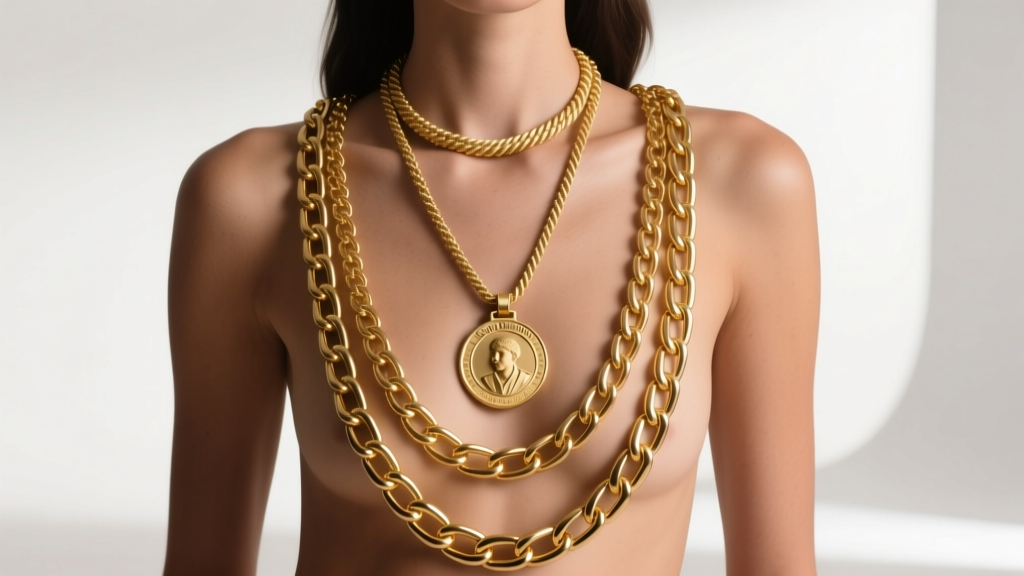
The Rule of Proportional Drops
For a flawless, tangle-free stack, maintain a strict 2-inch to 3-inch drop between each chain. This ensures the pendants rest in distinct visual zones on the chest.
- The Anchor (16 to 18 inches): Start with a minimalist, high-polish chain like a 2mm box chain or a simple herringbone. This sits near the collarbone and provides a clean, reflective baseline without competing for attention.
- The Focal Point (20 to 22 inches): This is where your San Benito necklace resides. Opt for a matte or brushed finish chain (like a wheat chain) to contrast with the high-polish border of the medal, allowing the intricate bas-relief to command the center of the stack.
- The Terminator (24 to 26 inches): Finish with a heavier, textured chain featuring a simple geometric drop, such as a plain gold bar, a raw gemstone, or a heavy rope chain left bare. This draws the eye downward and frames the central medal beautifully.
Care, Cleaning, and Maintenance Protocols
Proper maintenance of a San Benito necklace requires an understanding of its specific vulnerabilities. If your medal features vitreous enamel or niello inlay, never use an ultrasonic cleaner. The high-frequency acoustic cavitation can easily fracture the glass or sulfur inlays, causing them to flake out of the recessed lettering.
Instead, adopt a gentle, manual cleaning protocol. Mix a few drops of pH-neutral dish soap into a bowl of lukewarm distilled water. Submerge the necklace for three minutes to loosen sebum and environmental dust. Use a soft horsehair detailing brush to gently agitate the bristles into the deep crevices of the Latin text and the saint's portrait. Rinse thoroughly under a gentle stream of distilled water to prevent hard water spotting, and pat dry with a lint-free microfiber cloth. For the chain, occasionally run a polishing cloth treated with anti-tarnish compounds along the links to restore the metal's original luster and remove microscopic oxidation.
By prioritizing high-relief casting, selecting appropriate metallurgical grades, and respecting the physics of chain tension, your San Benito necklace will remain a powerful, beautiful, and enduring element of your personal style for decades to come.


