Expert Guide to Santa Necklace Materials, Enamel & Chain Tech
Discover the technical details behind fine jewelry Santa necklaces. We analyze vitreous enamel, precious metal casting, and chain mechanics.

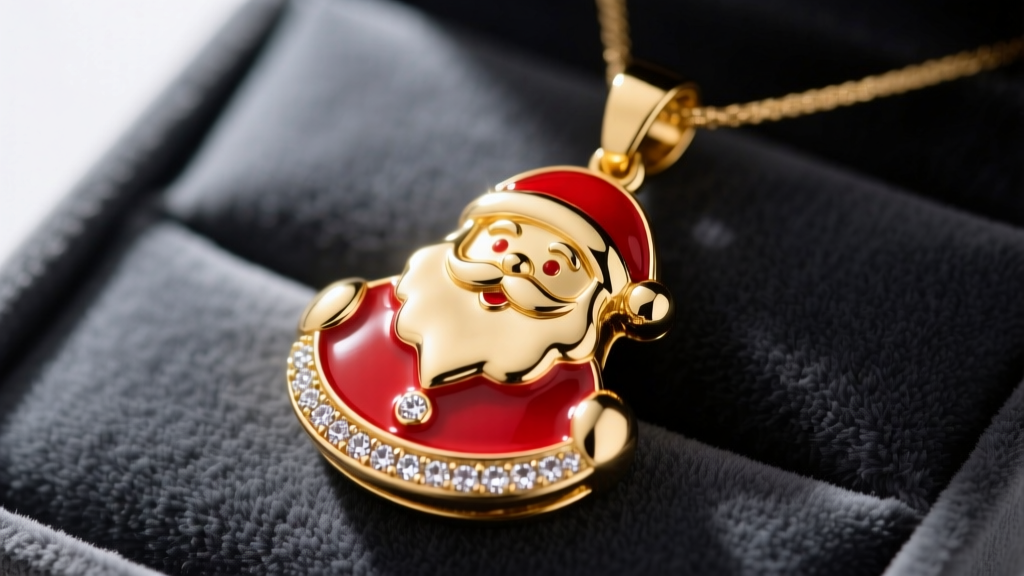
When collectors and fine jewelry enthusiasts search for a santa necklace, they are increasingly bypassing mass-produced, acrylic costume pieces in favor of artisan-crafted, technically complex pendants. The evolution of holiday-themed fine jewelry has transformed the classic Santa motif into a canvas for advanced metallurgy, precision stone setting, and traditional enameling. This expert deep dive explores the engineering, material grades, and structural mechanics that separate a high-end collectible Santa pendant from a seasonal novelty.
The Anatomy of a Fine Jewelry Santa Pendant
Creating a premium Santa necklace begins with 3D CAD modeling and lost-wax casting. Artisans typically utilize 925 sterling silver or 14k/18k gold. For sterling silver pieces, the raw casting is highly porous and prone to oxidation. To combat this, the pendant undergoes a multi-stage polishing process before receiving a flash plating of rhodium.
Rhodium Plating Specifications
Rhodium, a platinum-group metal, provides a brilliant, tarnish-resistant white finish. However, the thickness of the plating is critical for longevity. Standard commercial plating is often a mere 0.05 microns, which will wear off at the bail (the loop where the chain threads) within a single season of daily wear. High-end artisan pieces specify a rhodium thickness of 0.2 to 0.3 microns, ensuring the pendant withstands friction and environmental exposure for years without revealing the yellowish-grey base silver underneath.
For gold iterations, 14k gold (58.5% pure gold alloyed with copper and silver) is generally preferred over 18k gold for these specific pendants. The Santa motif often features deep, three-dimensional relief carving (such as the texture of the beard and the folds of the suit). 14k gold offers superior Vickers hardness (approx. 130-150 HV) compared to 18k gold, preserving these intricate micro-textures against scratching and deformation.
Enamel Techniques: Vitreous vs. Cold Epoxy
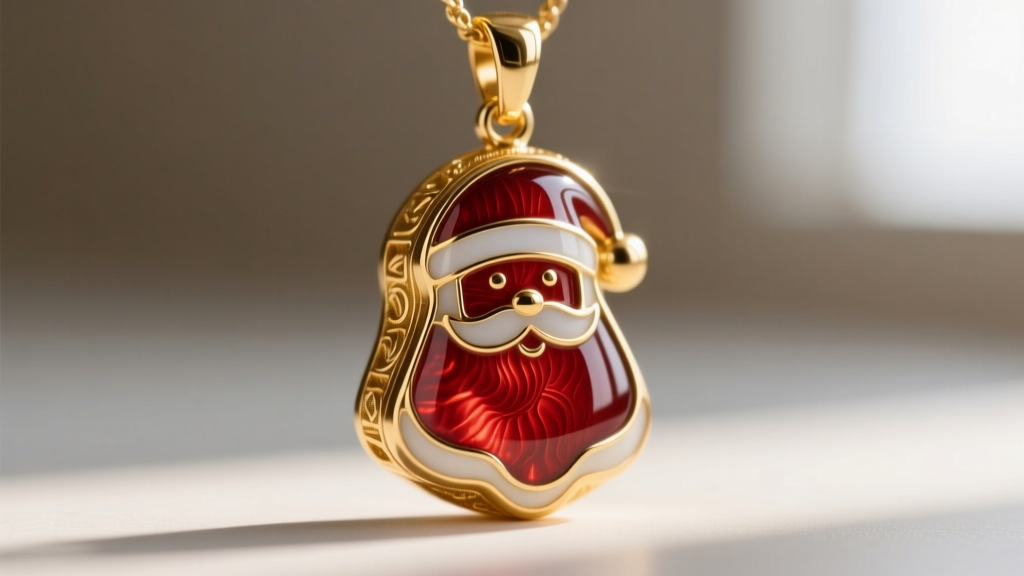
The iconic red of Santa’s suit is the focal point of the design. In fine jewelry, this color is achieved through either vitreous enamel or cold enamel (epoxy resin). Understanding the difference is crucial for evaluating the quality and longevity of a santa necklace.
Vitreous Enamel (Fired Glass)
Vitreous enamel is a silica-based glass powder that is packed into champlevé recesses (channels carved or cast into the metal) and fired in a kiln at temperatures exceeding 1400°F (760°C). The powder melts, fuses to the metal, and cools into a hard, glass-like surface. According to the Gemological Institute of America (GIA), vitreous enamel is highly resistant to UV fading and chemical solvents. However, its primary failure mode is brittleness; a hard impact against a granite countertop can cause the glass to shatter or craze.
Cold Enamel (Epoxy Resin)
Cold enamel is a two-part epoxy resin poured into the metal recesses and left to cure at room temperature. While it is shatter-resistant and cheaper to produce, it has significant drawbacks. Over a 3-to-5-year period, exposure to UV light causes the red pigments in epoxy to yellow and fade. Furthermore, cold enamel sits slightly below the metal bezel wall to prevent overflow, creating a 'dip' that traps skin oils and lotions, leading to a cloudy appearance over time.
'The hallmark of a master enamelist is the ability to maintain the opacity of lead-free red fluxes at 1450°F without burning out the metallic oxides, a technique essential for heirloom-quality holiday jewelry.'
Chain Selection and Clasp Mechanics for Heavy Pendants
A meticulously cast Santa pendant, complete with enamel and gemstones, typically weighs between 6 and 14 grams. Suspending this weight requires a chain with adequate tensile strength and a clasp engineered for security. Standard 0.8mm cable chains and spring-ring clasps will inevitably fail under this load.
Chain Gauge and Style Matrix
Below is a technical breakdown of chain styles recommended for heavy holiday pendants, based on structural data from jewelry manufacturing suppliers like Rio Grande.
| Chain Style | Recommended Gauge | Tensile Strength | Best For Pendant Weight | Friction Wear Profile |
|---|---|---|---|---|
| Box Chain | 1.2mm - 1.5mm | High | 5g - 12g | Low (smooth links) |
| Wheat Chain | 1.5mm - 2.0mm | Very High | 8g - 18g | Moderate (interlocking) |
| Rope Chain | 1.8mm - 2.5mm | High | 10g - 25g | High (twisted links) |
| Cable Chain | 1.5mm+ | Low-Medium | 3g - 8g | High (solder points) |
Clasp Engineering
For pendants over 8 grams, a standard lobster clasp is insufficient due to the weak internal spring mechanism. Experts recommend a trigger clasp or a heavy-duty locking lobster clasp featuring a secondary safety catch. The jump ring connecting the clasp to the chain must be soldered closed; an open jump ring will easily pull apart under the pendulum-like swinging motion of a heavy Santa pendant.
Gemstone Accents: Melee Diamonds and Ruby Alternatives
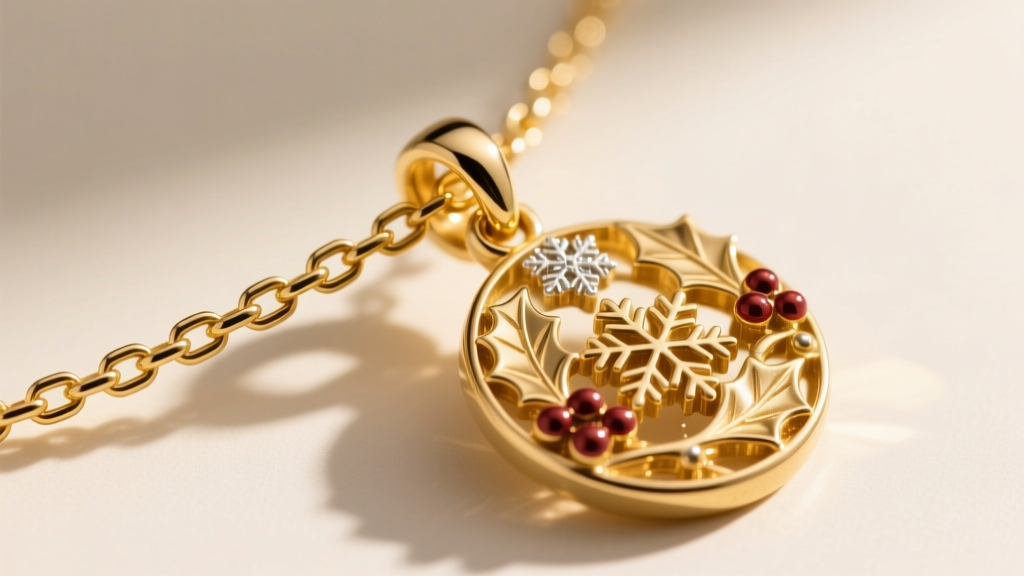
Elevating a santa necklace from a simple enameled charm to a luxury piece often involves incorporating gemstones. Santa’s belt buckle, the trim of his hat, and the toys in his sack are prime locations for diamond melee and colored gemstones.
Single-Cut vs. Full-Cut Melee
Melee diamonds (weighing between 0.01 and 0.05 carats) are used for micro-pavé settings. For stones smaller than 1.3mm in diameter, expert jewelers utilize single-cut diamonds (17 facets) rather than full-cut diamonds (57 facets). At microscopic scales, the 57 facets of a full-cut stone blur together, making the diamond look muddy or grey. A single-cut stone reflects light in broader, more brilliant flashes, providing the necessary 'sparkle' for Santa's belt buckle.
Lab-Created Ruby Accents
As of 2026, the use of lab-created rubies for Santa's suit accents has become the industry standard for high-end pieces. Created via the Verneuil (flame fusion) process, these synthetic corundum stones possess the exact same chemical composition (Al2O3) and Mohs hardness (9) as mined rubies but offer a deeply saturated, flawless 'pigeon blood' red that perfectly mimics the traditional velvet of Santa's suit without the inclusions that plague natural stones of similar size.
Maintenance, Tarnish, and Enamel Restoration
Proper maintenance of a fine jewelry Santa necklace requires understanding the chemical vulnerabilities of its composite materials.
- Ultrasonic Cleaners: Never place a vitreous enameled pendant in an ultrasonic cleaner. The high-frequency acoustic cavitation creates microscopic shockwaves that will instantly shatter the glass enamel and loosen the tension in micro-pavé diamond settings.
- Chemical Dips: Silver dip solutions (thiourea-based) will strip the rhodium plating and etch the surface of cold epoxy enamel. They will also leave a white, cloudy residue inside the porous crevices of the casting.
- Manual Cleaning Protocol: The only safe cleaning method is a lukewarm bath of distilled water and a few drops of pH-neutral dish soap. Agitate gently with an extra-soft baby toothbrush, paying special attention to the underside of the pendant where skin oils accumulate against the metal gallery.
By understanding the metallurgy, enamel chemistry, and structural mechanics involved, buyers and collectors can confidently invest in a santa necklace that serves not just as a seasonal accessory, but as a durable, heirloom-quality piece of fine jewelry engineering.


