How to Shorten Necklace Chain Links: An Expert Technical Guide
Learn how to shorten necklace chain links safely. Our expert technical guide covers tools, chain weaves, soldering, and structural integrity.

The Metallurgy of Chain Resizing: Why Technique Matters
When a client asks to shorten necklace chain lengths, it is rarely as simple as snipping a link and closing a jump ring. As a technical jeweler, you must consider the metallurgy, work hardening, and tensile strength of the specific alloy. Precious metals like 14k and 18k gold, as well as 950 platinum, undergo work hardening during the manufacturing process where the wire is drawn and the links are stamped or woven. Cutting into a chain relieves localized tension, but introducing a new soldered joint creates a thermal anomaly that can weaken adjacent links if not managed with precise temperature control.
Improperly shortening a chain can lead to catastrophic failure modes, such as the clasp tearing through the terminal link or the solder joint oxidizing and snapping under the dynamic load of daily wear. According to metallurgical guidelines from the Gemological Institute of America (GIA), understanding the specific alloy composition is critical before applying heat, as lower-karat golds or white gold alloys containing nickel or palladium react vastly differently to traditional torch soldering compared to laser welding.
Essential Jeweler Tools for Precision Shortening
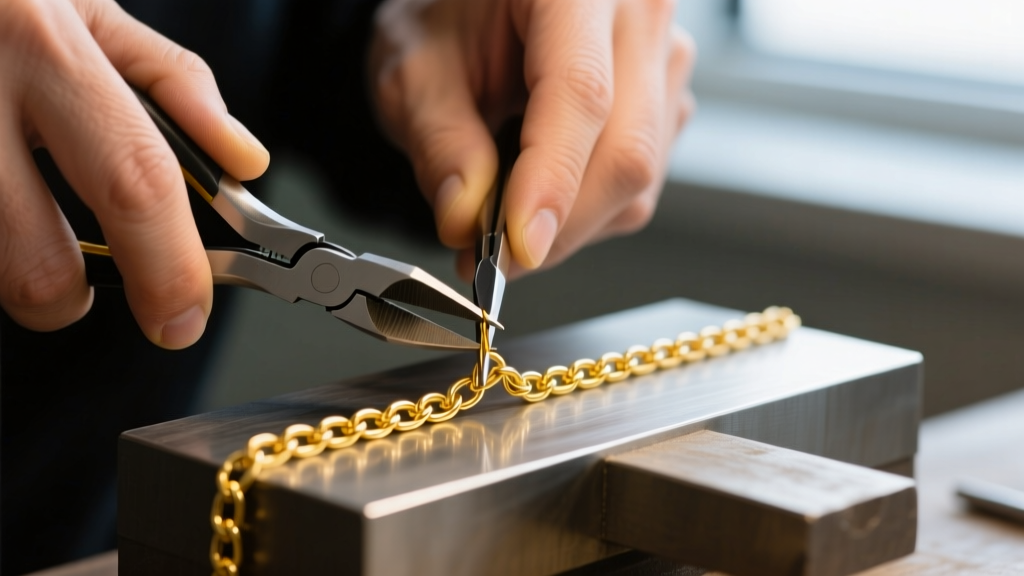
To execute a flawless resize, standard hardware store wire cutters will crush the link geometry and leave sharp, jagged burrs that will catch on textiles and scratch the wearer's skin. A professional bench requires specialized instruments:
- Precision Flush Cutters: Tools like the Lindstrom RX 8141 micro-shear provide a perfectly flat cut on wires up to 1.2mm thick, essential for cleanly severing cable or Figaro links without deforming the adjacent oval.
- Locking Tweezers and Cross-Locks: Used to hold the chain taut and dissipate heat away from the gemstone settings or delicate adjacent links during the soldering process.
- Soldering Mandrels and Charcoal Blocks: Provide a heat-reflective surface that helps bring the precious metal to flow temperature rapidly, minimizing the time the chain is exposed to oxidizing flames.
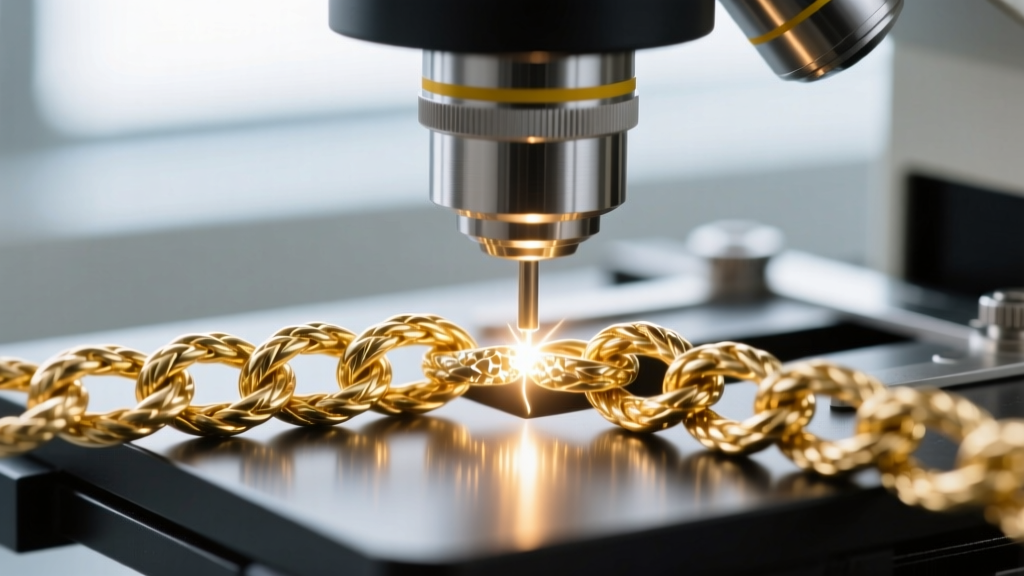
- Pulse Laser Welder: For complex weaves, an Orion pulse welder allows for microscopic, localized joins without the need for flux or bulk heating.

Chain Weave Analysis: Cutting and Rejoining Strategies
Not all chains are created equal. The topology of the weave dictates the exact methodology required to shorten necklace chain segments without ruining the drape or visual continuity. Below is a technical breakdown of common chain types and their resizing protocols.
| Chain Type | Link Structure | Shortening Method | Difficulty & Risk |
|---|---|---|---|
| Cable / Link | Uniform oval/round links | Flush cut, saw out link, hard solder | Low |
| Rope | Twisted helical links | Laser weld required to maintain twist | High |
| Box | Hollow square geometric links | Laser or specialized internal jig | High (crush risk) |
| Figaro | Alternating long and short links | Pattern-matched cutting, medium solder | Medium |
| Snake | Interlocking smooth plates | Cannot be traditionally cut/soldered | Extreme (often requires end-caps) |
Handling Hollow and Diamond-Cut Chains
Hollow chains present a severe structural challenge. Because the links are formed from thin-walled tubing (often less than 0.2mm thick), applying a traditional torch will instantly melt the link into a useless ball of metal. Furthermore, diamond-cut chains, which feature faceted surfaces designed to catch the light, will lose their reflective geometry if the heat from a torch alters the surface tension or melts the facets. For these variations, jewelers must rely on Rio Grande's recommended low-temperature easy solders or utilize a laser welder with a highly focused beam to preserve the structural integrity of the hollow voids.
The Soldering and Laser Welding Process
When traditional torch soldering is viable, the choice of solder grade is paramount. Gold solders are categorized by their flow temperatures: Hard (approx. 1450°F / 788°C), Medium (approx. 1350°F / 732°C), and Easy (approx. 1250°F / 677°C). To shorten a chain, a jeweler should always use Hard or Medium solder for the structural link joins to ensure the joint has a tensile strength matching the base metal. Easy solder should be reserved exclusively for the final clasp attachment to allow for future repairs without remelting the chain links.
However, the industry standard for high-end chain resizing in 2026 is laser welding. A pulse laser welder operates by delivering a concentrated burst of light energy that melts the metal only at the exact point of contact. For a standard 14k gold rope chain, typical laser parameters might be set to 35 Watts with a 3.5-millisecond pulse duration. This creates a seamless, oxidation-free joint that requires minimal cleanup with a rubber polishing wheel, preserving the original milligram weight and structural drape of the necklace.
Reattaching the Clasp and Jump Ring Integrity
A frequent failure point after shortening a necklace is the reattachment of the clasp. Many commercial necklaces are assembled overseas using open jump rings that are simply squeezed shut. This is mechanically unacceptable for a resized piece. The lateral force applied to a necklace when it catches on clothing can easily pry open a standard round jump ring.
Expert Rule: Never use a standard open round jump ring to connect a lobster or spring-ring clasp to a newly shortened chain. Always use a fully soldered closed ring, or at minimum, a heavy-gauge oval split ring where the lateral tension pulls the ring closed rather than prying it open.
If the original clasp is a delicate lobster claw that has suffered spring fatigue, the resizing appointment is the ideal time to upgrade the findings. Upgrading to a solid 14k gold magnetic clasp or a heavier-duty stainless steel spring-ring ensures that the weakest point of the chain is no longer the clasp mechanism itself.
Cost Estimates and When to See a Professional
The cost to professionally shorten necklace chain links varies wildly based on the metal, the weave complexity, and the equipment required. Below is a realistic 2026 pricing framework for bench jewelers:
- Standard Cable Chain (14k/18k Gold): $35 - $55. Involves cutting, sizing, and torch soldering two links.
- Rope or Figaro Chain (Torch/Laser): $60 - $95. Requires pattern matching and careful heat control to prevent twisting.
- Box or Hollow Chains (Laser Welding Only): $90 - $150. High risk of crushing or melting necessitates expensive laser time and microscopic precision.
- Platinum Chains (Any Weave): $120 - $200+. Platinum's extremely high melting point (3215°F / 1768°C) makes torch soldering nearly impossible without specialized platinum solder and a high-heat oxy-hydrogen torch, making laser welding the mandatory and costly choice.
Attempting to shorten a necklace at home with wire cutters and needle-nose pliers will almost certainly result in crushed links, sharp edges, and an inevitable trip to the jeweler for a much more expensive reconstruction. Trusting a certified bench jeweler with the proper metallurgical tools ensures the chain retains its original strength, drape, and aesthetic brilliance for decades to come.


