Size 11 Necklace Beads: A Technical Stringing Guide
Master the technical art of seed bead jewelry. Explore tension math, thread deniers, and structural finishing for a flawless size 11 necklace.

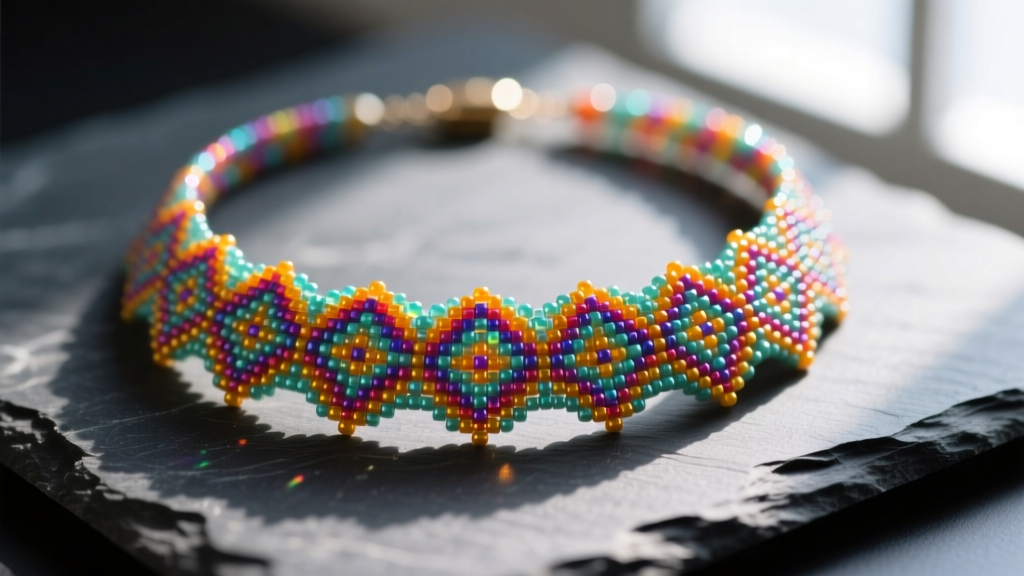
The Engineering of the Size 11/0 Seed Bead
When constructing a high-end beaded accessory, the structural integrity of the final piece relies entirely on the microscopic tolerances of its components. The size 11/0 seed bead is the undisputed workhorse of off-loom weaving, but treating it as a generic craft supply is a critical error. A true size 11 necklace requires an understanding of bead morphology, hole diameter variances, and the tensile physics of modern threading materials. In the professional jewelry sector, a size 11/0 bead typically measures 1.6mm in length and 1.3mm in width. However, the internal bore—the hole size—is where the engineering challenges begin.
Japanese manufacturers dominate this space, but their specifications differ slightly. Miyuki Rocaille size 11/0 beads feature a hole diameter of approximately 0.8mm. In contrast, Toho size 11/0 beads are engineered with a slightly larger 0.9mm bore. While a 0.1mm variance seems negligible to the naked eye, it dictates your thread selection, needle sizing, and the maximum number of thread passes you can execute in complex stitches like right-angle weave or tubular peyote. Attempting to force a heavy denier thread through a Miyuki bead with metallic lining (which further reduces the hole diameter by up to 0.05mm due to the galvanic coating) will result in micro-fractures in the glass, leading to catastrophic bead failure under the tensile load of a worn necklace.
Thread Metallurgy and Denier Mathematics
The era of relying solely on stretched nylon for bead weaving is over. Modern size 11 necklace construction demands a precise pairing of thread material to stitch topology. The thread must possess high tensile strength, minimal stretch, and exceptional abrasion resistance against the sharp inner edges of silica glass beads.
- Gel-Spun Polyethylene (GSPE): Marketed under brand names like Fireline, this micro-fused braided thread is the industry standard for structural rigidity. A 6lb test Fireline (0.006 inches / 0.15mm diameter) offers near-zero stretch. Because it does not elongate, it prevents the 'sagging' effect seen in older nylon threads when a heavy pendant is added to the beadwork.
- Nylon Monofilament and Multifilament: Threads like Nymo D (0.012 inches / 0.30mm diameter) are preferred for stitches that require drape, such as brick stitch fringe. However, nylon possesses a memory and a stretch factor of up to 12% under load. It must be pre-stretched manually before weaving to prevent tension warping later.
- Fused Nylon (WildFire): A thermally bonded nylon that bridges the gap between the drape of traditional nylon and the abrasion resistance of GSPE. Its 0.008-inch diameter makes it ideal for size 11/0 beads with opaque or color-lined finishes, which tend to have sharper internal edges that can slice standard braided threads.
The Physics of Tension and Stitch Selection
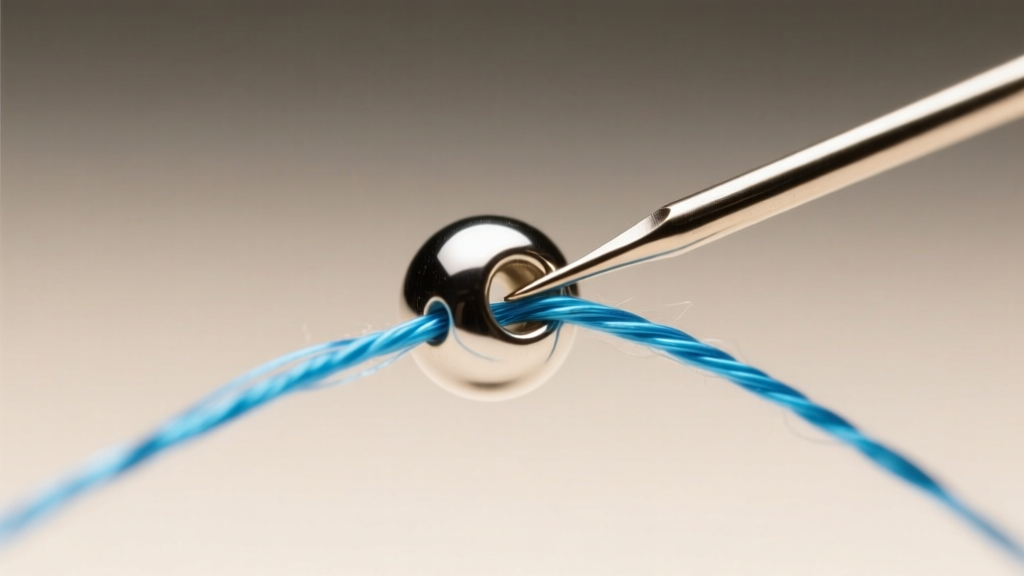
Tension in off-loom bead weaving is not merely an aesthetic choice; it is a structural imperative. The differential shrinkage between the thread and the glass beads dictates the final geometry of the piece. When weaving a flat peyote stitch size 11 necklace, applying more than 4 ounces of lateral pull per stitch will cause the work to 'cup' or warp inward. This occurs because the thread path is longer than the straight-line distance between beads; overtightening forces the beads out of their planar alignment to satisfy the thread's shortened path length.
Needle Sizing and Pass Limits
To navigate the 0.8mm bore of a Miyuki size 11/0 bead, needle selection is critical. English beading needles, specifically the John James brand, are manufactured from high-carbon steel to resist bending. A Size 10 needle (0.46mm diameter) is suitable for initial passes, but complex stitches often require passing through the same bead three or four times. Mathematically, four passes of a 0.15mm thread plus the 0.38mm eye of a Size 12 needle equals 0.98mm—a physical impossibility inside a 0.8mm hole. Therefore, expert weavers utilize 'step-down' needle techniques, transitioning to a finer Size 13 or 15 needle for the final reinforcement passes, or they rely on the rigid nature of GSPE thread to act as its own needle for the last pass by melting the tip to a microscopic point.
Material Compatibility Matrix
Choosing the wrong combination of bead finish and thread type is the leading cause of premature necklace failure. The chemical and physical properties of the bead coating must be matched to the thread's abrasion profile.
| Bead Finish Type | Internal Bore Condition | Recommended Thread | Failure Risk if Mismatched |
|---|---|---|---|
| Galvanized / Metallic | Rough, micro-abrasive edges | WildFire (Fused Nylon) | Thread fraying and snap under 2lbs tension |
| Color-Lined | Sharp glass ridges, fragile coating | Fireline 6lb (GSPE) | Thread cuts through lining, ruining color |
| Opaque / Ceylon | Smooth, rounded silica bore | Nymo D (Conditioned) | Minimal risk, optimal for high-drape stitches |
| Duracoat / Dyed | Smooth, slightly reduced diameter | Fireline 4lb or 6lb | Needle breakage if hole is blocked by dye |
Structural Finishing and Clasp Integration
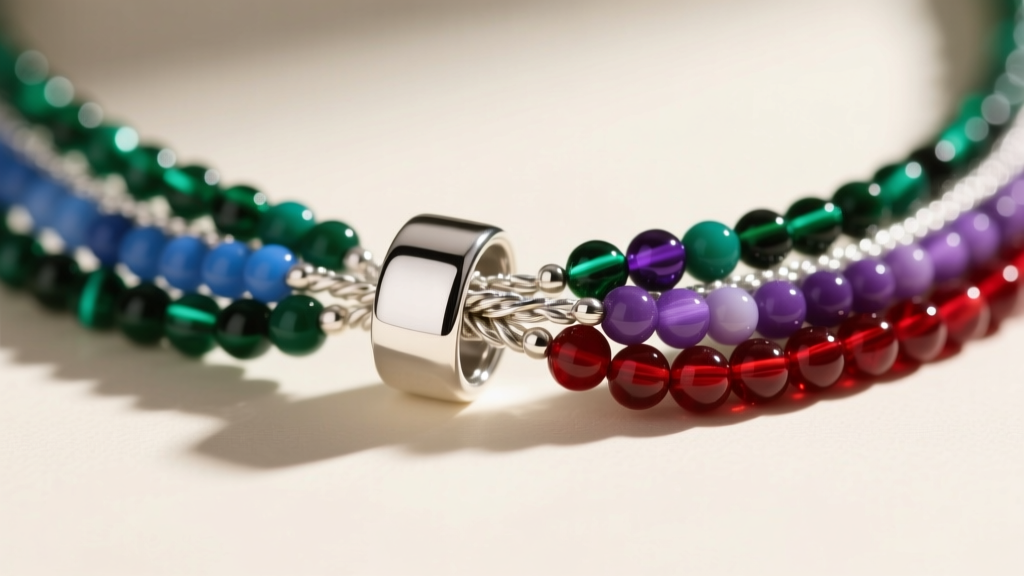
The termination point of a size 11 necklace is its most vulnerable structural node. The transition from flexible beadwork to rigid metal hardware introduces a severe shear-stress point. Tying off thread directly to a jump ring or using standard crimp beads on woven thread will inevitably lead to fraying and breakage due to metal-on-thread friction.
Professional finishing requires the use of sterling silver or gold-filled ribbon crimps, typically 3mm to 5mm in width, paired with a folded wire loop or a specialized bead tip. The beadwork must be woven into a reinforced 'zipper' edge—a technique where the final rows of size 11/0 beads are woven with a continuous, looping thread path that distributes the tensile load across the entire width of the necklace rather than relying on a single knot. Once the reinforced edge is complete, a thin layer of flexible jewelry adhesive (such as E6000 or a specialized cyanoacrylate gel) is applied inside the ribbon crimp before folding it over the thread loops. This creates a mechanical and chemical bond that can withstand over 15 pounds of lateral pull, far exceeding the breaking point of the necklace chain or clasp itself.
Troubleshooting Structural Anomalies
"Beadwork is essentially a tensioned textile. If the warp and weft equivalents are not balanced, the fabric will distort. You cannot force glass into submission; you must engineer the thread path to accommodate the glass."
— Master Beadweaver Technical Guidelines, Interweave Beading
When troubleshooting a size 11 necklace that exhibits structural anomalies, apply the following diagnostic framework:
- Edge Flaring (Ruffling): Caused by insufficient tension on the edge thread path, or using a thread with too much stretch (like unconditioned Nymo) combined with a heavy bead count. Solution: Weave a reinforcing pass using a high-modulus GSPE thread along the perimeter to lock the edge geometry.
- Cupping (Concave Warping): The result of overtightening the working thread, pulling the beads out of their natural planar resting state. Solution: This is often irreversible once the thread memory sets. Prevention requires practicing 'slack weaving' and relying on the natural friction of the beads to hold the work together, rather than muscle tension.
- Thread Visibility Between Beads: Occurs when the thread diameter is too thick for the bead size, preventing the beads from sitting flush against one another. Solution: Downgrade from 8lb to 6lb Fireline, or switch to a thinner monofilament. The beads should 'click' together; if they feel spongy, your thread gauge is too high.
By treating the creation of a size 11 necklace as an exercise in micro-engineering rather than simple crafting, jewelers can produce heirloom-quality, structurally sound garments that withstand the rigors of daily wear while maintaining perfect geometric alignment.


