The Standard Necklace Length for Women: Fit Troubleshooting Guide
Discover the true standard necklace length for women. Troubleshoot fit issues, clasp migration, and pendant flipping with expert hardware fixes.


The jewelry industry has long perpetuated a convenient but flawed myth: that there is a single, universal standard necklace length for women. Retailers typically stock 16-inch chokers and 18-inch princess chains, labeling them as 'one-size-fits-most.' However, as any seasoned jeweler or stylist will tell you, anatomical variance, posture, and the physics of metal drape mean that an 18-inch chain will sit drastically differently from one person to the next. In 2026, with the rise of custom-fit jewelry and modular layering, relying on arbitrary industry standards leads to frustrating fit failures.
If you are constantly adjusting your chains, dealing with clasps that slide to the front, or watching pendants flip backward, the issue isn't your body—it is a mismatch between your anatomy and the hardware. This comprehensive troubleshooting guide will help you decode the true standard necklace length for women based on real-world metrics, diagnose common drape failures, and implement professional hardware fixes.
The Myth of the Universal Standard
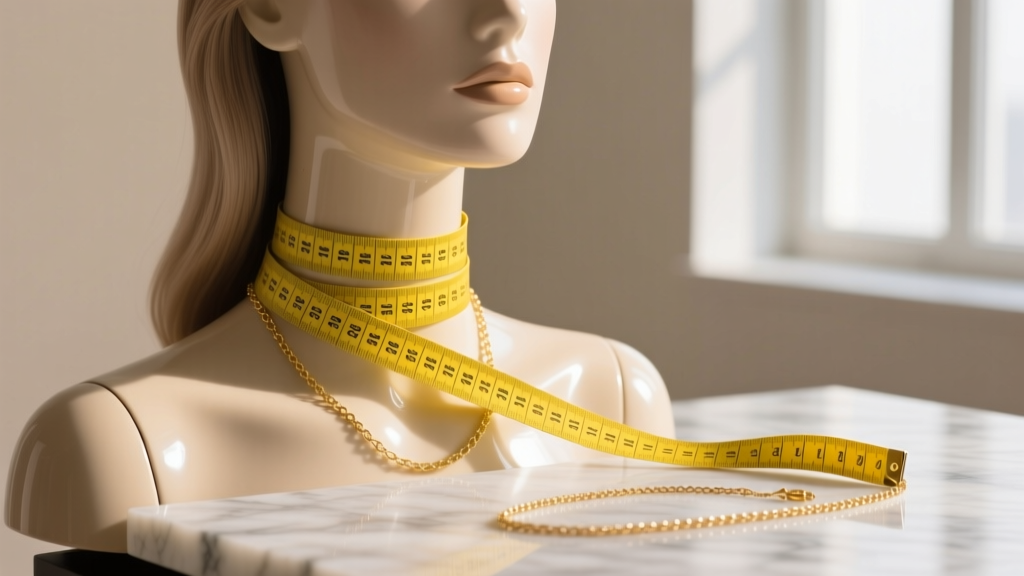
According to sizing guidelines published by Jewelers of America, the traditional 'princess' length is 18 inches, designed to rest just below the collarbone. But this metric assumes a standard neck circumference of 13 to 14 inches and a specific shoulder slope. If your neck circumference is 15 inches, an 18-inch chain functions as a tight choker, restricting movement and sitting awkwardly high on the suprasternal notch.
Furthermore, the type of chain dictates how it wears. A rigid 1.5mm snake chain requires more physical space to bend around the neck than a highly fluid 0.9mm cable chain. Therefore, the 'standard' must be treated as a baseline, not an absolute rule.
Anatomical Measurement vs. Industry Baseline
| Neck Circumference | Industry 'Standard' | True Custom Drape Length | Visual Placement |
|---|---|---|---|
| 12 - 13 inches | 16 inches (Choker) | 15 - 15.5 inches | Snug against the mid-neck |
| 13 - 14 inches | 18 inches (Princess) | 17 - 17.5 inches | Resting on the collarbone |
| 14.5 - 15.5 inches | 18 inches (Princess) | 19 - 20 inches | Just below the collarbone |
| 16+ inches | 20 inches (Matinee) | 22 - 24 inches | Upper chest / neckline |
Troubleshooting Common Necklace Fit Failures
When a necklace fails to sit correctly, it is usually due to a breakdown in the center of gravity or a friction mismatch between the metal and the skin. Below are the most frequent complaints and their mechanical solutions.
Problem 1: Clasp Migration (The Sliding Clasp)
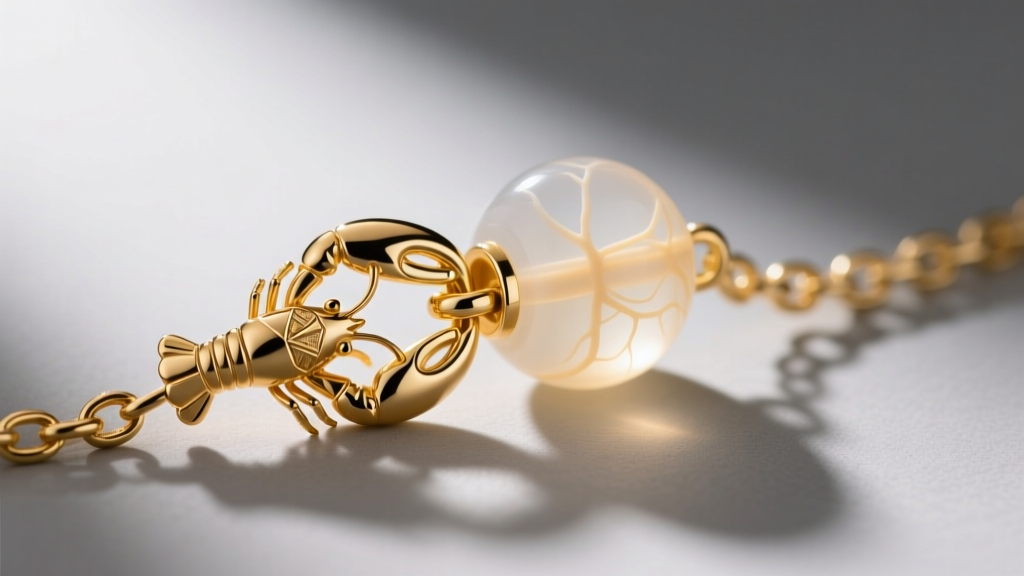
There is nothing more annoying than a heavy pendant pulling the chain forward, causing the lobster clasp to migrate from the nape of the neck to the front of the chest. This happens when the pendant's mass significantly outweighs the chain, creating a pendulum effect that pulls the lightest part of the assembly (the clasp) downward.
The Expert Fix: Do not simply buy a heavier chain, which can overpower delicate pendants. Instead, introduce a counterweight. Many high-end jewelers now solder a small, dense metal 'dangle' or tag directly next to the clasp ring. Alternatively, you can thread a discreet silicone necklace spacer bead onto the chain near the clasp. The high-friction silicone grips the skin and hair, anchoring the back of the neck and preventing migration.
Problem 2: The Pendant Flip
If your pendant constantly flips backward, hiding the gemstone or design against your skin, you are experiencing a bail-to-chain ratio failure. This occurs when the inner diameter of the pendant bail is substantially wider than the gauge of the chain, allowing the pendant too much lateral rotation.
The Expert Fix: The Gemological Institute of America (GIA) notes that proper mounting hardware is crucial for gemstone display. To fix a flipping pendant without altering the piece permanently, insert two tiny, clear rubber O-rings (available at any hardware or craft store) inside the bail on either side of the chain. This fills the negative space, centering the chain and restricting the pendant's ability to rotate backward.
Problem 3: The 'Choker' Choke and Skin Pinching
A chain that sits perfectly when you are standing still may feel like a garrote when you sit down or look down at your phone. This is because the neck expands and changes shape during movement. Furthermore, chains with interlocking geometric links (like box chains or herringbone) can trap fine vellus hair and pinch the skin if worn too tightly.
The Expert Fix: Always measure your neck while seated, looking slightly downward, to account for postural expansion. If you already own a chain that is slightly too tight, avoid wearing herringbone or box styles as chokers. Switch to a rounded, smooth profile like a wheat or rope chain, which naturally repels hair and glides over the skin without catching.
The Physics of Drape: Chain Gauge and Material Variables
Understanding the standard necklace length for women requires a deep dive into metallurgy and chain gauge. The thickness of the wire used to make the chain fundamentally alters how it drapes across the clavicle.
- Micro Gauges (0.5mm - 0.8mm): Highly fluid, these chains conform exactly to the body's contours. An 18-inch micro cable chain will sit closer to the skin and appear visually 'longer' because it drops deeply into the suprasternal notch.
- Medium Gauges (1.0mm - 1.5mm): The industry sweet spot. These offer enough structural integrity to hold a 2-5 gram pendant without stretching, while maintaining enough flexibility for a classic princess drape.
- Heavy Gauges (2.0mm - 4.0mm+): Rigid and structural. A 2.5mm Cuban link chain requires a wider circumference to bend comfortably. If you are buying a heavy gauge chain, you must add 0.5 to 1 full inch to your standard measurement to compensate for the metal's stiffness.
Hardware Upgrades and Quick Fixes
You do not always need to buy a new necklace to achieve the perfect fit. Modern jewelry findings offer several troubleshooting upgrades that can salvage a poorly fitting piece.
The 2-Inch Extender Chain
If you fluctuate in weight, or if your neck swells slightly in humid weather, a standard fixed-length chain is a liability. Retrofitting your necklace with a 14k gold or sterling silver 2-inch extender chain allows for micro-adjustments. Ensure the extender features a terminal jump ring that is large enough to easily catch with a lobster clasp, reducing the frustration of blind fastening behind the neck.
Magnetic Clasps for Dexterity Issues
For those with arthritis or limited shoulder mobility, fumbling with a 5mm lobster clasp behind the neck is a primary reason necklaces end up unworn in a jewelry box. Upgrading to a neodymium magnetic clasp with a safety catch allows the necklace to be fastened at the front of the chest and then rotated to the back. Note: Magnetic clasps add approximately 1 to 1.5 inches of dead length to the overall chain, which must be factored into your measurement.
Pairing Length with Necklines: A Troubleshooting Matrix
Even if you have found your perfect anatomical standard necklace length for women, the wrong pairing with clothing necklines will ruin the visual proportion. Use this troubleshooting matrix to avoid visual clutter.
The Golden Rule of Proportions: The necklace should never perfectly parallel the neckline of the garment. It must either sit distinctly above it or cross over it to create a contrasting visual layer.
- Crew Necks: Avoid 16-inch chokers, which will crowd the fabric collar. Opt for a 20 to 22-inch matinee length with a Y-drop or lariat style to elongate the torso.
- V-Necks: The chain should mimic the V shape. A 16 to 18-inch chain with a distinct, angular pendant works best. Ensure the pendant terminates at least one inch above the fabric's lowest point to avoid a messy intersection.
- Off-the-Shoulder / Bardot: This exposes the entire neck and clavicle. This is the only scenario where a true 14 to 15-inch choker is universally flattering, as it anchors the vast expanse of exposed skin.
Expert Verdict: Redefining Your Personal Standard
The search for the standard necklace length for women is ultimately a journey of personal calibration. The jewelry industry's 18-inch baseline is merely a starting point for mass production. By understanding your unique neck circumference, accounting for the rigidity of your chosen chain gauge, and utilizing modern hardware fixes like silicone spacers and extender chains, you can troubleshoot any fit issue. Stop settling for chains that choke, flip, or slide, and start engineering your jewelry to fit your anatomy with precision.


