Star Bead Necklace Anatomy: Materials, Wire Gauges, and Stringing
Explore the technical anatomy of a star bead necklace. Learn about wire gauges, gemstone vs. metal star beads, stringing methods, and durability.


When evaluating a star bead necklace, most consumers focus solely on the celestial aesthetic. However, from a jewelry engineering perspective, the star shape introduces unique structural challenges. The sharp vertices of the star create stress vectors that can snag on fabrics, while the internal drilling geometry often restricts the diameter of the stringing material. In this technical deep dive, we deconstruct the anatomy of a high-quality star bead necklace, examining the metallurgy, gemstone hardness, wire gauge tolerances, and crimping mechanics required to ensure lifelong durability.
The Material Science of Star Beads
The manufacturing method used to create star beads dictates not only their visual sharpness but also their structural integrity and how they interact with stringing wires. Broadly, metal star beads fall into two categories: stamped and cast.
Stamped vs. Cast Metal Stars
Stamped star beads are created by pressing sheet metal (usually sterling silver or brass) into a hardened steel die. This process yields incredibly sharp, precise points and a uniform thickness. However, the stamping process often leaves microscopic metallic burrs inside the central drilling hole. If you thread a soft beading wire through a stamped star bead without deburring the hole first, those microscopic edges will act like tiny saws, eventually fraying and snapping the wire.
Conversely, cast star beads are made using the lost-wax casting method. While their points may be slightly more rounded due to the surface tension of molten metal, their central holes are generally smoother, reducing wire fatigue. High-end manufacturers will often tumble-polish cast stars to eliminate porosity, but lower-tier cast beads may harbor hidden air pockets that can crush under the pressure of a tight crimp bead.
Gemstone Stars and the Mohs Scale
When working with gemstone star beads, the Mohs scale of mineral hardness is your most critical metric. Cutting a star shape requires removing significant material to form the points, leaving them highly vulnerable to chipping. According to the Gemological Institute of America (GIA), stones with a hardness below 5 are generally unsuitable for intricate, pointed shapes if they will be worn daily.
- Fluorite & Calcite (Mohs 3-4): Avoid for star beads. The points will chip and dull within weeks of wear.
- Lapis Lazuli & Turquoise (Mohs 5-6): Acceptable, but require protective bezel settings or careful spacing to prevent point-to-point impact.
- Quartz, Amethyst & CZ (Mohs 7-8.5): Ideal. These materials can be laser-cut to razor-sharp points that will not abrade or chip during standard wear.
Wire Gauges and Stringing Mechanics

The geometry of a star bead inherently limits the size of its central hole. While a standard 6mm round bead might comfortably accommodate a 1.5mm hole, a 6mm star bead typically features a hole no larger than 0.8mm to 1.0mm to preserve the structural mass around the center. This restriction demands high-tensile, low-diameter stringing materials.
| Stringing Material | Diameter (Inches) | Tensile Strength | Best Application for Star Beads |
|---|---|---|---|
| 49-Strand Micro Wire | 0.012" | ~12 lbs | Delicate 2mm-3mm gemstone stars; requires extremely small crimp tubes. |
| 49-Strand Standard Wire | 0.018" | ~20 lbs | The industry standard for 4mm-6mm metal and CZ star beads. Excellent drape. |
| 7-Strand Heavy Wire | 0.024" | ~30 lbs | Large, heavy cast metal stars. Stiffer drape, requires 2x3mm crimp tubes. |
| Nylon Silk Thread | Size F (0.35mm) | ~8 lbs | Knotted pearl and star bead combinations. Requires a bead reamer for star holes. |
For a standard 5mm sterling silver star bead necklace, a 0.018-inch 49-strand stainless steel beading wire (such as those produced by Beadalon or Soft Flex) provides the optimal balance of tensile strength and fluid drape. The 49-strand construction allows the wire to bend smoothly around the neck without developing memory kinks, which is crucial for maintaining the symmetrical layout of the stars.
Clasp Integration and Crimp Bead Failures
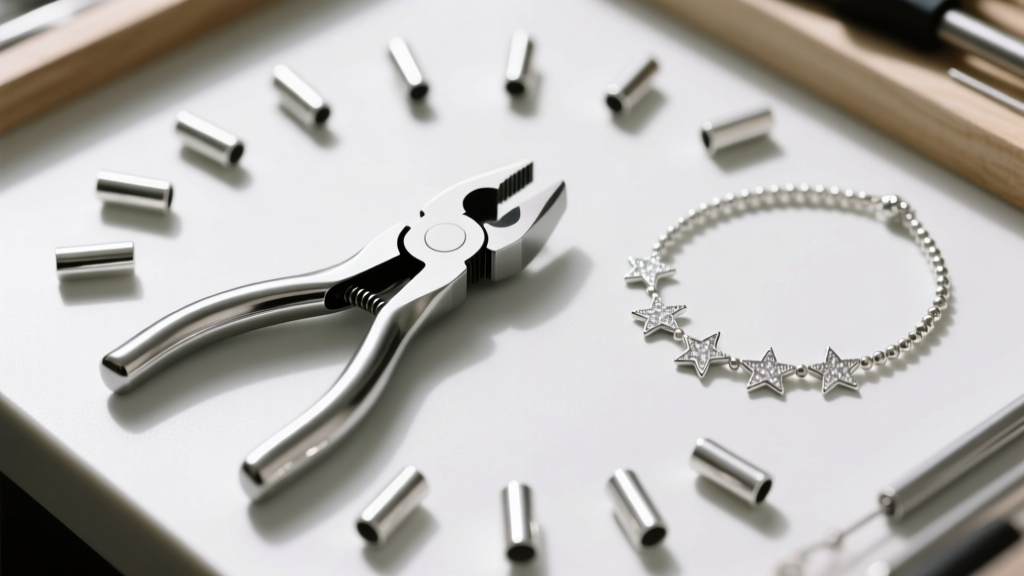
The most common failure point in any beaded necklace is the clasp loop, and star bead necklaces are no exception. Because star beads are often heavy and feature sharp edges that can catch on clothing, the sudden kinetic shock transferred to the clasp can pull the wire through an improperly secured crimp bead.
The Mechanics of the Crimp
Never use standard flat-nose pliers to flatten a crimp bead on a star bead necklace. Flattening creates sharp, folded edges of metal that will immediately begin cutting into the nylon coating of your beading wire. Instead, you must use a micro-crimping tool to fold the crimp tube into a clean, rounded 'U' shape, and then compress it into a secure, bead-like cylinder.
Expert Troubleshooting Tip: If your star bead necklace keeps snapping near the lobster clasp, check your wire guard (French wire). If the wire guard is too large, the beading wire will rub against the sharp edge of the clasp jump ring every time the wearer turns their head. Always use a 2x2mm sterling silver crimp tube paired with a 2.5mm wire guard for 0.018" wire to eliminate this friction point.
The Mathematics of Drape: Interval Ratios
Designing a star bead necklace that drapes correctly requires an understanding of interval ratios. If star beads are placed too close together, their points will interlock, causing the necklace to stiffen and sit rigidly on the collarbone. If spaced too far apart, the design loses its visual continuity.
The optimal aesthetic and structural ratio for a continuous star bead necklace is 1:3 or 1:4. This means for every 1 star bead, you should use 3 or 4 smaller spacer beads (such as 2mm seamless roundels or seed beads). This ratio provides enough physical clearance to prevent the star vertices from snagging on one another, while maintaining a dense, luxurious appearance. For a standard 18-inch princess-length necklace using 5mm stars and 2mm spacers in a 1:3 ratio, you will need exactly 45 star beads and 135 spacer beads.
Maintenance, Tarnish, and Ultrasonic Risks
Maintaining a star bead necklace requires specific protocols, particularly regarding the cleaning of the intricate angles. The inner vertices of a star bead trap skin oils, lotions, and environmental sulfur, leading to rapid tarnishing in sterling silver components.
While ultrasonic cleaners are excellent for removing debris from complex geometries, they pose a severe risk to gemstone star beads. As noted by jewelry supply experts at Fire Mountain Gems, the high-frequency cavitation bubbles generated by ultrasonic cleaners can easily fracture the delicate points of treated or included gemstones. For a mixed-material star bead necklace, stick to manual cleaning using a soft-bristled baby toothbrush and a mild, phosphate-free dish soap. For metal-only star bead necklaces, a quick dip in a non-toxic silver cleaning solution, followed by a thorough rinse and immediate microfiber drying, will restore the sharp, reflective facets of the star points without degrading the stringing wire.


