The Anatomy of a Statement Pendant Necklace: Technical Guide
Discover the engineering behind a statement pendant necklace. Learn about chain gauges, bail mechanics, and weight distribution for heavy jewelry.

The Physics of Heavy Pendants: Weight and Tension
When evaluating a statement pendant necklace, most consumers focus entirely on aesthetics—the carat weight of the center stone, the intricacy of the metalwork, or the overall visual footprint. However, from an engineering perspective, a statement piece is essentially a dynamic load-bearing structure. A pendant weighing 45 grams or more suspended on a 24-inch chain creates a continuous pendulum effect. Every time the wearer moves, kinetic energy transfers through the chain, concentrating tensile stress at two critical failure points: the clasp assembly and the bail.
The human cervical spine (specifically the C7 vertebra at the base of the neck) acts as the primary fulcrum. If the chain lacks the appropriate tensile strength or the clasp mechanism is undersized, the repetitive micro-abrasions and sudden kinetic shocks will inevitably lead to structural failure. In 2026, advanced CAD/CAM milling allows jewelers to create visually massive pendants that are hollowed out to reduce weight, but for solid cast pieces or those featuring large, dense gemstones like cabochon turquoise or heavy quartz, understanding the physics of weight distribution is non-negotiable.
Chain Gauge and Metallurgy: What Actually Holds Up?
The chain is the suspension bridge of your necklace. The most common mistake in heavy jewelry design is pairing a 50-gram pendant with a delicate 1.2mm cable chain. To support substantial weight, we must look at both the chain link architecture and the Vickers Hardness (HV) of the chosen metal.
While 18k gold (75% pure gold) offers a richer color, it is inherently softer, typically measuring around 110-125 HV. For heavy statement pieces, 14k gold (approx. 120-140 HV) or Platinum (approx. 130-160 HV) provides superior resistance to elongation and link deformation. According to the Gemological Institute of America (GIA), metal fatigue in lower-karat gold alloys often manifests as microscopic stress fractures long before a visible snap occurs.
Chain Architecture and Weight Capacity Matrix
| Chain Style | Recommended Gauge (mm) | Max Pendant Weight | Structural Advantage |
|---|---|---|---|
| Wheat (Spiga) | 2.5 - 3.5mm | Up to 85g | Four interwoven strands distribute kinetic stress evenly. |
| Box | 2.0 - 3.0mm | Up to 60g | Square links resist lateral twisting and kinking. |
| Rope | 3.0 - 4.0mm | Up to 90g | Helical twist provides high tensile strength and flexibility. |
| Cable | 3.0 - 4.5mm | Up to 50g | Simple links; requires thicker gauge to match wheat/rope strength. |
For any statement pendant necklace exceeding 40 grams, a lobster clasp is insufficient. You must utilize a box clasp with a double figure-8 safety catch to prevent accidental unhooking during high-movement activities.

Bail Mechanics: The Unsung Hero of Pendant Engineering
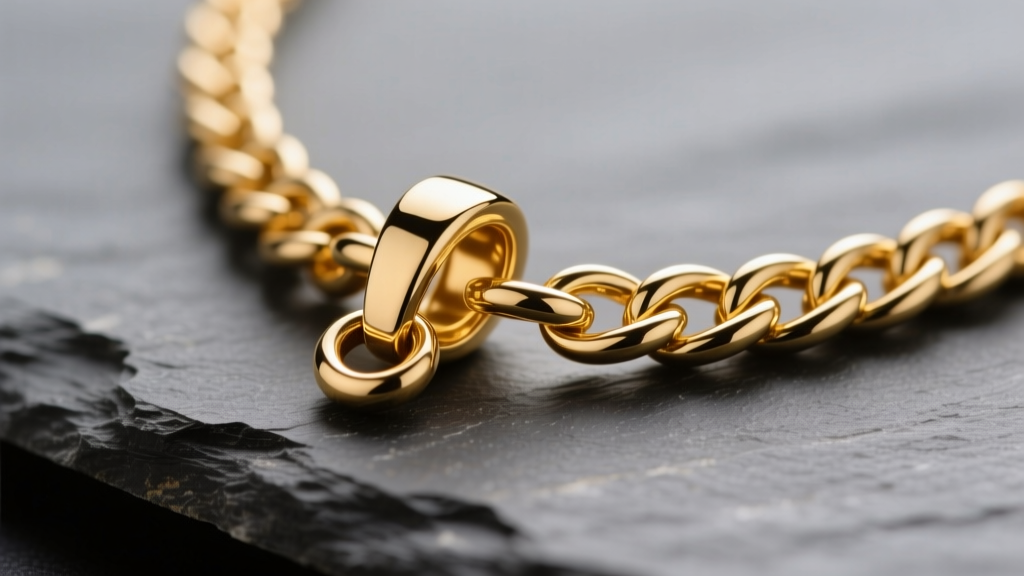
The bail is the mechanical joint connecting the static chain to the dynamic pendant. It endures the highest concentration of friction and shear stress. There are three primary bail types used in statement jewelry, and their engineering varies wildly.
- Soldered Wrap Bails: The gold standard for heavy pendants. The bail is cast or fabricated directly onto the pendant frame and soldered. It eliminates moving parts at the connection point, transferring all stress to the chain's jump ring.
- Tube Bails: A hollow cylinder through which the chain threads. While elegant, tube bails restrict chain articulation. If the inner diameter (ID) of the tube is not at least 1.5 times the thickness of the chain, the chain will bind, creating severe shear stress on the links.
- Pinch or Glue Bails: Common in commercial gemstone jewelry, these rely on industrial epoxies. Over time, skin oils, lotions, and thermal expansion will degrade the adhesive. For a true statement piece, pinch bails should be avoided or retrofitted with mechanical pins by a master jeweler.
"The inner diameter of a bail must always accommodate the chain's widest profile plus a 20% tolerance for articulation. A binding chain will snap before the bail fails." — Master Bench Jeweler Standard
Ergonomics and Neckline Mapping
A statement pendant necklace must be balanced. If you suspend a 60-gram pendant on a lightweight 15-gram chain, the pendant will constantly migrate off-center, pulling the chain through the bail until the clasp rests awkwardly on the wearer's collarbone. To counteract this, expert jewelers employ counterweighting.
By integrating a heavy decorative clasp, or adding a discrete tungsten or gold counterweight tag near the clasp assembly, the center of gravity is stabilized. This ensures the pendant remains anchored at the sternum. Furthermore, the length of the chain dictates the visual impact and physical comfort. A 20-inch chain places the heavy pendant directly on the sternum, utilizing the bone structure to support the weight, whereas a 24-inch chain leaves the pendant suspended in soft tissue, which can cause neck strain over prolonged wear.

Gemstone Structural Integrity in Statement Pieces
When a statement pendant necklace features a massive center stone, the gemstone's physical properties dictate the setting style. The Mohs scale of hardness is only half the equation; cleavage planes and tenacity are far more critical for impact resistance.
For example, a large emerald (Mohs 7.5-8) has distinct cleavage planes and is highly brittle. Setting a 40-carat emerald in a traditional four-prong setting on a heavy, swinging pendant is a recipe for catastrophic chipping. Instead, bezel settings or heavily reinforced rub-over settings are mandatory to absorb kinetic shocks. Conversely, a massive jade cabochon (Mohs 6-7) possesses exceptional tenacity due to its interlocking fibrous structure, making it highly resistant to impact and suitable for more exposed, open-back settings. The Jewelers of America consistently advises matching the setting security to the specific wear-and-tear profile of the garment and jewelry type.
Maintenance and Structural Failure Points
Even the most meticulously engineered statement pendant necklace requires scheduled maintenance. The primary enemy of heavy jewelry is friction wear. The constant rubbing of the chain against the inside of the bail will eventually wear through the metal. For a 14k gold bail supporting a heavy chain, expect to see measurable thinning within 3 to 5 years of daily wear.
To mitigate this, jewelers can install a hardened platinum or titanium sleeve inside the gold bail, creating a sacrificial friction layer that protects the structural integrity of the pendant. Additionally, if your statement piece is crafted from white gold, the rhodium plating will wear away faster at the high-friction bail and clasp points due to the acidity of human skin and environmental pollutants. Annual inspections using a jeweler's loupe to check for jump ring elongation and bail thinning are essential to ensure your investment remains secure for decades to come.